


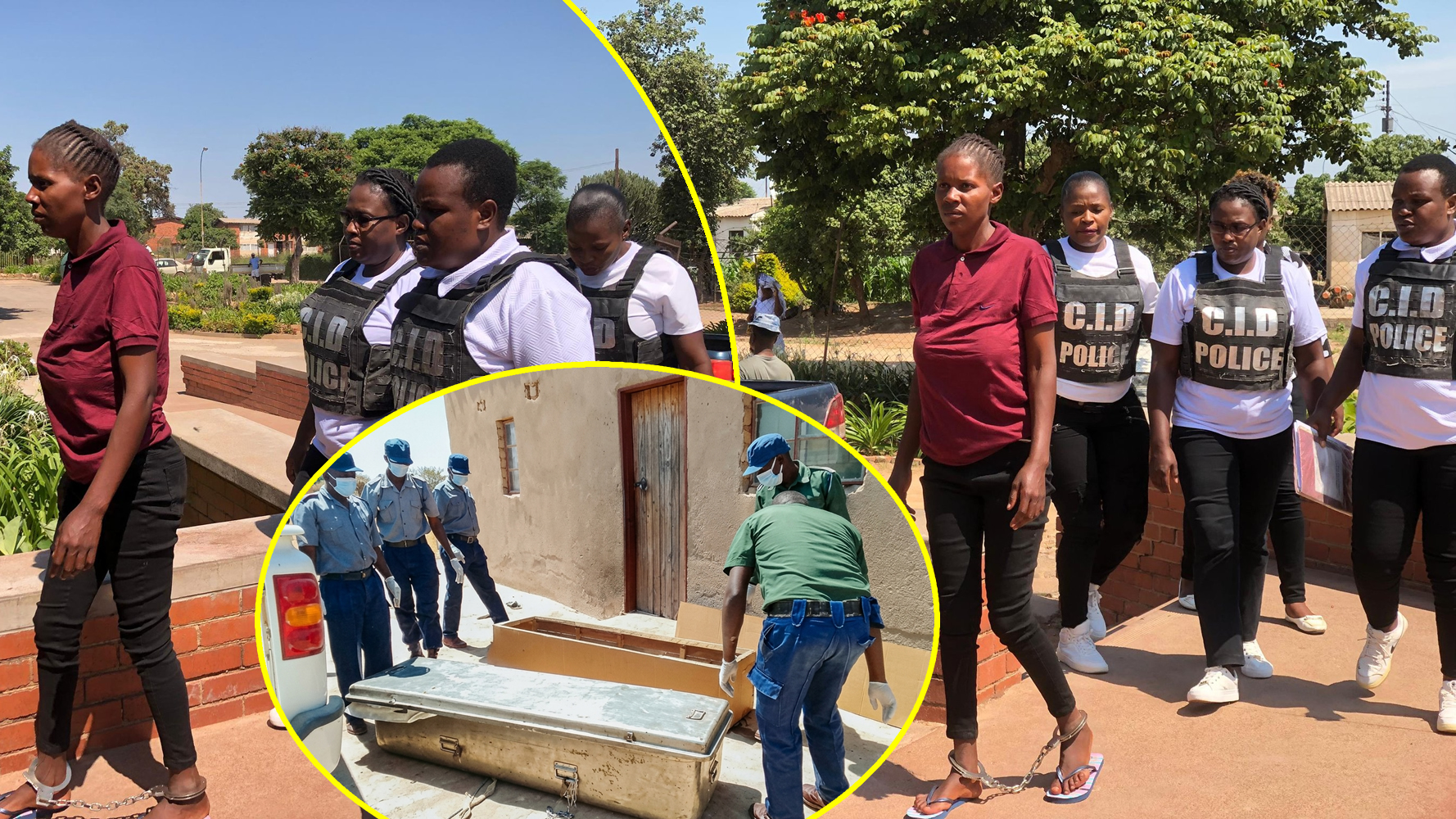
A 34-year-old woman who killed her husband and their two young children in the early hours of 30 January 2025 has been acquitted after a psychiatric assessment found that she was suffering from a mental disorder when the three deaths occurred.
Happiness Chimbangu, of Cowdray Park suburb in Bulawayo, appeared before Bulawayo High Court Judge Justice Donald Ndirowei facing three counts of murder over the deaths of her husband, Edwin Chimbangu, 35, their four-year-old son, Promise, and their seven-month-old daughter, Prudence.
The ruling brought to an end a case that began with warnings of suicide, continued with hours of counselling by relatives and church members, and ended with three members of one family being killed inside their home while they slept.
The court heard that Chimbangu first went to her mother’s home at about 3pm on 29 January 2025. She asked her mother to look after her two children because she wanted to take her own life.
Her mother counselled her and Chimbangu later returned to her home. But her condition remained a concern. At about 10pm, Edwin telephoned his mother-in-law and asked her to come to the house because his wife was still displaying suicidal tendencies.
Chimbangu’s mother went to the house with a relative. Two churchmates, Jethro Sibanda and Shepherd Ndlovu, were also there. They joined the family discussion and counselled Chimbangu for several hours.
“At around midnight, they all left after they were convinced that she was now well,” prosecutor Tsitsi Mutukwa told the court.
About 10 minutes later, at approximately 12.10am on 30 January, Chimbangu realised that her husband and children had fallen asleep. The court heard that she took a metal digger that was inside the house and attacked them.
She struck Edwin on the head with the tool, killing him instantly. She then attacked Promise on the back, face and head. The boy also died instantly. Chimbangu struck Prudence on the face and head, killing the infant as she lay in the home.
The weapon was later recovered near the door. It was covered in blood, while the victims were found inside the home. The infant was lying beside her father on the bed, and the four-year-old boy was on a mattress.
At about 2am, Chimbangu went to her uncle and told him that she had killed her husband and children. The uncle, identified in court as Moyo, took her to a police station and made a report. Police arrested her and attended the scene.
Chimbangu was represented by Thembelani Sibanda of Liberty Mcijo and Associates. After her arrest, she was referred for psychiatric evaluation at Mlondolozi High Security Prison in Bulawayo.
Court documents showed that she was examined by Dr Chinova in February 2025, on 22 May 2025 and again on 30 September 2025. The doctor diagnosed her with a mental disorder, and the court subsequently acquitted her on all three murder counts.
The case has drawn attention to the dangers that can arise when a person in acute distress is treated as having recovered after informal counselling, despite having already expressed an intention to die. In Chimbangu’s case, the warning signs were visible to several people. Her mother had been alerted, her husband had sought help and church members had spent hours with her. Yet within minutes of their departure, the family’s situation changed with fatal consequences.
The original dispute was linked to severe financial hardship in the household. Earlier that day, Chimbangu had complained about her husband’s failure to provide for the family’s needs. She told her mother that she wanted to die and asked her to take care of the children after her death.
The case comes as Zimbabwe faces continuing pressure over mental-health services, domestic violence and the limited support available to families dealing with crisis. A national mental-health investment assessment estimated that mental, neurological and substance-use conditions imposed direct health costs of about US$8.8 million and indirect costs of about US$154.8 million through lost productivity. It also described depression, anxiety, psychosis, bipolar disorder, epilepsy and alcohol-use disorders as major causes of illness and death.
The same assessment said Zimbabwe needed greater investment in community-based services, early intervention and care that could be provided outside hospitals. It identified schools, workplaces and communities as important settings for prevention and support, rather than relying only on hospitals or prisons after a crisis has already escalated.
Recent violence in Bulawayo has added to concerns about the safety of families inside their homes. On 24 July 2026, a 43-year-old church elder from Nkulumane was brought before the courts after his wife was killed during a late-night family dispute. The man was accused of striking her twice on the head with an axe before assaulting the couple’s children with a metal rod. The injured children escaped to a neighbour’s home and were taken to Mpilo Central Hospital.
Government figures cited in recent discussions on gender-based violence indicate that nearly 40 per cent of Zimbabwean women aged between 15 and 49 have experienced physical violence, while between 12 and 25 per cent have experienced sexual assault. Support organisations recorded more than 30,000 gender-based violence incidents in 2024, while police recorded nearly 19,000 cases.
Those figures do not directly explain the circumstances surrounding the Chimbangu family’s deaths, but they show the scale of violence and distress being managed inside homes across the country. In many households, relatives, neighbours, church leaders and traditional family advisers are the first people called when someone threatens suicide or begins behaving unpredictably.
The Cowdray Park tragedy shows the limits of relying on reassurance alone. Chimbangu had been counselled until midnight and those around her believed she had settled. Minutes later, Edwin, Promise and Prudence were dead.
For the Chimbangu family, the court proceedings have closed with an acquittal based on the psychiatric findings. The verdict does not bring back the three people who died, or erase the final hours in which relatives and church members tried to keep the household safe. It leaves behind a grieving family, a devastated community and a stark reminder that a crisis can remain dangerous even after a person appears calm.