


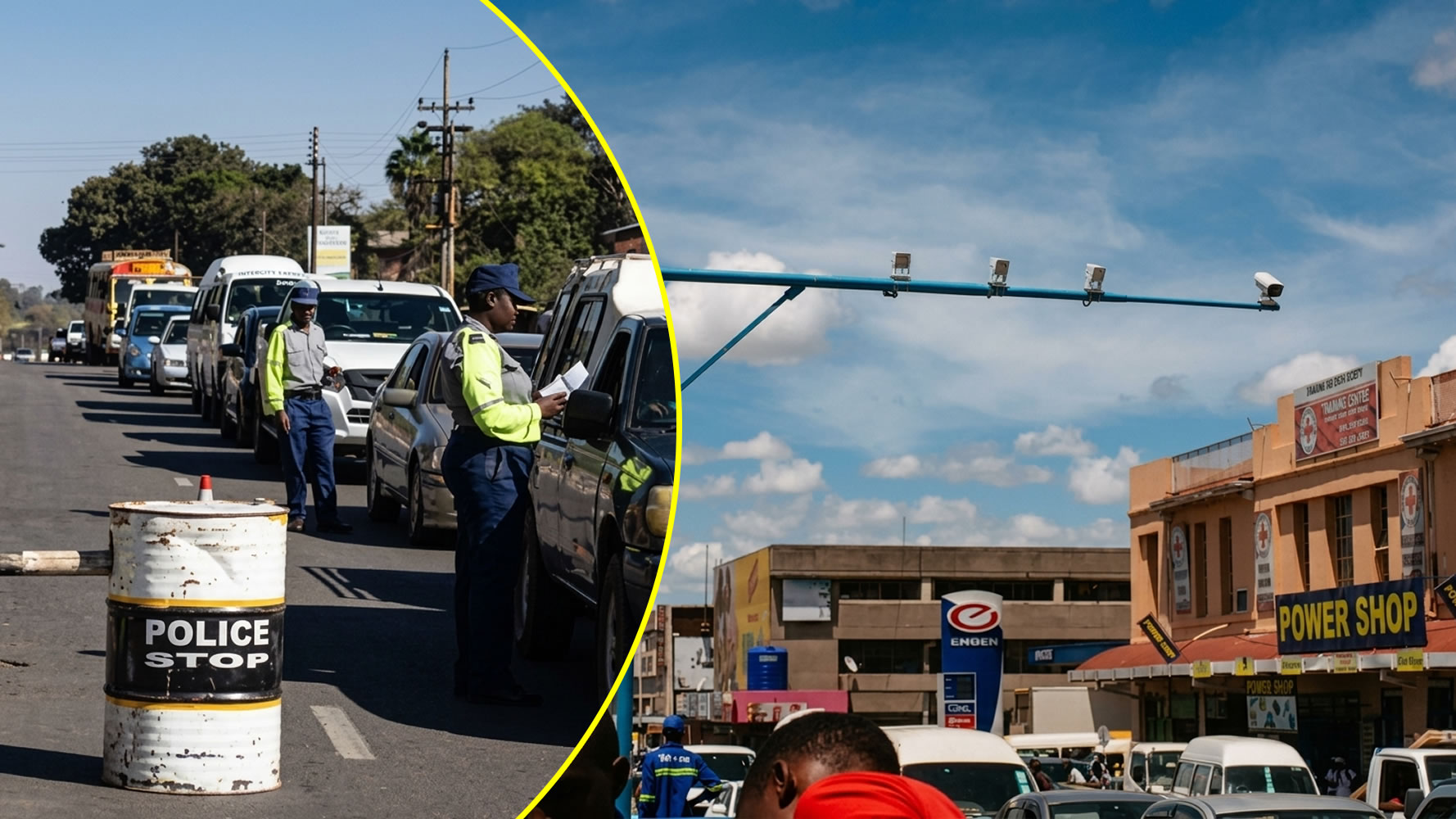
HARARE – Motorists who ignore traffic tickets issued through Zimbabwe’s Smart Traffic Management System risk being blacklisted and pursued by the police, with authorities warning that warrants of arrest may be issued against offenders who refuse to respond.
The warning comes as the system expands its reach across Harare and authorities move to enforce thousands of traffic violations recorded by cameras at major intersections.
Police have also cautioned vehicle owners who sell their cars but fail to transfer ownership. Under Zimbabwean law, ownership must be changed within two weeks of a vehicle sale. Until that process is completed, the registered owner remains responsible for offences committed using the vehicle.
This means a person who sold a car months or even years ago could receive a traffic fine if the new owner has not updated the registration details.
The Zimbabwe Republic Police said the issue had become more urgent following the introduction of the Smart Traffic Management System, which uses cameras, sensors and number-plate recognition technology to identify road offences.
The system is fully operational at 20 intersections in Harare’s central business district. It records vehicles moving through the city and detects a range of violations, including speeding, running red lights, using a mobile phone while driving, failing to wear a seatbelt, driving against the flow of traffic and picking up or dropping off passengers at prohibited points.
Pedestrians who cross roads away from designated crossing points can also be penalised.
Once a vehicle is captured, the registration number is read by the system and the registered owner is sent a notification by SMS. The message contains details of the offence and a link allowing the motorist to view the recorded footage.
The police have stressed that the cameras do not automatically decide whether a motorist should be fined. Footage is reviewed by officers at the Smart Traffic Management System command and control centre before a notification is sent.
“It’s not only the cameras that are sending the offences, but there is another layer of human validation,” Assistant Commissioner Gajiwett Gomo, the police director of information technology, said.
POLICE IT DIRECTOR OUTLINES OPERATION OF SMART TRAFFIC MANAGEMENT SYSTEM
National Police IT Director, Assistant Commissioner Gajiwett Gomo, explains how officers manning the Smart Traffic Management System will validate various driving offences.
📹: Fatima Bulla-Musakwa https://t.co/3qgmHPvEQb— The Herald Zimbabwe (@HeraldZimbabwe) October 28, 2026
This validation process is intended to ensure that motorists are not penalised solely because of a technical error, an unclear image or circumstances that require human judgement.
Police national spokesperson Commissioner Paul Nyathi said the system would apply to all motorists, including drivers of government vehicles.
“So we won’t spare anyone, whether it’s a government vehicle or not,” Nyathi said. “That’s why I say we are in this together, the media, the police and all Zimbabweans.”
He said the system was designed to improve behaviour on the roads rather than punish people who had not committed offences.
“The system is there and it is there to stay,” Nyathi said. “But it is not there to punish innocent Zimbabweans. It is there to deal with erratic driving in the country.”
The cameras began operating in Harare earlier this year and have already recorded millions of suspected violations. Police figures show that the number rose from about 2.3 million in mid-August to more than four million by the end of September. By the following week, the figure had reached 4.8 million, while authorities later said about five million suspected violations had been recorded.
Officials are now working through the footage and validating the cases before enforcement action is taken.
The number of offences has increased pressure on the police and traffic authorities to process cases quickly. The system is being monitored from police headquarters, where officers can review incidents and track violations recorded at different locations.
The process gives a motorist seven days to respond after receiving a notification. A further seven days is allowed for payment. Anyone who ignores both deadlines may be blacklisted and placed on a police wanted list for prosecution.
Police have warned that unpaid or ignored fines can move beyond an administrative penalty and result in legal action, including the issuing of a warrant of arrest.
Drivers can first view the footage linked to their vehicle before deciding whether to pay the fine or challenge the matter in court.
The fines range from Level 1 to Level 3, depending on the offence.
“We can accept US$5, we can even accept US$15, up to US$30, depending with the offence,” Nyathi said.
Motorists have been told to use official government payment platforms when settling fines. These include paymyfines.co.zw and paymyfines.gov.zw. Authorities have warned drivers not to send money to individuals or use unofficial payment links, as the growing number of traffic notifications creates opportunities for fraudsters to impersonate police officers.
The system has also exposed the problem of outdated vehicle registration records. Many vehicles in Zimbabwe continue to be driven by people whose names do not appear on the registration documents. In some cases, owners sell cars privately and do not complete the required transfer of ownership.
The seller may assume that the transaction has ended once the money and vehicle have changed hands. However, the registered owner remains linked to the number plate until the official records are changed.
“The challenge which we have is that most of us in Zimbabwe do not want to change vehicle ownership. In terms of the country’s Vehicle Registration and Licensing Act, any vehicle owner, whether it is company-owned or family-owned, has to change ownership within two weeks.
“What it entails is that if somebody is driving a vehicle which he or she has acquired and has not changed ownership, they are committing an offence. The seller remains accountable; even if you say ‘I have sold it’, you remain accountable until change of ownership is effected,” Nyathi said.
The police have said the Smart Traffic Management System will make it more difficult for motorists to avoid responsibility by claiming that another person was driving the vehicle.
“Once the system becomes operational, what it also entails is that people will be made accountable for their dues, whether it’s dues to the State, local authority or any other misdemeanour which you committed. The system is all-encompassing,” Nyathi said.
Motorcyclists, including delivery riders, will also be monitored by the cameras and will not be exempt from enforcement.
The programme is expected to expand beyond the 20 intersections currently covered in Harare. Authorities plan to install more than 300 high-tech cameras in the capital before extending the system to other cities and towns.
The cameras are intended to do more than issue fines. They can provide information on traffic movement, congestion, dangerous driving patterns and incidents on major roads. This is expected to help authorities identify bottlenecks and respond more quickly when accidents or disruptions occur.
The system is being introduced at a time when Zimbabwe continues to face a serious road-safety problem.
The country recorded 48,150 road traffic crashes during the first nine months of 2026. The crashes resulted in 1,979 deaths and 8,061 injuries.
The Traffic Safety Council of Zimbabwe has said human error accounts for 94 per cent of road traffic accidents, while poor road infrastructure accounts for about two per cent.
TSCZ managing director Munesu Munodawafa said the figures showed that dangerous behaviour by motorists remained a major threat on the country’s roads.
“We have realised that only two percent of the accidents are as a result of poor road infrastructure, and we are happy that some of the major highways are navigable and are in good shape, but due to human error, we still record several accidents, and it is a challenge that needs a holistic approach to avoid these road carnages,” he said.
Human error includes speeding, reckless overtaking, drink-driving, overloading, using mobile phones while driving, ignoring traffic lights and failing to maintain vehicles properly.
The human cost of crashes extends beyond the people killed or injured at the scene. Families can lose their main source of income, while survivors may face long periods of medical treatment, lost earnings and permanent disabilities.
Munodawafa said the death of a breadwinner could also disrupt children’s education. Relatives may initially assist with school fees, but that support can become difficult to maintain.
“Maybe at the end of the term, an uncle pays the school fees. The second term, the father or the mother pays the school fees, and eventually the fees are paid. But perhaps the third, fourth or the next year, the child probably goes out of school,” he said.
The road-safety campaign has urged journalists and public officials to focus on the causes and consequences of crashes, rather than reporting only the number of people killed or injured.
“Let us identify the problem, investigate the solutions, evaluate the effectiveness, promote accountability and share lessons,” Munodawafa said.
Authorities believe the Smart Traffic Management System will help enforce rules more consistently because roads can be monitored even when traffic officers are not physically present.
Some journalists who toured the command centre were shown footage of their own traffic offences. The demonstrations showed how cameras capture vehicles, record the suspected violation and link the incident to the vehicle’s registration details.
Motorists are now being urged to check their phone numbers and vehicle records, complete ownership transfers after selling or buying cars, and respond promptly to notifications from the system.
Those who ignore the messages could find that a traffic ticket does not disappear. Instead, it may lead to a blacklist, police action and a warrant of arrest.