

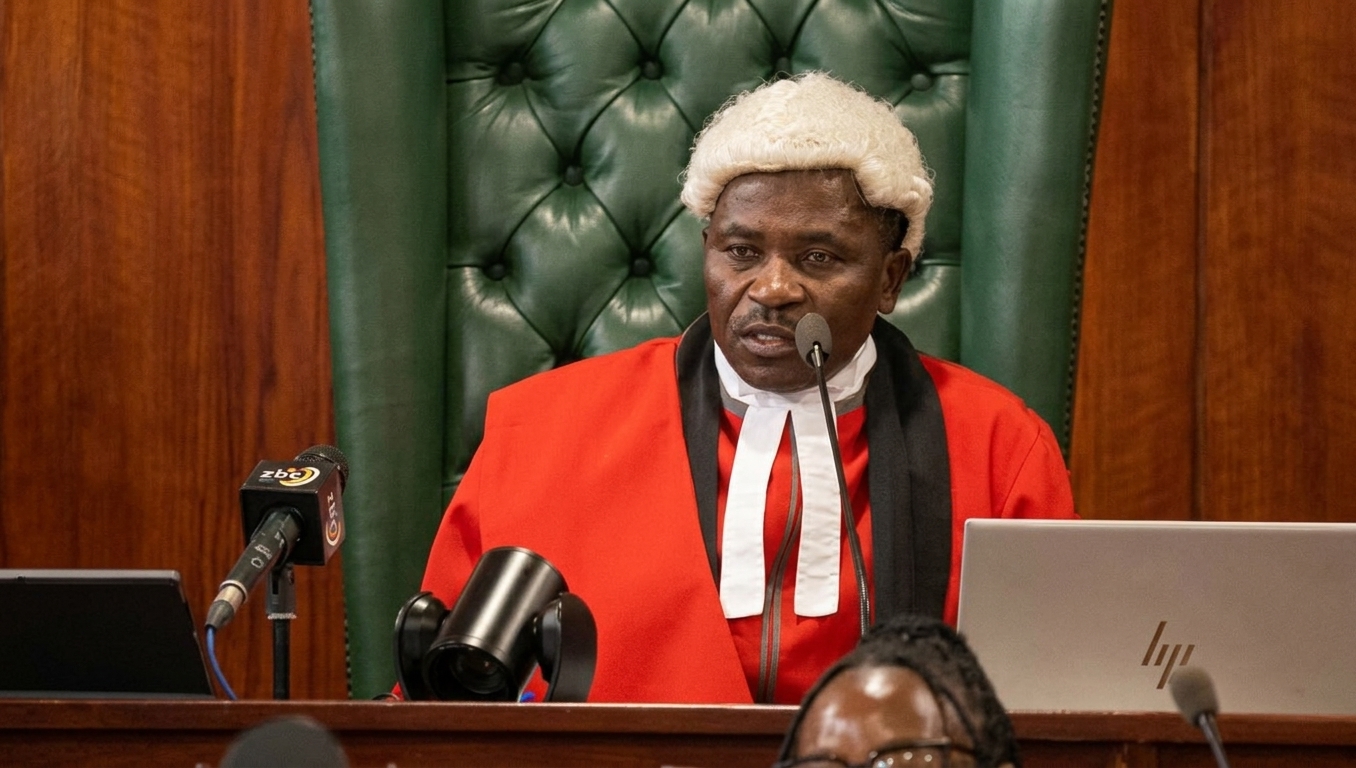
The Judicial Service Commission has opened a formal investigation into allegations of misconduct involving Justice Pisirayi Kwenda, the head of the Civil Division of the High Court.
The investigation follows a complaint by Gatooma Development Corporation (Private) Limited, a company involved in a long-running dispute over the ownership of a property in Kadoma known as the Remainder of Westhey of Sabonabon Estate.
In a letter dated 24 November 2026, the JSC confirmed that it had received the complaint on 16 November. The Commission also said the Judge President had already started examining the issues raised.
The complainant has been told that it will be advised of the outcome after the process is completed.
At the centre of the dispute is a property held under Deed of Transfer No. 4110/92. Gatooma Development Corporation says it is the registered owner of the land and that it entered into an agreement of sale with William Guta, who was acting as the promoter of Balwearie Holdings (Private) Limited, company number 1898/20.
The company says it never entered into a contract with another entity known as Balwearie Holdings (Private) Limited, company number 45/77. That company was dissolved in 1982.The ownership dispute has already passed through the High Court and the Supreme Court. In case number HC 2860/20, the High Court ruled on the status of Balwearie Holdings 1898/20 and confirmed the dissolution of company number 45/77.
That decision was later upheld by the Supreme Court in Ezekiel Chinongira v Sabre Services (Private) Limited and Another, case number SC 22/22. The Supreme Court recognised the dissolution of the company as a judgment in rem, meaning the finding applied generally and was not limited only to the parties who had appeared in the case.
A separate High Court decision under case number HC 2861/20 dealt with ownership of the Kadoma property. The court upheld the adoption of the pre-incorporation agreement linked to Balwearie Holdings 1898/20.
Gatooma now claims that later proceedings before Justice Kwenda treated the dissolved company as though it remained a legally active and interested party. One of the incidents cited in the complaint occurred during proceedings in chambers on 1 September 2026 in matter HCH 4109/26.
The company says Justice Kwenda questioned why Balwearie Holdings 45/77 had not been cited in the proceedings and indicated that the dissolved company could be joined to the case.
According to the complaint, counsel told the judge that the company had already been declared dissolved by previous court decisions.
The complaint also concerns what happened when the matter was placed on the unopposed roll. Gatooma says its legal representatives were instructed to withdraw the application after the judge allegedly warned that contempt proceedings could follow if they did not do so.
The complaint quotes the judge as saying: “You either withdraw or I will hold you in contempt.”
The application was subsequently withdrawn.
The company has also raised concerns about proceedings held on 5 November 2026 in matters R-R HCH 3067/26 and HCH 2836/26. It says a request for a postponement was not properly considered.
Gatooma further claims that one of the applications was dismissed with costs and recorded as having been made by consent, although the applicants dispute that account of what happened.
Another complaint relates to a rescission application under case number HCH 2209/26. Gatooma alleges that Justice Kwenda set aside an earlier consent order and directed that Balwearie Holdings 45/77 be joined to the proceedings.
The company says that order conflicts with earlier judgments confirming the dissolution of the company and dealing with ownership of the property.
The complaint also refers to a discussion that allegedly took place in the judge’s chambers after the 5 November court session. Court officials and legal representatives are said to have been present.
Gatooma says reference was made in Shona to the cases having been discussed “over tea and while studying judgments”.
The company is asking the JSC to establish whether those remarks suggested that the matters had been discussed or decided outside the proper court process.
It is also asking the Commission to examine the allocation of several related cases to Justice Kwenda. Since a number of matters involving the same property have been placed before him, the company wants the JSC to consider whether the circumstances justify his recusal and whether they create a reasonable apprehension of bias.
The complaint invokes constitutional guarantees concerning the right to an independent and impartial tribunal, the right to legal representation and the principles governing judicial independence and judicial conduct.
Gatooma has asked the Commission to investigate the alleged threat of contempt, the alleged denial of audience, the recording of consent, the order joining the dissolved company and the statements allegedly made in chambers.
It has also requested an audit of how the connected cases were allocated and called for the preservation of court records relevant to the dispute.
The JSC has not commented on the substance of the complaint. Its response confirms only that investigations are under way and that the complainant will be informed of the result.
The investigation places Justice Kwenda among a number of Zimbabwean judges whose conduct has faced formal scrutiny in recent years.
In 2020, High Court judge Justice Erica Ndewere was suspended after complaints about her work output and the handling of a criminal review matter.
The JSC accused Ndewere of wrongly quashing a prison sentence imposed on a convicted thief and replacing it with an order for the trial magistrate to consider community service. The Commission said the accused had previous convictions which had not been properly considered.
The complaint also focused on delays in delivering judgments. Ndewere was said to have had 12 reserved judgments as at 30 June 2019, with the cases having remained undecided for more than two years.
By May 2020, the number of pending matters had risen to 28, with judgments reserved for periods ranging from nine to 24 months.
The JSC said the failure to deliver a reserved judgment within 90 days breached the Judicial Service Commission Code of Ethics Regulations.
She later withdrew an urgent application challenging the JSC referral.
In another court application, Ndewere argued that the referral process and the involvement of the President threatened judicial independence. The High Court dismissed her application.
Justice Sunsley Zisengwe said Ndewere had been invited to respond to the complaints and therefore had an opportunity to give her side of the story.
“I do not understand this current application as being an amalgam of an application for the review of the decision of the JSC of the 12th of October 2020 merged with a challenge of the direct referral made under section 187 (3) of the Constitution,” Zisengwe said.
He added: “Be that as it may, the applicant cannot in one breath spurn the invitation to respond to the complaints against her (ostensibly on the basis that the respondents had elected to pursue the wrong procedure) and in the next breath claim that her right to be heard was violated.”
The complaints against Ndewere ultimately led to a formal process concerning her fitness to remain in office.
The same year, Supreme Court and Constitutional Court judge Justice Francis Bere was removed from office after a complaint by a lawyer triggered an investigation.
Bere was accused of interfering in a court case involving the Zimbabwe National Roads Administration and Fremus Enterprises. The complaint centred on an alleged telephone call to a lawyer representing one of the parties.
The JSC investigated the complaint and recommended that Bere be removed.
The President then removed him from office with immediate effect in terms of section 187(8) of the Constitution.
The official announcement stated: “His Excellency the President, accordingly, acting in terms of section 187(8) of the Constitution, has removed the Honourable judge from office with immediate effect.”
Bere had been suspended while the proceedings were under way. He challenged the tribunal process in court, but the proceedings continued and ended with his removal.
The cases involving Ndewere and Bere showed the different forms that action against a judge can take. A complaint may lead to an internal investigation, a disciplinary committee, suspension, a tribunal or a recommendation for removal from office.
The Chief Justice has previously explained that complaints about judicial officers are handled according to the nature of the issue raised.
Where a complaint is simply an expression of dissatisfaction with a judgment, the complainant is directed towards legal remedies such as an appeal or review.
Where the complaint concerns the conduct of a judicial officer rather than the decision itself, it is sent to the head of the court in which that officer works.
The judicial officer concerned is then asked to respond to the complaint.
“Where the complaint does not relate to the decision of a judicial officer in the exercise of judicial power but relates to the conduct of a judicial officer, it is forwarded to the head of the court in which the officer works,” the Chief Justice said.
He added: “Where the complaint relates to the conduct of a non-judicial member of staff, it is forwarded to the secretary of the JSC.”
The Chief Justice also said that some complaints ended after a judicial officer provided an explanation that satisfied the complainant. More serious matters, however, could result in disciplinary proceedings.
“Where the conduct a judge is alleged to have committed is not of a serious nature but is prohibited by the code of ethics, the chief justice has authority to set up a disciplinary committee to investigate the allegations made against the judicial officer concerned,” he said.
The tribunal was asked to examine a judgment in a property dispute involving Technoimpex JSC and Rajendrakumar Jogi and others. Among the allegations was that the judgment had been handed down before the scheduled hearing date and without submissions from lawyers representing the parties.
The inquiry was also asked to examine claims that submissions had been attributed to named advocates even though they had not appeared before the judge.
Other allegations concerned the alteration of the judgment date, the rescission of the judgment and the handling of an application for leave to appeal in a criminal matter.
The tribunal was further directed to examine a delayed judgment in case number HCH2524/22. Judgment in that matter had been reserved on 7 November 2024 and had still not been delivered after nine months.
Retired judge Maphios Cheda was appointed to chair the tribunal. Legal practitioners Tafadzwa Hungwe and Chaka Mashoko were appointed as members, while the Permanent Secretary in the Ministry of Justice, Legal and Parliamentary Affairs, was designated as secretary.
The tribunal was given five months from the date on which its members were sworn in to conduct the inquiry. It was required to submit its report within 30 days after the hearings ended.
The Katiyo inquiry came after the JSC had considered complaints and recommended further action.
Justice Kwenda’s case is now at an earlier stage. The JSC has acknowledged receipt of the complaint and confirmed that an investigation has begun.
The allegations centre on the handling of the Kadoma property dispute, the treatment of a company already declared dissolved, the alleged threat of contempt, the recording of consent, a disputed rescission order and the allocation of connected cases.
The complainant is also seeking answers about discussions allegedly held in chambers and whether the repeated allocation of related matters to one judge should be examined. The Commission is expected to communicate its findings to Gatooma Development Corporation once the investigation has been completed.