
Almost half of the primary school pupils who sat for the 2026 Zimbabwe School Examinations Council (ZIMSEC) Grade 7 examinations failed to achieve a full six-subject pass, even as the national pass rate edged just past the halfway mark to 50.94 per cent.
Announced in Harare on Friday, 27 November 2026, by ZIMSEC board chairperson Professor Paul Mapfumo, the results reveal a sharply divided picture across subjects, genders, and classrooms. While indigenous languages ChiShona and IsiNdebele delivered soaring pass rates above 80 per cent and female candidates widened their lead over boys once again, parents and guardians across the country have erupted in frustration over an English paper they say crushed their children’s hopes of top scores. Professor Paul Mapfumo also stated that all subjects recorded pass rates above 50 percent.
The Numbers Behind the 2026 Cohort
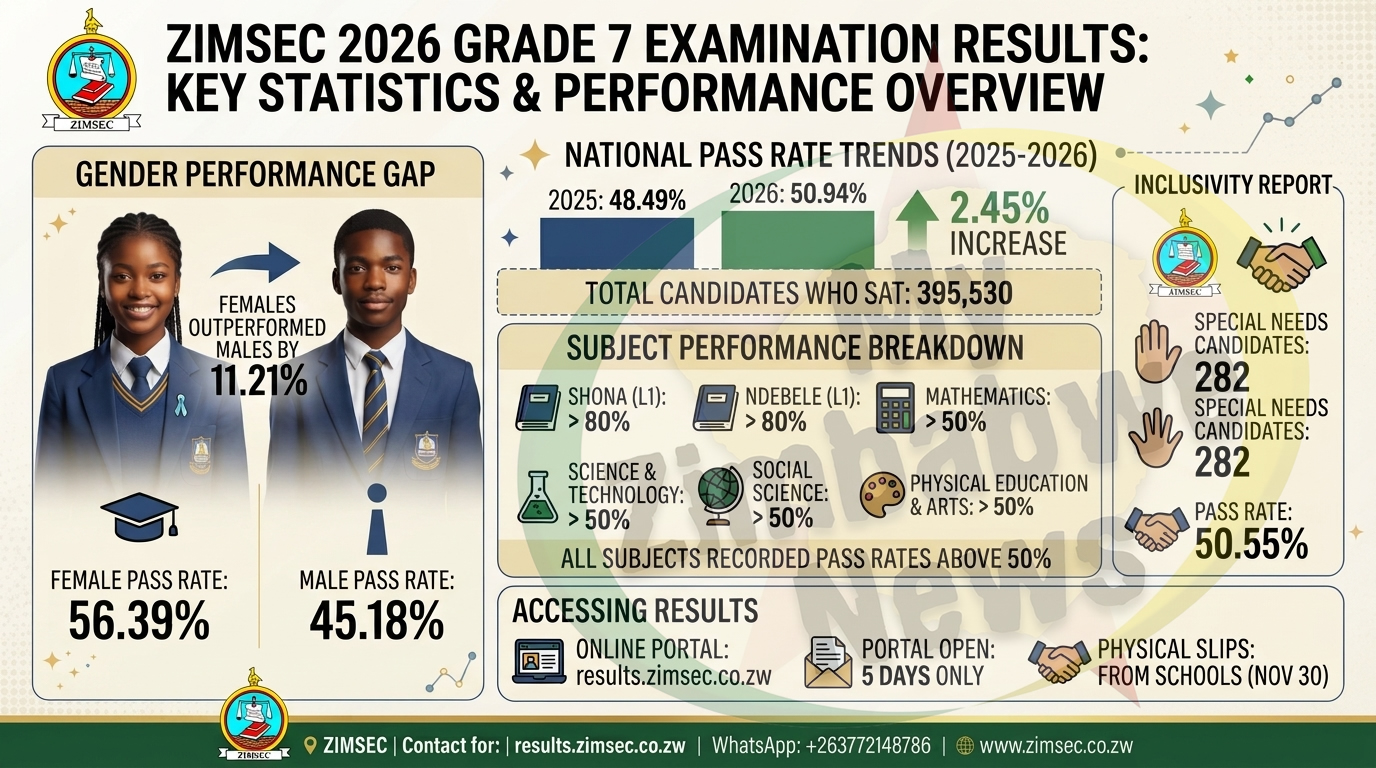
A total of 413,792 candidates registered for the 2026 Grade 7 tests, and 395,530 actually sat for the examinations. That sitting figure represents a modest increase of 0.11 per cent—or 440 additional pupils—compared with the 395,090 candidates who wrote in 2025.
For candidates who sat for all six required subjects, the overall national pass rate climbed by 2.45 percentage points, rising from 48.49 per cent in 2025 to 50.94 per cent this year. While this marks a recovery from the dip recorded between 2024’s 49.01 per cent and 2025’s 48.49 per cent, and pushes the national figure above 50 per cent for the first time since 2018, it still leaves 49.06 per cent of sitting learners—nearly half of the entire cohort—without a complete pass.
“This milestone marks the successful completion of another national examination cycle and reflects the collective commitment of learners, educators, parents, examination personnel and the Ministry of Primary and Secondary Education towards the advancement of quality education in Zimbabwe,” Prof Mapfumo said.
“This positive trajectory demonstrates continued progress in achievement across the primary education sector,” Prof Mapfumo said.
The 2026 cohort is the first group of Grade 7 learners to be examined under the government’s Heritage-Based Education Framework, which began rolling out in 2024. Prof Mapfumo linked the marginal upward movement in overall pass rates directly to the new syllabus.
“These results signify sustained improvements in learning outcomes in the heritage-based curriculum and affirm ongoing efforts to strengthen foundational competencies among primary school learners nationwide,” he said.
Inclusivity figures released alongside the main statistics showed that 282 learners with special educational needs sat for the 2026 examinations. They achieved an overall pass rate of 50.55 per cent, virtually matching the national average.
“The council remains committed to promoting inclusivity and equitable access to examinations for all categories of learners,” Prof Mapfumo said.
Girls Outshine Boys by Over 11 Percentage Points
When broken down by gender, the statistics confirm a wide and persistent gap between female and male learners at the primary school exit level. Female candidates achieved a pass rate of 56.39 per cent, outperforming male candidates, who recorded a pass rate of 45.18 per cent—a difference of 11.21 percentage points.
“This trend remains consistent with previous years and highlights the continued strong performance of female learners in national examinations,” Prof Mapfumo said.
Shona and Ndebele Soar While English Sparks Outcry
Subject-level data released by the examinations council showed that every examined subject recorded a pass rate above 50 per cent. Indigenous languages led the pack by a wide margin, with both ChiShona and IsiNdebele recording pass rates exceeding 80 per cent.
However, ZIMSEC did not release specific pass percentages for the remaining subjects, including English, Mathematics, Social Science, Science and Technology, and Physical Education and Arts. That omission has done little to quieten a wave of anger from parents and guardians over the English examination.
Since the results went live on Friday afternoon, social media platforms have been flooded with complaints from families who say English was by far their children’s weakest subject, even among high-achieving pupils. In ZIMSEC’s Grade 7 grading system, Grade 1 is the highest possible score, and parents commonly celebrate when a child “akarova one” (scores a one). Many parents expressed dismay that English stood in the way of a clean sweep of top grades.
Results slips shared online by frustrated guardians show a recurring pattern: pupils scoring straight 1s in Shona, Mathematics, Social Science, Physical Education and Arts, and Science and Technology, only to drop to a 2 in English. Phrases such as “Haaa English yakawisira vana vakawanda pasi” (English pulled many children down) and “English yakakuvadza vana” (English hurt the children) have dominated online discussions.
Numerous commenters directed blame at the paper setters and the Ministry of Primary and Secondary Education, arguing that the examination was excessively difficult and unfair for learners being tested in a language that is not their mother tongue. Other parents questioned the marking process itself, suggesting that grading had been unusually harsh or even conducted using artificial intelligence, while issuing repeated demands for ZIMSEC to release the examination paper to the public.
A smaller group of voices pushed back against the criticism, defending the need to uphold rigorous academic standards. Meanwhile, several parents shared accounts of primary school teachers themselves struggling to explain some of the answers on the paper. Elsewhere, families celebrated their children’s overall unit totals and congratulated them on passing, though many still noted that English had proved to be the toughest hurdle.
How to Access Results and Beware of Online Scams
Candidates, parents, and authorised users have been able to view results online since 4 pm on Friday, 27 November 2026, through the official ZIMSEC results portal at https://results.zimsec.co.zw as well as regional gateway servers covering Zimbabwe’s ten provinces. Users must select the province where their school is located and enter the school’s six-digit examination centre number, the candidate’s four-digit number, exact name, and date of birth.
The online portal will remain active for only five days from Friday afternoon, closing early next week around Tuesday, 1 December, or Wednesday, 2 December 2026. Because heavy nationwide traffic routinely slows down the servers during peak hours, parents who encounter loading delays have been advised to try again late at night or early in the morning, and to use standard web browsers like Google Chrome rather than in-app browsers within WhatsApp or Facebook.
Families have also been warned to watch out for fraudulent links circulating on WhatsApp and other messaging platforms. ZIMSEC’s official portal is completely free to access, and any website or forwarded message asking parents to pay a fee or enter an EcoCash PIN to unlock results is a scam.
Once the five-day online window closes, candidates must obtain physical result slips directly from their examination centres. Heads of schools will begin collecting printed result schedules from ZIMSEC regional offices nationwide starting Monday, 30 November 2026.
Why School Rankings Are Not Available Yet
Parents looking for national rankings comparing how primary schools performed against one another will not find an official list. ZIMSEC stopped publishing national school league tables several years ago in a deliberate policy move to discourage unhealthy competition among schools, choosing instead to focus solely on national pass rates and broad subject breakdowns.
Furthermore, because the results were only released on Friday afternoon and school heads only begin collecting printed result schedules from regional offices on Monday, 30 November 2026, individual school pass rates have not yet been compiled or verified publicly.
What Happens Next: Top Schools and Form 1 Places
Starting early next week, once heads collect their printed schedules, top-performing private, mission, police, and former Group A primary schools across Zimbabwe are expected to announce their individual pass rates and the number of candidates who scored the maximum aggregate of 6 units directly to parents and local media.
In recent examination cycles, such as 2024 and 2025, a consistent group of institutions across the country regularly recorded 100 per cent pass rates:
-
Harare and Surrounds: Mother Touch, Lusitania, Highlands, Wise Owl Learning Centre, Braeside ZRP Primary, Tynwald Primary, Greystone Park Primary, Ariel Primary, Northwood Adventist Primary, Maranatha Junior School, and Beatrice Government Primary.
-
Mashonaland East and Manicaland: Barnies Junior School in Marondera, Milestone Primary School and John Cowie Primary School in Rusape, and Chancellor Junior School and Manicaland Christian School in Mutare.
-
Mashonaland Central and West: Dudley Hall Primary in Norton, Amai Mugabe Junior School in Mazowe, Shashi View Primary in Bindura, Ngezi Barracks Primary in Mhondoro-Ngezi, and Westview Primary in Kadoma.
-
Bulawayo: Dominican Convent Primary, ZRP Ross Camp Primary, Queen Elizabeth SDA Primary, Fairview Primary, Coghlan Primary, Kumalo Primary, Malindela School, The Pillar, Centenary, and Charlestone Primary Schools.
-
Midlands and Masvingo: Riverton Academy in Masvingo, Anderson Adventist Primary in Gweru, Kwekwe Primary School, and Ironside Primary School in Shurugwi.
Beyond celebrating results, families now turn immediately to securing Form 1 places ahead of the 2027 school term, which opens on Tuesday, 12 January 2027. Under Ministry of Primary and Secondary Education regulations, secondary schools are strictly barred from conducting Form 1 entrance tests and must allocate places based strictly on Grade 7 results.
Parents seeking boarding places at government and registered schools must apply through the Ministry’s online Electronic Ministry Application Platform (eMAP), which closes on 31 December 2026. With roughly 36,000 Form 1 boarding places available across 320 registered schools for more than 395,000 learners, competition for top boarding spots will hinge heavily on unit totals—especially for pupils whose overall aggregates were nudged up by that controversial English paper. For day school places, parents must apply directly in person at individual schools.