


TelOne is preparing an ambitious expansion of its fibre network that will connect at least 114,000 homes across Zimbabwe, placing the state-owned telecommunications company at the centre of an intensifying battle with Starlink owned by the world’s richest man, Elon Musk and Liquid Intelligent Technologies, a company owned by Zimbabwe’s richest business mogul – Strive Masiyiwa.
TelOne’s proposed fibre-to-the-home project requires an estimated investment of US$50 million and is designed to extend last-mile broadband services to households and individual subscribers. The plan forms part of a wider fundraising drive by TelOne for three digital infrastructure projects valued at US$343.17 million, with combined projected revenue of about US$3.8 billion. Let’s do some simple calculations. The cheapest TelOne fibre package costs $40 per month. If the company connects 114,000 new customers, that’s US$4.56 million per month. In a year that would be $54 million. Therefore, the company only needs 12 months to return the initial the US$50 million investment for this proposed network expansion.
The fibre project is being presented as a brownfield development, meaning it will build on existing infrastructure rather than starting with a completely new network. It will use Gigabit Passive Optical Network technology, commonly known as GPON, to deliver high-speed connections from the network to homes.
The investment is expected to cover US$30.5 million for GPON infrastructure, plant and equipment. A further US$14.8 million would go towards civil works and fibre termination, while US$3.9 million is allocated as operating capital. The remaining US$1 million is intended for an Environmental and Social Impact Assessment.
The project is structured around a build, lease, maintain and transfer public-private partnership. Under the proposed arrangement, a private-sector partner would help finance and develop the network, which would then be operated and maintained before being transferred under the agreed terms.
The figures attached to the proposal show why TelOne is pursuing the expansion. The project is projected to generate US$719 million in revenue, with an 88% gross profit margin, a 35% net profit margin and a 47.1% return on investment. Its projected net present value is US$98 million, while the payback period is estimated at 4.75 years.
TelOne is also seeking money for a much larger wireless broadband project aimed at underserved areas in southern and eastern Zimbabwe. The proposed US$263.2 million initiative would deploy about 1,600 wireless base stations across the Midlands, Matabeleland, Masvingo and Manicaland provinces, with the aim of connecting 500,000 users in rural and peri-urban communities.
The company’s wider broadband push comes at a critical moment for Zimbabwe’s internet market. Starlink, which received approval to operate in Zimbabwe in 2024, has rapidly changed the choices available to homes, businesses, farms, schools and organisations that previously had limited access to reliable fixed broadband.
Starlink’s satellite service has been particularly attractive in areas where trenching fibre is expensive or where fixed-line infrastructure does not reach. The service uses a small satellite dish and a clear view of the sky, allowing customers in remote and peri-urban locations to connect without waiting for a terrestrial network to be extended to their neighbourhood.
That growth is now reflected in sector data. Fixed internet and data traffic in Zimbabwe rose from about 440.9 petabytes in the third quarter of 2025 to 479.94 petabytes in the fourth quarter. Starlink’s traffic, classified under VSAT in regulatory statistics, increased from 117.83 petabytes to 168.21 petabytes over the same period, a quarterly rise of 42.76%.
VSAT subscriptions also increased by more than 31% during the period, reaching 67,057. The rise has made Starlink one of the fastest-growing internet services in Zimbabwe and has placed pressure on operators whose networks depend on fixed routes, local exchanges and last-mile installations.
Starlink’s growth has not removed the appeal of fibre. In Harare, Bulawayo and other major urban centres, many homes and businesses still prefer a connection that offers stable performance and does not depend on satellite capacity or weather conditions. Fibre is also well suited to offices, cloud services, video conferencing, content production and other activities that require dependable upload speeds. Some of the videos we upload are 1Gb in size, and with TelOne Fibre we often take around 5 minutes to complete the upload.
Meanwhile, Liquid Home has responded by promoting the capacity and consistency of its fibre network. Its FibroniX service advertises speeds of up to 100 megabits per second (100Mbps) on its general service page, while higher packages offer speeds of up to 300Mbps, 500Mbps and 750Mbps. The operator also provides uncapped packages and support services aimed at households with several connected devices.
The company’s fibre proposition includes free installation on listed packages, a free phone number and free calls between Liquid Home numbers. Its higher-speed packages are aimed at customers who stream high-definition video, use multiple devices, work from home or require a faster connection for gaming and other demanding applications.
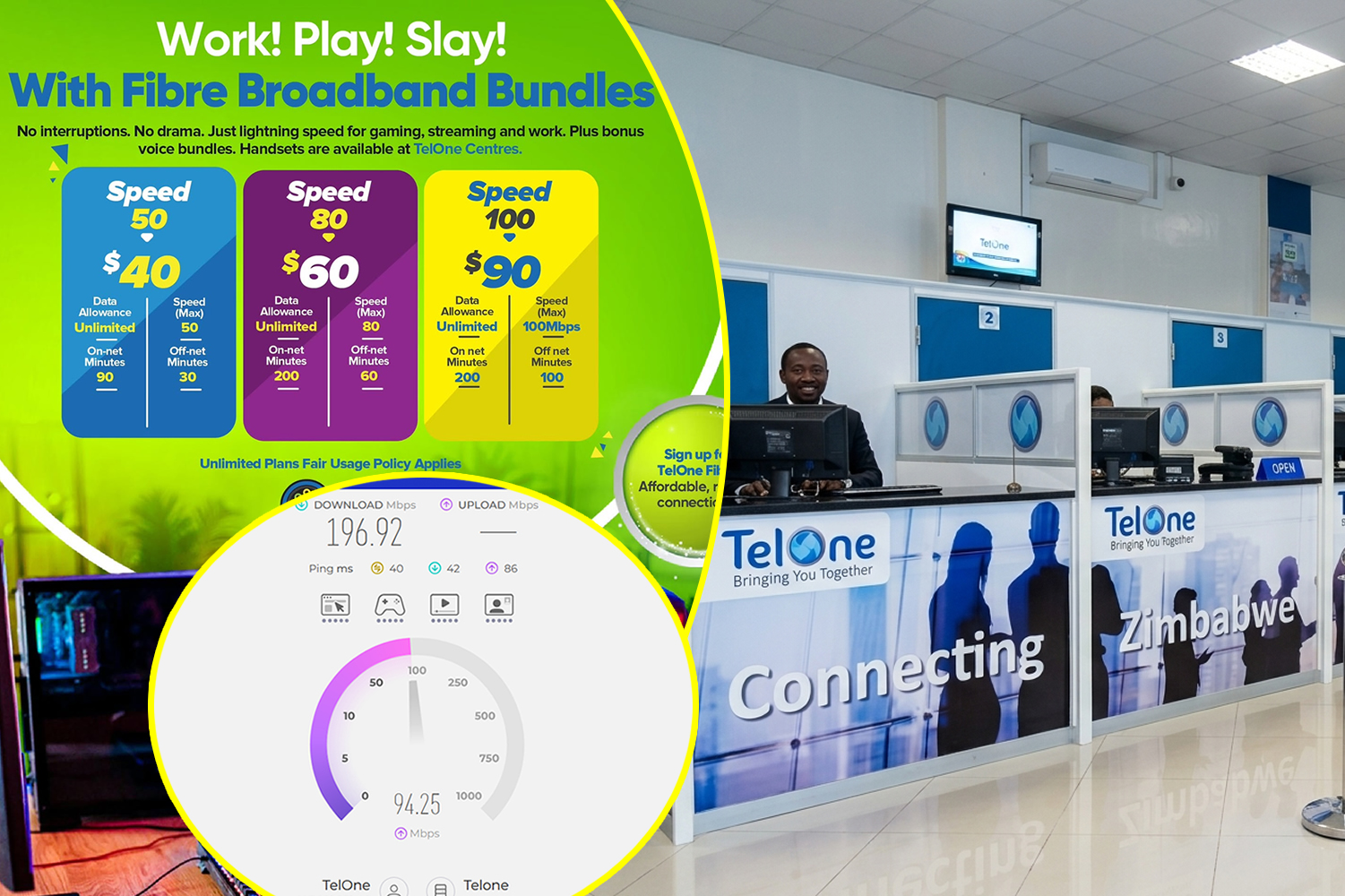
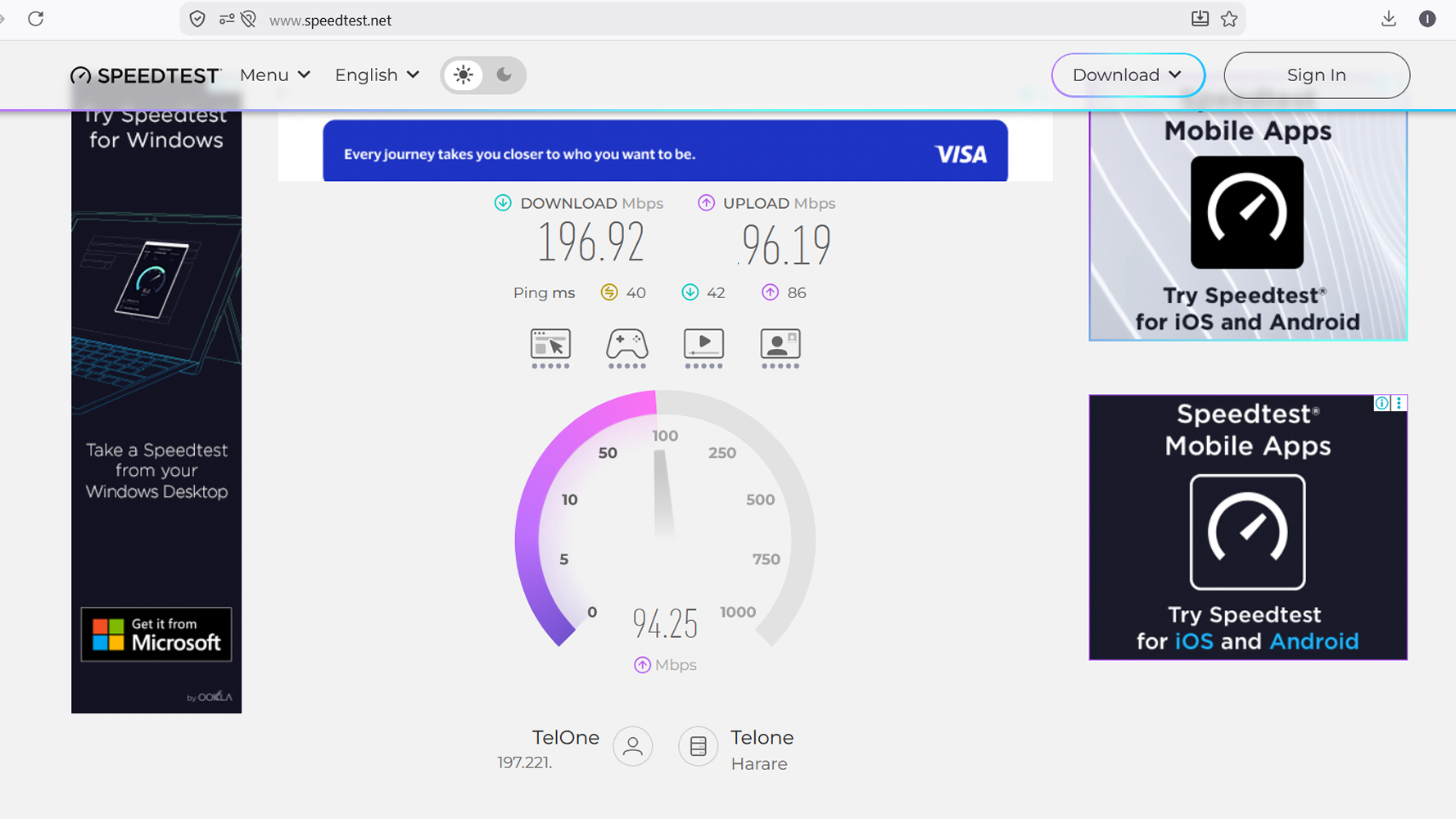
TelOne is competing on both price and reach. Its tariff structure introduced in August 2025 included an unlimited fibre package called Speed 50, offering speeds of up to 50Mbps for US$40 a month. The package includes 90 minutes for calls to TelOne landlines and 30 minutes for calls to mobile phones within Zimbabwe. This reporter uses the US$40 TelOne Fibre internet package, and with some little bit of hardware tweaking, the download speeds are often around 200mbps while the upload speeds range between 90mbps and 100mbps.
The company also lists higher unlimited fibre options, with speeds of up to 80Mbps for US$60 and up to 100Mbps for US$90. The combination of internet access and voice minutes gives TelOne an additional selling point, particularly for households and small businesses that still depend on conventional voice services.
TelOne’s challenge is that it is carrying the cost of a broad and ageing network while trying to expand its modern fibre footprint. Older ADSL, CDMA and copper systems require maintenance, but they generate less traffic and are less attractive to customers who now expect faster and more reliable broadband.
The company has also faced pressure from unpaid government bills. Amounts owed to TelOne reportedly rose to nearly US$42 million by June 2026, up from US$19.2 million a year earlier. The arrears have affected the company’s ability to finance capital projects, maintain its network and upgrade equipment.
Despite those difficulties, TelOne’s data traffic increased by 35.01% as its metro-fibre network expanded. The proposed 114,000-home project is therefore intended to accelerate the shift away from legacy services and place more customers on a network capable of supporting modern broadband use.
For Zimbabwean consumers, the result is a more competitive market. Starlink offers reach in places that fibre networks have not yet covered. Liquid brings an established fibre network and high-speed packages to urban customers. TelOne is now seeking to combine the reach of a national operator with lower-priced unlimited services and a large new fibre build.
The contest will not be decided by speed alone. Coverage, installation time, monthly charges, service reliability and the ability to support heavy upload demand will all influence which provider customers choose. By targeting 114,000 homes and another 500,000 wireless users, TelOne is signalling that it intends to compete across both urban and underserved markets rather than surrendering the next phase of Zimbabwe’s broadband growth to private operators and satellite technology.
The proposed investment still needs to move from the project pipeline to construction, but its scale marks a clear change in TelOne’s approach. The company is no longer relying only on its legacy fixed-line base. It is positioning fibre and wireless broadband as the foundation of a new fight for Zimbabwe’s homes, businesses and rural users.