


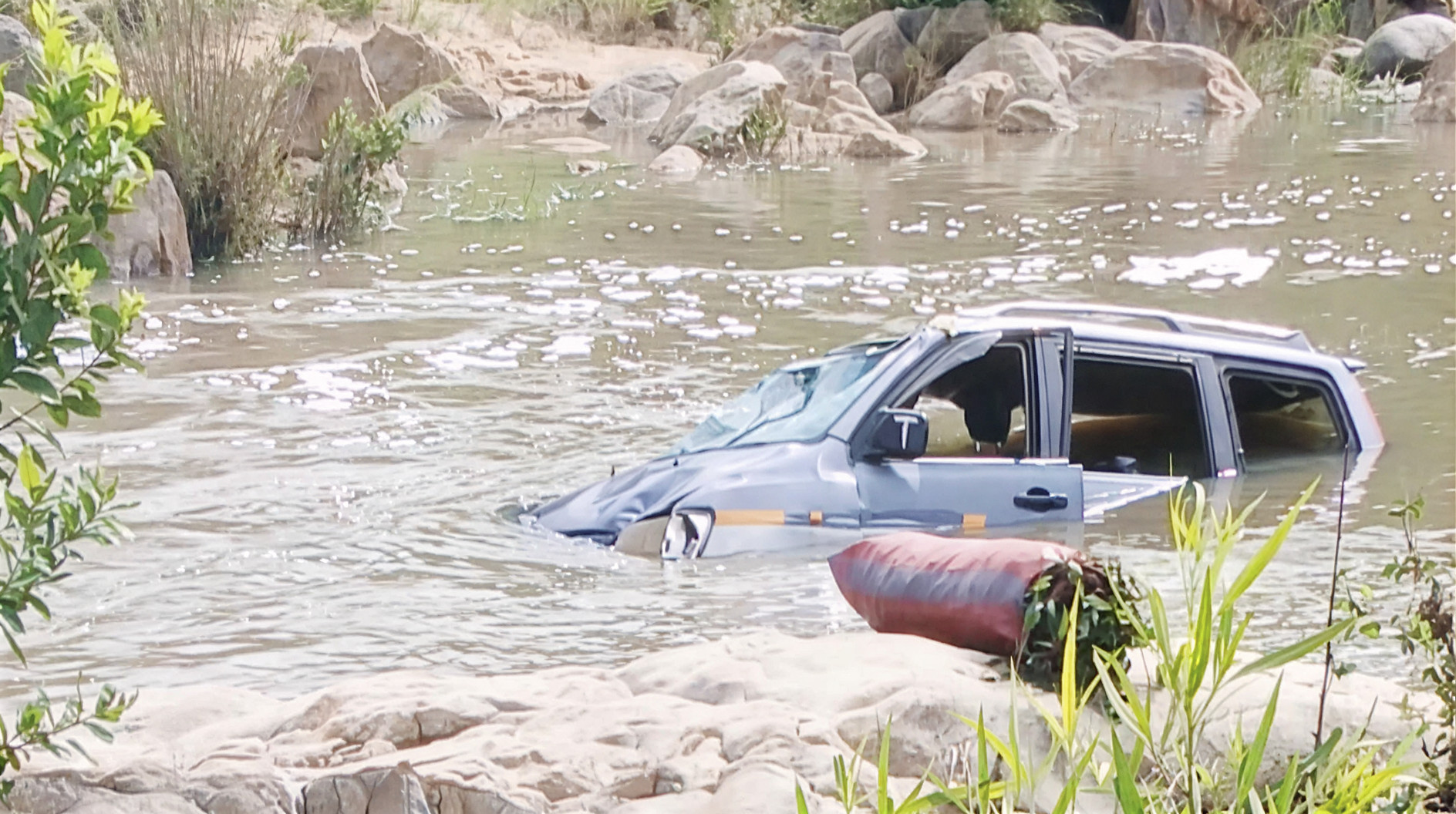
FILABUSI — Death has once again stalked Zimbabwe’s swollen rivers, drifting through the dark currents and leaving only grief in its wake. It is a grim reminder that this tragedy — like so many before it — did not need to happen. On a Thursday night that will forever be etched into the collective memory of the Insiza District, nine lives were claimed when a vehicle was torn from a low-lying bridge and surrendered to the raging Tshangamutope River in the Mukula area. Among the dead was a newborn baby whose future had barely begun to breathe, a victim of a moment’s fatal impatience.
The catastrophe unfolded with a chilling familiarity, a sorrow that this nation has known too many times, yet one it remains painfully unprepared to prevent. As the Zimbabwe Republic Police (ZRP) confirmed the details of the incident, a narrative of human error and natural fury emerged, painting a bleak picture of the risks many continue to take despite the season’s violent temper.
The Fatal Decision at Tshangamutope
The incident occurred on Thursday evening, 22 January 2026, at approximately 22:00 hours. A Toyota Noah, carrying nine occupants, approached the Tshangamutope River. The river, fed by weeks of relentless torrential rain, had transformed from a manageable stream into a churning, debris-laden torrent.
According to National Police Spokesperson, Commissioner Paul Nyathi, the driver of the vehicle acted with initial caution. He stopped the vehicle and disembarked to assess the water levels on the bridge, a common practice for motorists navigating Zimbabwe’s rural roads during the rainy season. However, in a lapse that would prove catastrophic, he left the keys in the ignition.
“The driver had stopped the vehicle and disembarked to assess the water level, leaving the keys in the ignition. One of the passengers then drove the vehicle into the flooded bridge, where it was swept away and submerged, trapping all the occupants,” Commissioner Nyathi stated.
While official police reports remain focused on the mechanics of the accident, social media has been abuzz with a harrowing voice note that provides a more personal, if unverified, account of the final moments. The recording alleges that the vehicle belonged to a man named Njabulo, who had flatly refused to attempt the crossing. Another passenger, identified in the audio as Mthandazo, reportedly insisted that the waters were crossable. In a moment of tragic bravado, Mthandazo is said to have taken the wheel and steered the vehicle into the flow. Seconds later, the river claimed them all.
A Heartbreaking Retrieval
The retrieval of the victims began on the morning of Friday, 23 January 2026. It was a somber scene as members of the local community joined forces with the police to recover the bodies from the submerged wreckage. The force of the water had been so great that the vehicle was completely overwhelmed, leaving no chance for those trapped inside.
The victims represent a cross-section of a community now in mourning. The group comprised five adult females, two adult males, one female juvenile, and a male toddler. Perhaps most heartbreaking was the inclusion of the newborn baby, whose life was cut short before it had truly begun.
“Two of the victims have been positively identified, while efforts to identify the remaining victims are ongoing. Bodies were conveyed to Filabusi District Hospital mortuary for post-mortem,” Commissioner Nyathi added.
A Nation Under Water
The tragedy in Insiza is not an isolated event but part of a much larger, more devastating pattern. The Civil Protection Unit (CPU) recently painted a bleak national portrait of the current rainy season. Since the rains began in October, at least 74 lives have been lost across Zimbabwe. Infrastructure worth an estimated US$107,402 has been swept away, cracked, or buried.
The statistics tell a story of widespread devastation. Manicaland has emerged as the hardest-hit province, recording 32 fatalities. Mashonaland West follows with 19, while the Midlands has seen 13 deaths. Mashonaland Central and Matabeleland South have each recorded three deaths, Mashonaland East two, and Matabeleland North and Bulawayo one each.
These figures, however, are more than just entries in a national ledger of loss. They represent faces once animated by laughter and ambition — ordinary Zimbabweans whose lives were ended by the elements. Beyond the human cost, the floods have destroyed over 1,000 homes, leaving families destitute and reliant on government aid.
The Frustration of Unheeded Warnings
For the authorities, the most painful aspect of these deaths is their preventability. CPU Chief Director Nathan Nkomo expressed a deep sense of frustration, burdened by the knowledge that the Insiza deaths followed countless public appeals.
“We are worried about such deaths, especially after all the communication we have put out advising people not to cross flooded rivers and bridges. These alerts are meant to save lives,” Nkomo said.
His frustration simmered just beneath the surface as he addressed the recurring nature of these incidents. “It is obvious that Government will always come in to assist families of the deceased, but it is worrying that people continue to put themselves in danger after being warned countless times. The same Government that assists is the one that keeps issuing alerts — yet some choose to do the opposite, and lives are lost.”
The trend of defying nature is not limited to motorists. Social media continues to overflow with images of pedestrians and drivers tempting fate on flooded bridges, often for the sake of a shortcut or out of a misplaced sense of urgency.
A Season of Narrow Escapes and Hidden Dangers
While Insiza mourns, other parts of the country have seen miraculous escapes. Near Maphisa in Matobo District, fate offered a different script just days before the Filabusi tragedy. On Tuesday morning, an Isuzu single-cab misjudged the temper of the flooded Mwewe River. The vehicle missed the bridge entirely and was dragged into the furious flow around 10:30 am.
Bulawayo Chief Fire Officer, Mhlangano Moyo, revealed that the two occupants managed to clamber onto the roof as the river claimed their vehicle. They clung to life as the waters snarled below until the Maphisa and Bulawayo fire brigades arrived. Using rescue and throw lines, firefighters were able to pull the pair back from the edge in a rare triumph for the emergency services this season.
However, the dangers of the floodwaters extend beyond the currents themselves. Recent reports have highlighted a more predatory threat: crocodiles. On 16 January, authorities announced that at least three people had been killed by crocodiles lurking in floodwaters. The displacement of these reptiles by rising rivers has added a terrifying dimension to the already hazardous conditions.
The Regional Crisis
Zimbabwe’s struggle is mirrored across Southern Africa. The extreme weather has killed over 100 people across Mozambique, South Africa, and Zimbabwe in recent weeks. South Africa has been forced to declare a national disaster as the death toll rises in its northern provinces of Limpopo and Mpumalanga.
In response to the regional crisis, the Zimbabwean government has dispatched humanitarian aid, including maize, tents, and blankets, to its neighbours in Malawi and Mozambique. Yet, even as the country extends a helping hand abroad, it continues to grapple with the internal challenge of convincing its own citizens to respect the power of the water.
The Investigative Perspective: Why the Risk?
As an investigative journalist looking into these recurring tragedies, one must ask: why do people continue to cross? The answers are often found in the intersection of poor infrastructure and human psychology. Many of the bridges in rural Zimbabwe are “low-lying” or “submersible” designs, intended to be underwater during peak flows. However, these designs rely on the judgment of drivers who may not fully grasp the hydraulic force of moving water.
A vehicle like a Toyota Noah, while versatile, has a high profile and relatively low weight, making it particularly susceptible to being swept away. Once the water reaches the chassis, the vehicle can lose traction and become a floating object, at which point the driver loses all control.
Furthermore, there is the “urgency of the journey.” In many rural areas, a flooded bridge can mean a detour of dozens, if not hundreds, of kilometres. For many, the temptation to “just try” is fueled by a lack of alternative routes and the pressure to reach a destination.
A Call to Listen
In the end, the rivers continue their rise, their warnings often unheeded and their toll unrelenting. The tragedy at Tshangamutope River serves as a stark reminder that no destination is worth a life. The water may look calm, the crossing may seem deceptively familiar, but the power of a flooded river is absolute.
Every rainy season, the rivers of Zimbabwe roar the same message. It is a plea carved into the country’s collective consciousness: respect the water. As the families in Filabusi prepare to bury their loved ones, the rest of the nation must decide if it is finally time to listen.
Table 1: National Flood Fatality Statistics (October 2025 – January 2026)
|
Province
|
Number of Fatalities
|
|
Manicaland
|
32
|
|
Mashonaland West
|
19
|
|
Midlands
|
13
|
|
Mashonaland Central
|
3
|
|
Matabeleland South
|
3
|
|
Mashonaland East
|
2
|
|
Matabeleland North
|
1
|
|
Bulawayo
|
1
|
|
Total
|
74
|
Table 2: Details of the Insiza Incident
|
Category
|
Detail
|
|
Date & Time
|
22 January 2026, 22:00 Hours
|
|
Location
|
Tshangamutope River, Mukula, Filabusi
|
|
Vehicle Type
|
Toyota Noah
|
|
Total Victims
|
9
|
|
Victim Breakdown
|
5 Adult Females, 2 Adult Males, 1 Juvenile Female, 1 Toddler/Newborn
|
|
Primary Cause
|
Passenger drove into flooded bridge after driver disembarked
|