


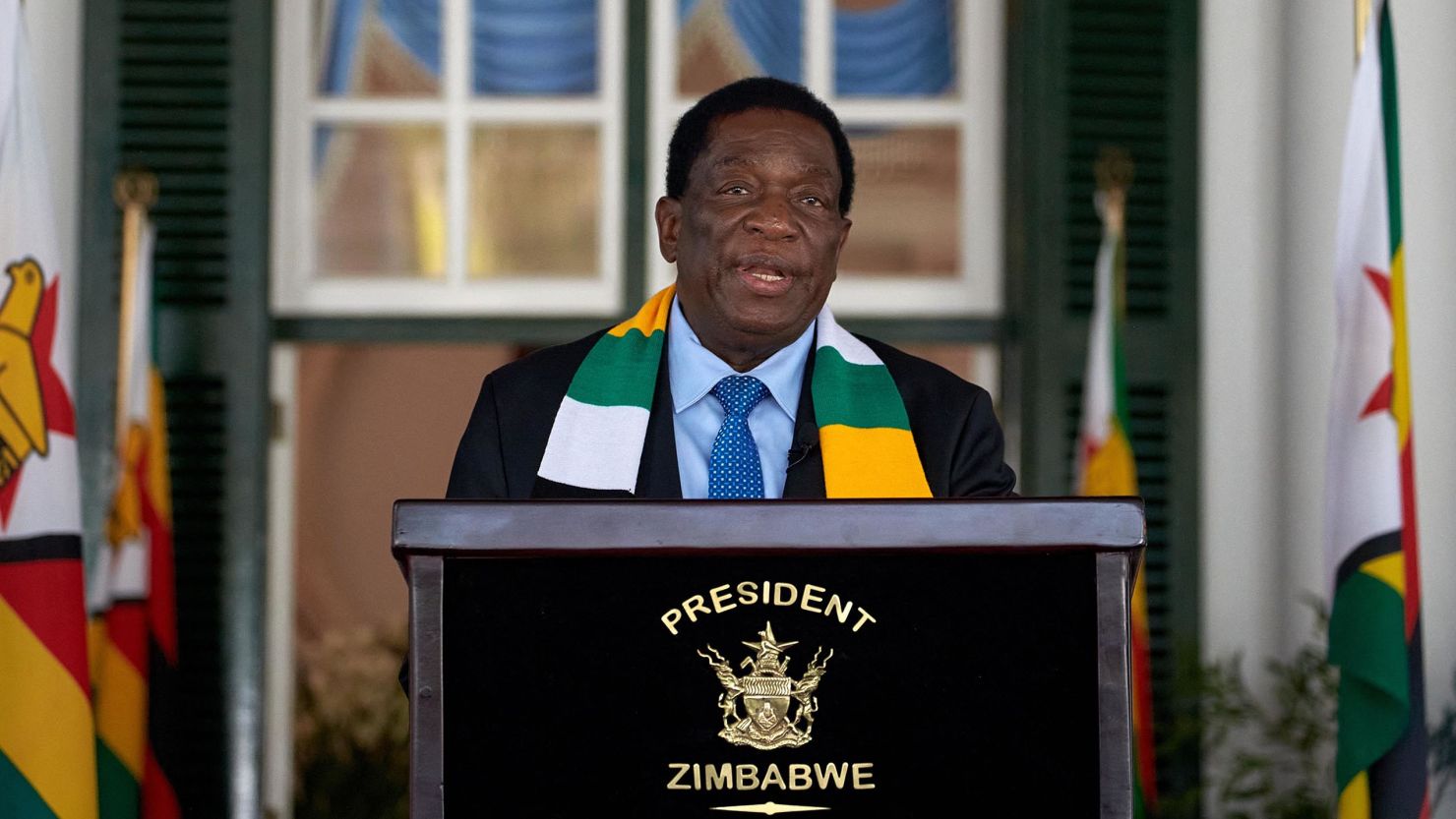
HARARE – In a move that has left the political corridors of Harare buzzing with speculation, President Emmerson Mnangagwa has unceremoniously shown the exit door to his Minister of Information, Publicity and Broadcasting Services, Jenfan Muswere. The dismissal, which came as part of a sudden mini-cabinet reshuffle on Wednesday, follows a high-stakes power struggle involving one of the most influential families in the country’s current political landscape – the Rushwayas.
The official announcement was made by the Chief Secretary to the President and Cabinet, Martin Rushwaya. In a brief statement that carried the weight of a heavy judicial sentence, it was revealed that Muswere had been shunted to the Ministry of Skills Audit and Development. Taking his place at the helm of the government’s communication machinery is Soda Zhemu, who previously served as the National Housing Minister. The reshuffle also saw Paul Mavhima, the former Skills Audit Minister, being moved to fill the vacancy left by Zhemu at the National Housing Ministry.
While the official communique focused on the “rejigging” of the cabinet to improve efficiency, those close to the heart of power in Zimbabwe know that the real story lies in a botched attempt by Muswere to assert his authority over the state-owned Zimbabwe Broadcasting Corporation (ZBC). Specifically, it was his ill-fated decision to fire the ZBC board chairperson, Helliate Rushwaya, that sealed his fate.
Helliate Rushwaya is not just any civil servant or board member. She is a niece to President Mnangagwa and a sister to both Henrietta Rushwaya, the powerful head of the Zimbabwe Miners Federation, and Martin Rushwaya, the very man who had to announce Muswere’s demotion. In the intricate web of Zimbabwean politics, messing with the Rushwaya siblings is widely regarded as a cardinal sin, a risk that few are brave – or perhaps foolish – enough to take.
The drama began to unfold earlier this week when Muswere, seemingly confident in his ministerial powers, announced the dismissal of the entire ZBC board. He did not stop there. In a move to quickly fill the vacuum, he appointed Chipo Nheta as the interim board chairperson and named the well-known media personality Ruvheneko Parirenyatwa as his deputy. The decision was so advanced that the state-controlled newspaper, The Herald, had already prepared its morning edition featuring the news of the board’s ouster.
Insiders report that approximately 3,000 copies of The Herald had already been printed and were ready for distribution when the order came to halt the presses. President Mnangagwa, who was away on an official trip to Dubai in the United Arab Emirates at the time, reportedly intervened personally after receiving word of the move against his niece. The President’s directive was clear: the decision must be reversed immediately.
The resulting chaos at the government-controlled newspaper led to substantial financial losses, as the already-printed copies had to be scrapped and the front page redesigned in the middle of the night. It was a public relations disaster for a ministry tasked with managing the government’s image, and it exposed a deep lack of coordination between the minister and the presidency.
To understand why this incident was the final straw for Muswere, one must look at the historical context of the Rushwaya family’s standing. They are a family that has consistently shown they are not to be trifled with. A few years ago, the family was at the centre of a major legal battle after Henrietta Rushwaya was arrested at the Robert Mugabe International Airport. She was accused of attempting to smuggle six kilogrammes of gold out of the country, destined for Dubai.
During the legal proceedings that followed, a State Prosecutor named Pardon Dziva made the mistake of demanding a bribe from Helliate Rushwaya to facilitate a favourable outcome for her sister. Instead of complying, Helliate reported the matter to the authorities. The result was swift and severe: the prosecutor was arrested, convicted, and sentenced to a lengthy prison term. Henrietta, meanwhile, was eventually fined and freed, further cementing the perception of the family’s resilience and influence.
For Muswere, the attempt to remove Helliate from her position at ZBC was seen as a direct challenge to this family’s authority and, by extension, the President’s own circle. Sources within the government suggest that Mnangagwa had already been feeling a sense of dissatisfaction with how government messaging was being handled. He reportedly viewed the communication strategy as weak and poorly coordinated, often leaving the government on the back foot during times of crisis.
“The President wants a tighter grip on the narrative,” said one source who requested anonymity. “Muswere’s move against the ZBC board was seen as a clumsy attempt to play power politics without the necessary clearance. It wasn’t just about the board; it was about who holds the remote control to the state’s primary broadcaster.”
The appointment of Soda Zhemu to the Information Ministry is seen by many analysts as a move towards a more compliant and predictable communication department. Zhemu, who has held various portfolios in the past, is regarded as a loyalist who is unlikely to make such bold, uncoordinated moves.
The shift of Jenfan Muswere to the Ministry of Skills Audit and Development is being widely interpreted as a significant demotion. While still a cabinet-level position, it lacks the political weight and public visibility of the Information portfolio. It is a quiet corner of government where ministers are often sent when they are being “parked” or phased out of the inner circle.
This mini-reshuffle may also be a precursor to even larger changes on the horizon. There have been persistent reports that President Mnangagwa is considering bringing the retired Zimbabwe Defence Forces commander, General Phillip Valerio Sibanda, into the cabinet. Speculation suggests that Sibanda could be appointed as the Minister of Lands, a move that would further integrate military leadership into the civilian government structure.
As the dust settles in Harare, the message to other ministers is unmistakably clear. In the “Second Republic,” loyalty to the first family and their extended network is paramount. The professional survival of a minister depends not just on their performance, but on their ability to navigate the complex family ties that underpin the current administration.
For now, Jenfan Muswere serves as a cautionary tale for those who might forget where the true power lies. He attempted to flex his muscles in a territory guarded by the President’s own kin, and he paid the price with his political career. The “shock” of his removal is less about the change in personnel and more about the reminder of the risks involved in challenging the established order.
In the end, the story of Muswere’s fall is a classic Zimbabwean political drama: a mixture of family loyalty, state media control, and the unforgiving nature of the presidency when it feels its interests are being undermined. As Soda Zhemu takes over the Information Ministry, he will no doubt be looking over his shoulder, well aware of the fate that befell his predecessor for daring to “mess up” with the wrong people.
The ZBC board remains in place, Helliate Rushwaya continues to lead it, and the President has once again demonstrated that when it comes to his family, the rules of engagement are very different.