


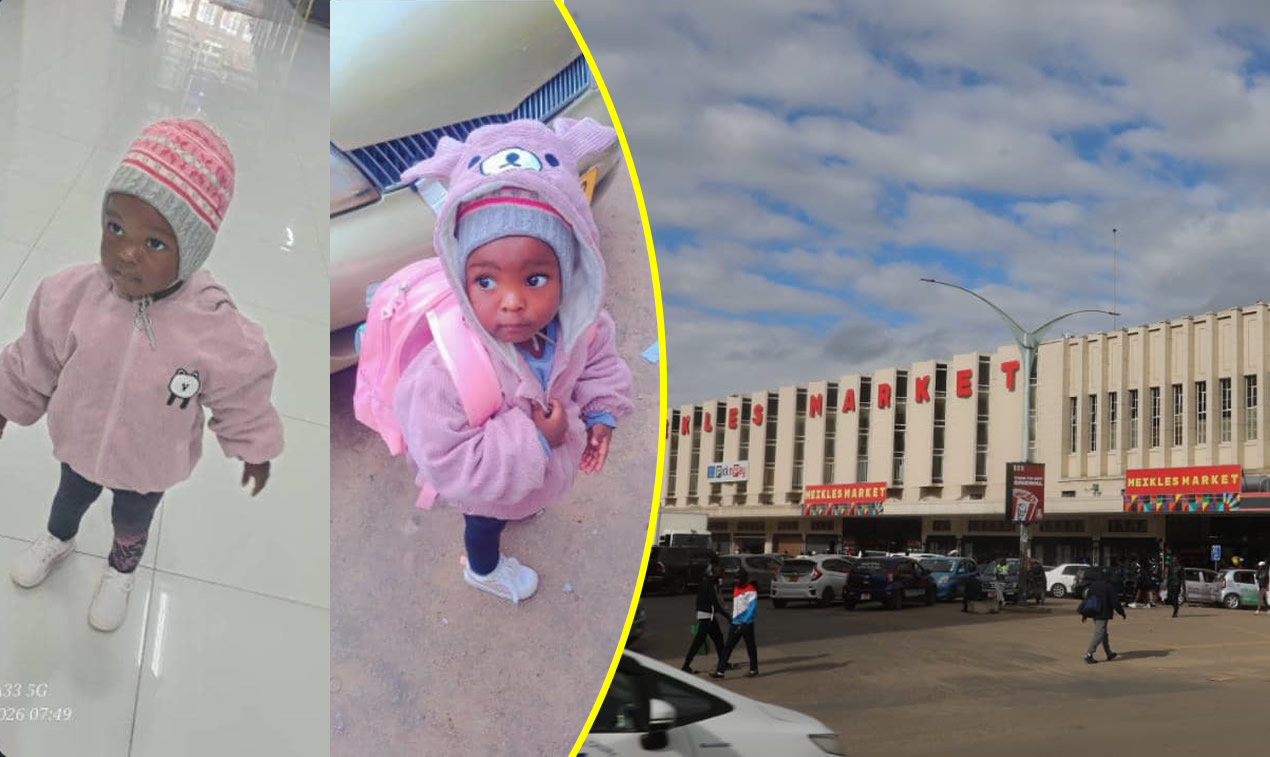
BULAWAYO – The morning sun was already beating down on the bustling pavements of Bulawayo’s Central Business District when the unthinkable happened. In the heart of Meikles Mall, a place of commerce and daily survival, a two-year-old toddler named Assandra Ndhlovu vanished into thin air. It took only twenty minutes of distraction for a family’s world to crumble, and for the city to be reminded of a predatory darkness that continues to haunt the nation’s streets.
The incident occurred on a Tuesday morning, around 9:00 am. Assandra’s mother, like many others in the city, was at her stall serving customers. The toddler, dressed in a pink jersey and blue jean trousers, was playing nearby. She was barefoot—a detail that makes her vulnerability all the more heart-wrenching. By 10:30 am, the routine of the morning had turned into a nightmare.
“After about 20 minutes the complainant then checked her child and failed to locate her,” confirmed Inspector Nomalanga Msebele, the Bulawayo police spokesperson. “Complainant asked her workmates and no one saw the child. She then checked at the mall CCTV office.”
What the grainy security footage revealed was chilling. An unknown man, clad in a brown hooded jacket and blue work suit trousers, was seen lifting the small child and calmly walking out of the mall. His face remained obscured, a shadow moving through a crowd of witnesses who saw nothing out of the ordinary.
“The mother was attending to a customer, and when she turned back, the child was no longer there,” said the child’s aunt, who spoke on behalf of the mother. The mother herself was described as too traumatised to speak, her voice stolen by the sheer weight of the tragedy. “She immediately started asking around at neighbouring stalls, hoping that someone had seen her, but no one could give clear answers. Panic quickly set in.”
The aunt described the moment the family watched the CCTV footage as “heart-breaking.” “The security guard assisted us, and when we reviewed the footage, we saw the child being taken away. That moment was heart breaking. The mother broke down completely and could not speak after that”.
Assandra’s grandfather, Bhekekhaya Hadebe, stood amidst the chaos, his face a mask of grief. “It is devastating to lose a child in such circumstances. We are appealing to anyone who might have information to help us find our granddaughter,” he pleaded.
A Pattern of Predation
The abduction of Assandra Ndhlovu is not an isolated tragedy. It is part of a disturbing surge in child disappearances across Zimbabwe, many of which share a common, sinister thread. Only weeks prior, on 29 December 2025, another family in Bulawayo was plunged into despair when a four-month-old baby girl was kidnapped from New Parklands. In that instance, the mother had been lured through a WhatsApp group—a modern tool used by predators to exploit the vulnerable.
Further north, in Gweru’s Central Business District, a two-month-old baby was snatched in November 2025, mirroring an abduction from March 2024 where a two-year-old was lost to a stranger. The frequency of these incidents suggests a professionalised or culturally driven market for children, where the innocent are treated as commodities.
In January 2026, the border town of Beitbridge became a focal point of this crisis. Border Management Authority (BMA) officials intercepted two Zimbabwean nationals attempting to cross into South Africa with three abducted children. In a separate incident on 13 December 2025, an 11-month-old baby was found abandoned at the same port of entry, likely discarded when the risk of detection became too high.
The Muti Motive: A Grimmer Reality
While some abductions are linked to human trafficking for labour or illegal adoptions, a darker motive often lurks in the background of Zimbabwean disappearances: ritual murder. The belief in “muti”—traditional medicine enhanced by human body parts to bring wealth, luck, or political power—remains a terrifying reality in parts of the country.
No case illustrates this horror more vividly than that of Tapiwa Makore. In September 2020, the seven-year-old boy from Murewa was kidnapped and brutally murdered. The investigation revealed a motive that defied comprehension: his own uncle, Tapiwa Makore Senior, along with a herdsman, Tafadzwa Shamba, killed the boy to use his body parts for ritual purposes. They believed the “muti” would boost their cabbage farming business.
The High Court judgement in the Makore case, delivered in June 2023, sent a clear message by sentencing the killers to death. Yet, the conviction has done little to quell the superstition that fuels such crimes. In Guruve, a suspected serial killer named Anymore Zvitsva was arrested in January 2026, linked to a staggering 19 cases of murder and ritual killings committed between April 2024 and December 2025.
“There were continuing reports of ritual murders and killings of children for body parts which were associated with traditional religious practices,” noted a human rights report on the region. The victim is often kidnapped, killed, and their body parts—frequently the head, heart, or private parts—are harvested while they are still alive, under the horrific belief that the victim’s screams enhance the “power” of the medicine.
A Community Under Siege
In Bulawayo, the atmosphere at Meikles Mall has shifted. What was once a place of vibrant trade is now a site of suspicion. Shop owners and vendors, who once looked out for one another, now cast wary glances at strangers in hooded jackets.
The police have intensified their search for Assandra, but the trail is growing cold. A message continues to circulate on social media, a digital cry for help: Missing child, Assandra Ndhlovu, 2 years old. Last seen in a pink jersey and blue jeans. Please help.
For the family of Assandra, every passing hour is a fresh agony. The grandfather’s appeal remains the same, a desperate hope that someone, somewhere, saw the man in the brown jacket. “We are appealing to the public, shop owners, and anyone who may have been in the area at the time to come forward,” Hadebe said.
The abduction of a child in broad daylight, in a crowded mall, suggests a level of boldness that has left the public reeling. It is a reminder that in the shadow of the nation’s economic struggles, a more visceral threat persists. Whether the motive is trafficking, ransom, or the macabre rituals of “muti,” the result is the same: a chair left empty, a mother’s voice lost to trauma, and a city forced to confront the fact that its most vulnerable are no longer safe, even in the light of day.
As the investigation into the Meikles Mall abduction continues, the people of Bulawayo are left to wonder who will be next. The story of Assandra Ndhlovu is now woven into the grim tapestry of Zimbabwe’s missing children—a list that grows longer while the answers remain few. The “brazen” nature of the crime has left many questioning the adequacy of security in public spaces and the underlying societal rot that allows such evils to flourish.
For now, the pink jersey and the blue jeans are all that remain in the memory of those who saw Assandra last. The man in the brown hood remains at large, a phantom in the crowd, while a family waits for a miracle that, with each setting sun, feels further and further away.