


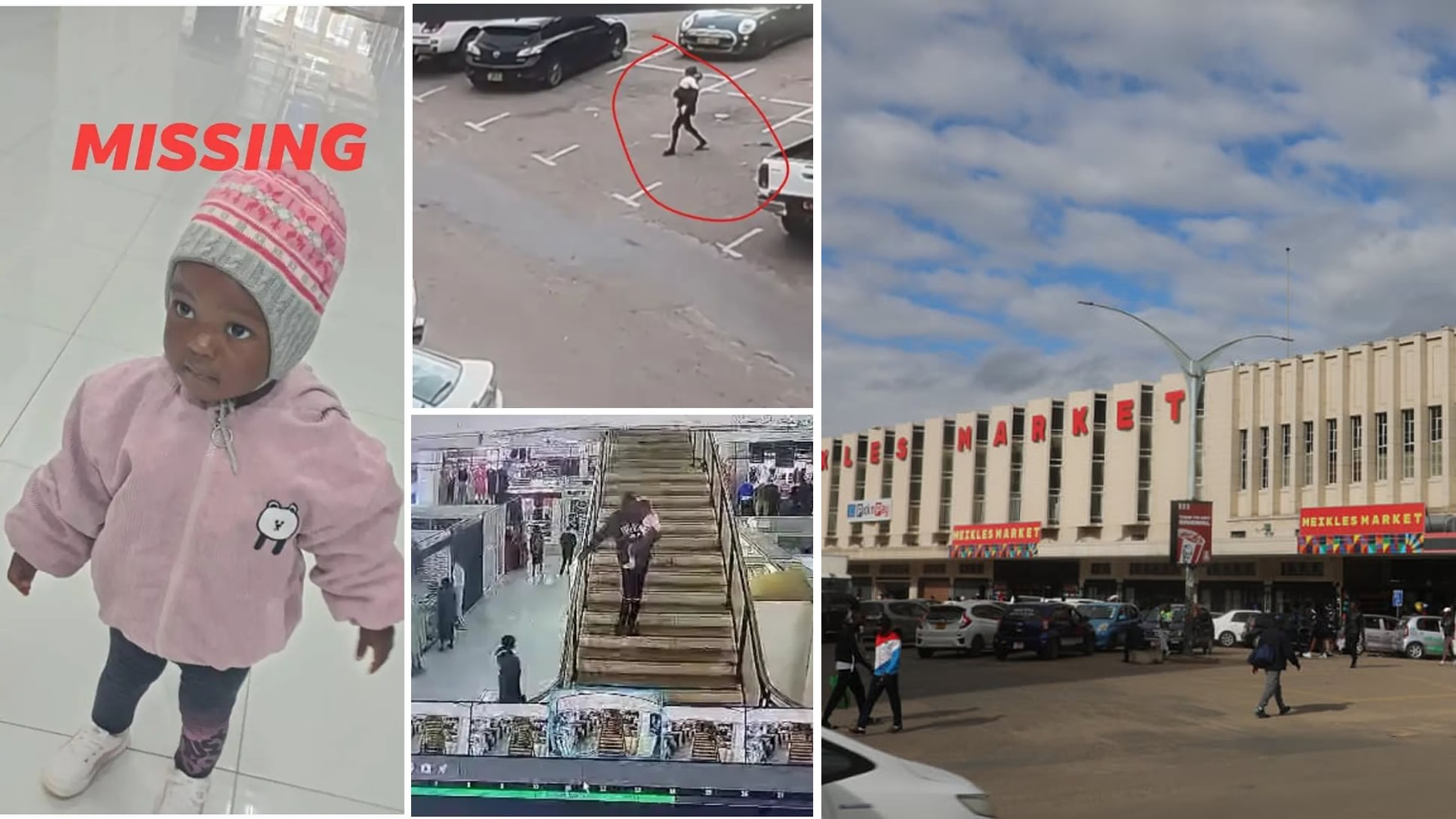
BULAWAYO – The narrow, bustling corridors of Meikles Market in Bulawayo are usually a symphony of commerce—the rustle of second-hand clothes, the rhythmic calling of vendors, and the occasional cry of a restless toddler. On Tuesday, February 17, 2026, that symphony was shattered. Nesisa Mpofu, a 25-year-old mother from New Lobengula, was tending to her stall when a young girl, her face partially obscured by a hoodie, approached. She seemed like any other customer, perhaps a student on her way home, browsing for a pillow. But within minutes, Nesisa’s two-year-old daughter, Asanda Ndlovu, was gone.
The nation watched in collective horror as grainy CCTV footage circulated online, showing a figure in jeans and a hoodie carrying the toddler away. For 48 hours, Bulawayo was a city on edge. When Asanda was finally found unharmed on Thursday morning at a business premises on the corner of Herbert Chitepo Street and 3rd Avenue, the headlines hailed it as a “miracle recovery.” However, as the dust settles, a much darker and more complex narrative has emerged. The “snatcher” was not a seasoned criminal or a member of a human trafficking syndicate; she was a 14-year-old Form One pupil.
A Startling Confession and a Hidden Reality
When the teenager was paraded before reporters on Friday, her face hidden behind a mask, the air was thick with tension. In a startling confession that left many questioning the state of Zimbabwean youth, she laid bare her motivations. “I’m really sorry. I made a mistake. I’m asking for forgiveness,” she whispered to the gathered journalists. Her reason for the abduction was as tragic as it was bizarre: she wanted to prove to her 36-year-old boyfriend, a kombi driver identified as Godwell Mumba, that she had a child.
“Mumba asked me if I have a child and I said yes. So he asked me to bring the baby. That’s when I went to Meikles,” the girl stated. She described the moment of the snatching with a chilling simplicity that highlighted her lack of adult foresight. “When I got there the baby was crying and I lifted her up. She stopped crying. She is a friendly baby.” For two days, while a massive police hunt was underway, the toddler was kept in a residence in Trenance, fed on a diet of rice, hot chips, and corn puff snacks.
|
Key Incident Details
|
Information
|
|
Victim
|
Asanda Ndlovu (2 years old)
|
|
Suspect
|
14-year-old Form One Pupil
|
|
Location of Snatched
|
Meikles Market, Bulawayo
|
|
Duration Missing
|
48 Hours
|
|
Motivation
|
To impress a 36-year-old boyfriend
|
|
Diet of Child
|
Rice, hot chips, and corn puffs
|
This isn’t just a story of a “delinquent” child; it is a window into a disturbing social trend where young girls are driven to extreme measures by psychological trauma and a desperate desire to “belong.” The girl, who lives with her mother in Rangemore, was navigating a world of adult consequences without any adult guidance. The involvement of Godwell Mumba, who has since been arrested on allegations of raping the 14-year-old, adds a sinister layer of grooming and exploitation to the case. It suggests that the “baby snatcher” was herself a victim of a different kind of predator long before she stepped into Meikles Market.
The Conspiracy of Silence and Mental Health
Why did no one notice a thirteen or fourteen-year-old girl harbouring a stolen baby? This question points toward a conspiracy of silence surrounding mental health and child protection in Zimbabwean schools and communities. Recent studies, including a 2025 report from Mapanzure High School, indicate a high prevalence of mental health symptoms among students, ranging from attention deficit to low self-esteem. Yet, these issues are often overlooked in a society grappling with more immediate survival needs.
Sociologists argue that the economic hardships in Bulawayo are fracturing the family unit. With food insecurity reaching 41% in urban areas and high inflation forcing parents into the diaspora, many children are left in “child-headed” households or with elderly relatives who cannot provide the necessary supervision. This environment creates a vacuum where social media “clout” and the need to “impress” older men become the primary drivers of identity for vulnerable teenagers. The 14-year-old’s lie to her boyfriend was a desperate attempt to anchor herself in a relationship that was inherently abusive.
“We are seeing a generation of children who are physically present but emotionally abandoned,” says a local sociologist. “They are trying to navigate adult complexities—relationships, parenthood, social status—with the tools of a child. The result is often catastrophic, not just for them, but for the innocent victims like little Asanda.”
The Shadow of Rituals and Security Lapses
The Bulawayo incident also reignited the “kidnapping for rituals” fears that haunt Zimbabwean parents. While this case turned out to be a desperate act of a confused teenager, the fear is grounded in a history of gruesome ritual murders, such as the infamous Tapiwa Makore case. This cultural trauma ensures that every missing child report is met with a level of panic that borders on hysteria. It is a fear that the “stolen babies” are being taken for their “purity” to satisfy the demands of rogue traditional healers seeking “muthi” for wealth or luck.
The reality, however, is often more mundane but equally disturbing. Babies are frequently stolen for “baby-selling” syndicates or, as in this case, to satisfy a personal psychological need. The security lapses at Meikles Market, where a teenager could simply walk out with a crying toddler by pulling up a hoodie, have prompted administrators to promise “strengthened safety protocols.” But security guards and CCTV are only reactive measures; they do not address the root causes of why a child would think kidnapping is a viable solution to her problems.
A Society Failing its Youngest Members
This “isolated incident” might actually be a symptom of a much larger, hidden epidemic of child-led crime. When we look at the statistics of juvenile delinquency in Zimbabwe for 2025 and 2026, there is a clear upward trend. Children are increasingly involved in theft, drug distribution, and now, kidnapping. The legal framework, as explored in recent legal analyses, is often ill-equipped to handle offenders who are also victims. The 14-year-old girl will appear before a juvenile court, but the legal system cannot fix the broken social structures that led her there.
The story of the Bulawayo baby snatcher is a thought-provoking analysis of a society that is failing its youngest members—both the victim and the perpetrator. Asanda Ndlovu is back in her mother’s arms, but the psychological scars of those 48 hours, and the diet of “hot chips and corn puffs,” will remain. Meanwhile, the Form One girl faces a future defined by a crime she committed in a fog of grooming and desperation.
If we are to prevent the next kidnapping, we must look beyond the “miracle” of recovery and address the “why.” We must break the silence on mental health, provide better support for families fractured by economic migration, and protect our children from the predatory “Mumbas” of the world. Until then, the bustling corridors of Bulawayo’s markets will remain a place of both commerce and hidden danger, where the next tragedy is only a hoodie and a desperate lie away.
Comparative Trends in Child-Led Incidents (2024-2026)
|
Trend Category
|
Observation
|
Impact
|
|
Juvenile Delinquency
|
15% increase in urban centres
|
Strained social services and juvenile courts
|
|
Grooming/Exploitation
|
Rising cases involving older men and schoolgirls
|
Increased vulnerability to criminal coercion
|
|
Economic Migration
|
“Diaspora orphans” left with minimal supervision
|
Higher risk of children engaging in risky behaviours
|
|
Mental Health
|
60%+ of students reporting symptoms of distress
|
Lack of intervention leads to extreme coping mechanisms
|
The case of the Bulawayo baby snatcher is a wake-up call. It is a reminder that in the absence of adult guidance and a functional social safety net, children will create their own versions of reality—versions that can have devastating real-world consequences. As the city of Bulawayo breathes a sigh of relief for Asanda, it must also begin the hard work of reflecting on how it allowed a 14-year-old girl to fall so far through the cracks.