


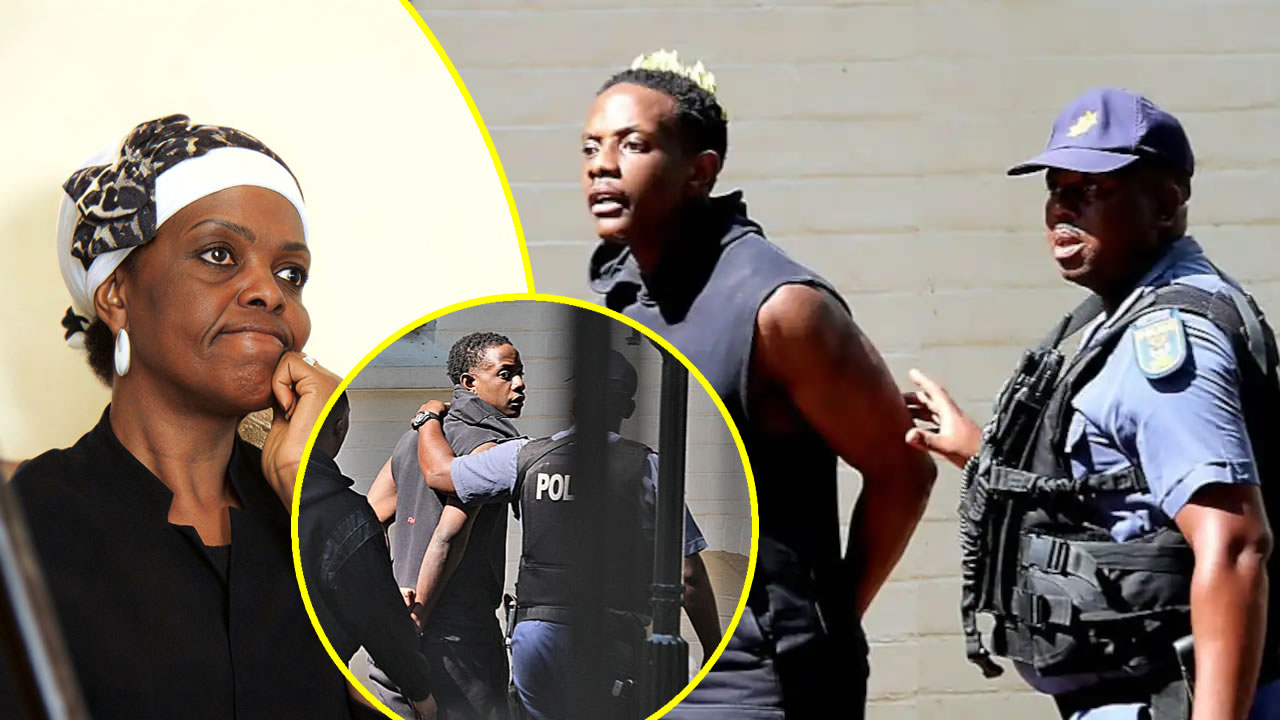
The opulent, leafy suburb of Hyde Park in Johannesburg is usually a sanctuary of silence, broken only by the hum of high-end security systems and the occasional luxury car gliding down its pristine streets. But for the Mugabe family, the silence has been shattered by a single gunshot that has reignited a decade-long legal feud and left a young man fighting for his life. As Bellarmine Chatunga Mugabe, the 28-year-old youngest son of the late Zimbabwean strongman Robert Mugabe, sits in a South African police cell, his mother, Grace Mugabe, is facing her own terrifying reality. For the former First Lady, her son’s arrest is more than just a family crisis; it is a legal trap that could finally see her in handcuffs.
The incident that triggered this diplomatic and legal firestorm occurred just days ago at a property where Bellarmine was staying. According to the South African Police Service (SAPS), a 23-year-old man, believed to be employed as a gardener at the residence, was shot and critically injured. The victim remains in a critical condition in hospital after being shot once. While the mainstream media has focused on the arrest itself, the “hidden details” emerging from the scene suggest a far more volatile environment than previously understood. Neighbours, speaking on condition of anonymity, have described the Mugabe residence as a place where the rules of normal society often seemed not to apply.
Col Dimakatso Nevhuhulwi, a spokesperson for the SAPS, confirmed the gravity of the situation during a briefing outside the Hyde Park property. “The suspects have not told us where the gun is, they are not saying anything about the gun,” Nevhuhulwi stated, highlighting a deliberate wall of silence that has frustrated investigators. While officers have recovered spent cartridges at the scene, the missing firearm remains a central mystery. This lack of cooperation has led many to question the “conspiracy of impunity” that has long surrounded the Mugabe children, who have frequently made headlines for their spendthrift and often chaotic lifestyles in both Harare and Johannesburg.
Now, with her son facing a charge of attempted murder, the former First Lady is reportedly “paralysed with fear” at the prospect of returning to South Africa to support him. Legal experts suggest that the moment she steps across the border, she would be vulnerable to immediate arrest.
The “Diplomatic Immunity” shield that the Mugabes once used as a weapon has been permanently shattered. Dr Gideon Chitanga, a seasoned political analyst and international relations expert, was blunt in his assessment of the family’s current standing. Speaking to IOL, he emphasized that immunity is not a hereditary right. “Primarily, there are no grounds for diplomatic immunity. Robert Mugabe was a former president and he is no longer alive. There are no treaties that address a situation like this,” Chitanga said. He further clarified that “this is a purely criminal matter. You cannot invoke the Vienna Convention or diplomatic immunity under these circumstances. The Vienna Convention relates to individuals acting as state representatives, not private citizens.”
The tragedy of the situation is that Bellarmine Chatunga and his older brother, Robert Mugabe Jr., have long struggled to escape the controversy that seems to follow their every move. Just last year, Robert Jr. was fined $300 after admitting to possession of marijuana in Zimbabwe. He had also faced charges of malicious damage to property and assaulting a police officer in 2023, though those matters were eventually settled out of court. The brothers’ “TripLife” entertainment empire, which promised to bring high-end nightlife to Harare, has often been overshadowed by reports of violent brawls and drug-fuelled parties.
In Hyde Park, the shooting of the gardener has brought these tensions to a bloody climax. Reporters at the scene witnessed a heavily armed police presence, including K9 units and divers, as they scoured the property for the missing weapon. The fact that gunshots were reportedly “frequent” at the home, according to some residents, suggests a culture of recklessness that has finally resulted in a near-fatal tragedy. “The tragedy is that Grace Mugabe cannot travel to South Africa to support her son because she has an outstanding warrant of arrest,” noted one commentator on social media, echoing a sentiment that has spread rapidly across the region.
The legal mechanics of the case are straightforward but devastating for the Mugabe legacy. Bellarmine and another man arrested alongside him are expected to appear before the Alexandra Magistrate’s Court shortly. Without the protection of the state, Bellarmine is being treated as any other foreign national accused of a violent crime. The South African authorities, perhaps stung by the criticism they faced for allowing Grace to flee in 2017, seem determined to follow the letter of the law this time.
This incident also highlights the crumbling remains of a dynasty that once ruled Zimbabwe with an iron fist for 37 years. Since Robert Mugabe’s death in 2019, the family’s influence has waned significantly. The “Blue Roof” mansion in Harare, once a symbol of untouchable power, now feels more like a gilded cage for a family that is increasingly isolated. The “conspiracy” of silence that protected them for decades is being picked apart, one court case at a time.
As the gardener fights for his life in a Johannesburg hospital, the question remains: why was he really shot? Was it a tragic accident during a moment of drug-induced paranoia, or was it the result of a heated dispute that turned deadly? The missing gun suggests a level of premeditation in the aftermath—an attempt to scrub the evidence before the law could intervene. For the Zimbabwean public, who have watched the Mugabe children flaunt their wealth while the nation struggled, there is a sense that the “chickens are finally coming home to roost.”
Grace Mugabe’s nightmare is far from over. If her son is convicted, he faces a lengthy prison sentence in a country where the Mugabe name no longer carries any weight. For a mother who once believed she was the “Mother of the Nation,” the reality of being unable to even visit her son in a time of crisis is a bitter pill to swallow. The Hyde Park shooting is not just a local crime story; it is a documentary-style autopsy of a fallen regime, showing how the arrogance of power can eventually lead to a cold-blooded tragedy in a foreign land.
The SAPS investigation continues, and as more details emerge, the pressure on the Zimbabwean government to intervene will likely grow. However, with the “new dispensation” in Harare keen to distance itself from the excesses of the Mugabe era, it is unlikely that any official help will be forthcoming. Bellarmine Chatunga Mugabe is, for perhaps the first time in his life, truly on his own. And for Grace, the silence from across the Limpopo is the loudest sound of all.
The Hyde Park Enigma: A History of High-Stakes Living
To understand the gravity of the current situation, one must look at the lifestyle the Mugabe brothers have maintained in South Africa. Hyde Park is not just any suburb; it is the pinnacle of South African wealth. The residence where the shooting occurred is a sprawling estate that reportedly costs thousands of dollars in monthly upkeep. For years, the Mugabe sons, Robert Jr. and Bellarmine Chatunga, have been the talk of the town, known for their “champagne-popping” lifestyle that stood in stark contrast to the economic hardships faced by millions of Zimbabweans back home.
The “hidden details” of their residence reveal a pattern of behaviour that many neighbours found increasingly alarming. One resident, who lives just three houses away, recalled multiple instances where the peace of the neighbourhood was disturbed. “It wasn’t just the music or the late-night guests,” the resident said. “There was always an air of tension around that house. You could see the private security guards, the luxury SUVs coming and going at all hours, and sometimes, you would hear things that didn’t sound like a party.” These “things” included the frequent sound of what many believed were gunshots, a claim that the SAPS is now taking very seriously.
The gardener, whose name has been withheld by authorities for his protection, was more than just an employee; he was a witness to the inner workings of the Mugabe household. Sources close to the investigation suggest that the shooting may have been the result of a domestic dispute that spiralled out of control. The fact that the firearm has vanished into thin air suggests a frantic effort to cover up the crime. “You don’t just lose a gun after shooting someone in your own home,” a retired detective noted. “Either it was hidden, or it was taken away by someone who knew the police were coming.”
The Ghost of 2017: Gabriella Engels and the Unfinished Business
For many South Africans, the name Grace Mugabe is synonymous with the 2017 Sandton hotel incident. The image of Gabriella Engels with a gashed forehead, allegedly inflicted by the former First Lady with an extension cord, remains a potent symbol of the Mugabe family’s perceived “untouchability.” At the time, the South African government’s decision to grant Grace diplomatic immunity was seen as a betrayal of justice. It allowed her to be whisked away in the middle of the night, back to the safety of Harare, leaving her victim without recourse.
However, the legal landscape has changed dramatically since then. Organizations like AfriForum have relentlessly pursued the case, successfully challenging the immunity in court. This means that the warrant for Grace Mugabe’s arrest is not just a piece of paper; it is a live legal instrument. The current crisis involving Bellarmine has effectively turned South Africa into a “no-go zone” for his mother. “She is in a catch-22 situation,” says a legal analyst. “If she stays in Zimbabwe, she looks like a mother who has abandoned her son. If she comes to South Africa, she faces the very real prospect of being the one in the cell next to him.”
The “conspiracy” of diplomatic protection that once shielded the family has evaporated. The Zimbabwean government, now led by President Emmerson Mnangagwa, has shown little appetite for bailing out the family of his predecessor. The relationship between the Mnangagwa administration and the Mugabes has been frosty at best, and the current legal troubles in South Africa are seen by many in Harare as a “private matter” for the family to resolve on their own.
The Falling Pillars of a Fallen Dynasty
The Mugabe legacy is being dismantled piece by piece. Robert Mugabe Jr.’s recent legal troubles in Zimbabwe, where he was arrested for smashing cars and property worth thousands of dollars, showed that the family’s influence at home is also at an all-time low. The “TripLife” brand, once meant to be a symbol of their entrepreneurial spirit, has instead become a lightning rod for criticism. It represented a world of excess that few could afford and even fewer respected.
In Johannesburg, the SAPS divers and K9 units scoured the Hyde Park property with a level of thoroughness that would have been unthinkable a decade ago. The search for the firearm extended to the property’s swimming pool and garden, as police left no stone unturned. The fact that they are willing to keep Bellarmine in custody while they search for the weapon sends a clear message: the Mugabe name is no longer a shield.
The shooting of the gardener is a tragedy that goes beyond the individuals involved. It is a symptom of a deeper malaise—a sense of entitlement that has finally hit the hard wall of reality. For the 23-year-old victim, the “high life” of his employers has resulted in a life-altering injury. For Bellarmine, it is a moment of reckoning that could define the rest of his life. And for Grace, it is the ultimate nightmare: the realization that the power she once wielded is gone, and the consequences of the past are finally catching up.
As the Alexandra Magistrate’s Court prepares for the appearance of the suspects, the eyes of two nations are fixed on the proceedings. This is not just a trial for attempted murder; it is a trial for a way of life that the world has moved past. The “Hyde Park Horror” will be remembered as the moment the Mugabe dynasty finally ran out of road.