


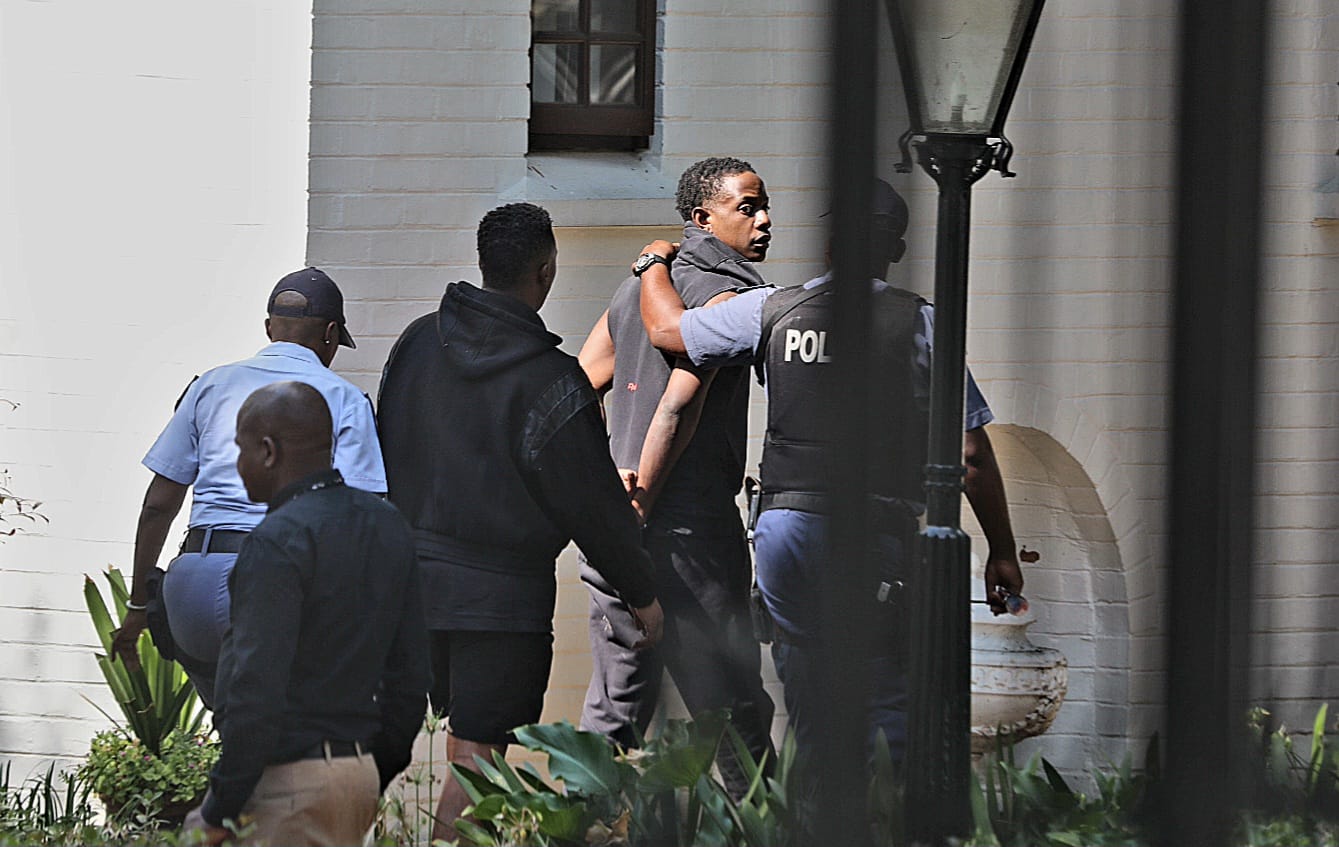
JOHANNESBURG — In the leafy, high-security enclave of Hyde Park, where the hum of electric fences and the discreet patrols of private security usually define the atmosphere, the silence was shattered on a Thursday afternoon. The quiet of one of Johannesburg’s most affluent suburbs was replaced by the clinical efficiency of the South African Police Service (SAPS) as they descended upon a luxury property.
At the centre of the storm was Bellarmine Chatunga Mugabe, the 28-year-old youngest son of the late Zimbabwean strongman Robert Mugabe. He was led away in handcuffs, leaving behind a trail of spent cartridges, a critically injured employee, and a growing cloud of diplomatic tension that threatens to test the limits of accountability for the continent’s former first family.
The incident, which occurred on February 19, 2026, has been described by police as a case of attempted murder. According to official reports, a 23-year-old man, believed to be a gardener or household employee at the property where Mugabe was staying, was shot once. The victim was rushed to a nearby hospital where he remains in a critical condition.
In the immediate aftermath of the shooting, the scene inside the house was one of chaotic defiance. Reports from the site suggest that Chatunga initially locked himself inside a room and refused to come out when SAPS officers arrived, a final, desperate attempt to maintain the shield of privilege that has protected him for most of his life.
Colonel Dimakatso Nevhuhulwi, a spokesperson for the Gauteng police, confirmed the arrest of Chatunga and one other unidentified man. Speaking to the media outside the property, Nevhuhulwi highlighted a significant hurdle in the investigation: the missing weapon. “The two suspects have not told us where the gun is; they are not saying anything about the gun,” she stated.
The absence of the firearm led to an intensive search of the grounds, involving K9 units and police divers who combed through the property’s swimming pool and garden, looking for the piece of evidence that could definitively link the accused to the crime. While bullet cartridges were recovered from the scene, the weapon itself remains a mystery, adding a layer of suspicion to an already murky situation.
For those living in the vicinity of the Mugabe residence, the sound of gunfire was not entirely unexpected. One security guard working in the area, who spoke on condition of anonymity, claimed that disturbances at the home were a recurring theme.
“Gunshots at the Mugabe home are frequent,” he remarked, painting a picture of a household where the rules of civil society seemed not to apply. This latest incident is not an isolated outburst but rather the latest chapter in a long history of legal skirmishes and allegations of violence that have followed Chatunga across borders.
|
Date
|
Location
|
Incident
|
Outcome
|
|
August 2024
|
Beitbridge, Zimbabwe
|
Assaulting a police officer and disorderly conduct
|
Arrested after a scuffle at a security checkpoint
|
|
July 2025
|
Zimbabwe
|
Alleged taser attack on a man
|
Court heard he tasered a victim for “not greeting him with respect”
|
|
February 2026
|
Johannesburg, SA
|
Shooting of a 23-year-old employee
|
Arrested on charges of attempted murder; investigation ongoing
|
The shadow of the Mugabe family’s past in South Africa looms large over this case. In 2017, Chatunga’s mother, Grace Mugabe, was accused of assaulting a young South African model, Gabriella Engels, with an extension cord in a luxury hotel room in Sandton. At the time, the South African government controversially granted her diplomatic immunity, allowing her to flee back to Harare and avoid prosecution. This decision was later overturned by a South African court in 2018, which ruled the immunity “unconstitutional and invalid.” An arrest warrant for Grace Mugabe remains active in South Africa, a fact that has created a poignant irony in the current crisis.
As Chatunga sits in a police cell, his mother remains in Zimbabwe, reportedly in a state of extreme distress. However, she is unable to travel to Johannesburg to support her son without facing immediate arrest herself. This “diplomatic silence” from the Zimbabwean government and the Mugabe family’s inner circle is deafening. In the past, the family could rely on the “kid gloves” treatment from regional allies, but the political landscape has shifted. The current administration in Harare has maintained a calculated distance, neither condemning nor defending the young Mugabe, perhaps wary of the public backlash that would follow any attempt to interfere in South Africa’s judicial process.
The investigation into the Hyde Park shooting is being watched closely as a litmus test for the South African justice system. Critics point to the slow pace of the Grace Mugabe case as evidence that the powerful often enjoy a different standard of justice. “Is there a concerted effort to suppress information, or are there deeper, more sinister forces at play?” is the question being whispered in the corridors of power. The fact that details remained scarce in the hours following the arrest, and the initial refusal of the police to officially name Chatunga despite his identity being common knowledge, suggests a high degree of sensitivity surrounding the case.
The narrative of Chatunga’s life is one of unbridled excess and a seemingly total disregard for the consequences of his actions. His presence in Johannesburg has been marked by a “lavish lifestyle” that stands in stark contrast to the economic devastation of his home country. In one infamous incident, he shared a video of himself pouring a bottle of Armand de Brignac “Ace of Spades” champagne—worth hundreds of pounds—over a diamond-encrusted watch that cost more than many Zimbabweans earn in a lifetime. This display of wealth was not just a sign of vanity; it was a signal of a generation that believed itself to be above the law.
“He is the poorest president the world over. I have never seen him asking for money from anyone,” Grace Mugabe once famously said of her husband, Robert. Yet, the reality of her sons’ lives in South Africa tells a different story—one of multimillion-pound properties, luxury vehicles, and a sense of entitlement that seemingly extends to the use of firearms against those they employ.
The victim of the shooting, a young man whose life now hangs in the balance, represents the collateral damage of this culture of impunity. While the Mugabe family navigates the complexities of diplomatic sensitivities and legal strategies, he remains in a hospital bed, a silent witness to a world of privilege that most South Africans and Zimbabweans can only imagine. The police have indicated that the two suspects are expected to appear in court “soon,” but the definition of “soon” often depends on the status of the accused.
Beyond the immediate crime, the shooting has reignited debates about the role of the Mugabe family in post-coup Zimbabwe and their continued influence in South Africa. For years, the Mugabes used Johannesburg as their playground, purchasing high-end properties and frequenting exclusive clubs. The city’s elite circles often turned a blind eye to their excesses, but the discharge of a firearm in a residential neighbourhood has crossed a line that even the most well-connected can find difficult to justify.
The “diplomatic silence” surrounding the case is particularly telling. Usually, the arrest of a high-profile foreign national would elicit a flurry of statements from their home government. In this instance, the silence from Harare suggests a strategic retreat. The Zimbabwean government, under President Emmerson Mnangagwa, has spent years trying to rebrand the country and distance itself from the Mugabe era’s more egregious scandals. Defending Chatunga in a South African court for an alleged shooting of a gardener would be a public relations disaster that the Mnangagwa administration can ill afford.
Furthermore, the legal complexities of the case are daunting. If the missing firearm is never found, the prosecution will have to rely on forensic evidence from the cartridges and eyewitness testimony. However, in cases involving the powerful, witnesses often become reluctant to speak, and evidence has a strange habit of being “misplaced.” The SAPS’s decision to bring in divers and K9 units indicates that they are taking no chances, aware that any lapse in procedure could be exploited by a high-priced legal team.
The broader implications for South Africa’s relationship with Zimbabwe are significant. Any perceived interference or “special treatment” for Chatunga could strain ties and provoke public anger in both nations. South Africa has often been accused of being too lenient with its northern neighbour’s ruling elite, but the brazen nature of a shooting in a residential suburb may have pushed the limits of that tolerance. The South African public, already frustrated by high crime rates and a perceived lack of accountability for the political class, is unlikely to accept anything less than a full and transparent trial.
As the layers of official silence are peeled back, the story that emerges is not just about a single night of violence in Hyde Park. It is a story about the intricate dynamics that govern justice when the powerful are involved. It is about whether the ghost of Robert Mugabe still carries enough weight to tilt the scales of justice, or if his youngest son will finally have to answer for his actions. For now, the investigation continues, the firearm remains missing, and the question of whether true accountability will ever be served remains unanswered.
The “Untold Story” of the Hyde Park shooting is still being written, but the opening chapters suggest a murky world where power and privilege collide with the cold reality of the law. Whether this case will end in a quiet diplomatic resolution or a high-profile trial remains to be seen. But for the 23-year-old man in a Johannesburg hospital, and for the millions of people who have watched the Mugabe family’s exploits from afar, the hope is that this time, justice will not be silenced.
In the coming days, the court proceedings will likely reveal more about what truly transpired on that fateful Thursday. Was it a moment of reckless rage, a calculated act of intimidation, or something even more sinister? As investigative journalists, our task is to keep asking the questions that the powerful would rather see buried. We will continue to follow the money, the connections, and the legal manoeuvres that will undoubtedly follow. Because in the end, the true measure of a society is not how it treats its most powerful members, but how it protects its most vulnerable.
The Mugabe name once commanded fear and respect across the continent. Today, it is increasingly associated with the sordid details of police reports and courtroom dramas. Chatunga Mugabe’s arrest may be the end of an era of impunity, or it may just be another entry in a long list of scandals that eventually fade from the headlines. But as long as there are those willing to peel back the layers of silence, the truth will have a way of surfacing. The story of the Hyde Park shooting is far from over, and the world is watching to see if the rule of law will finally apply to the sons of presidents.