


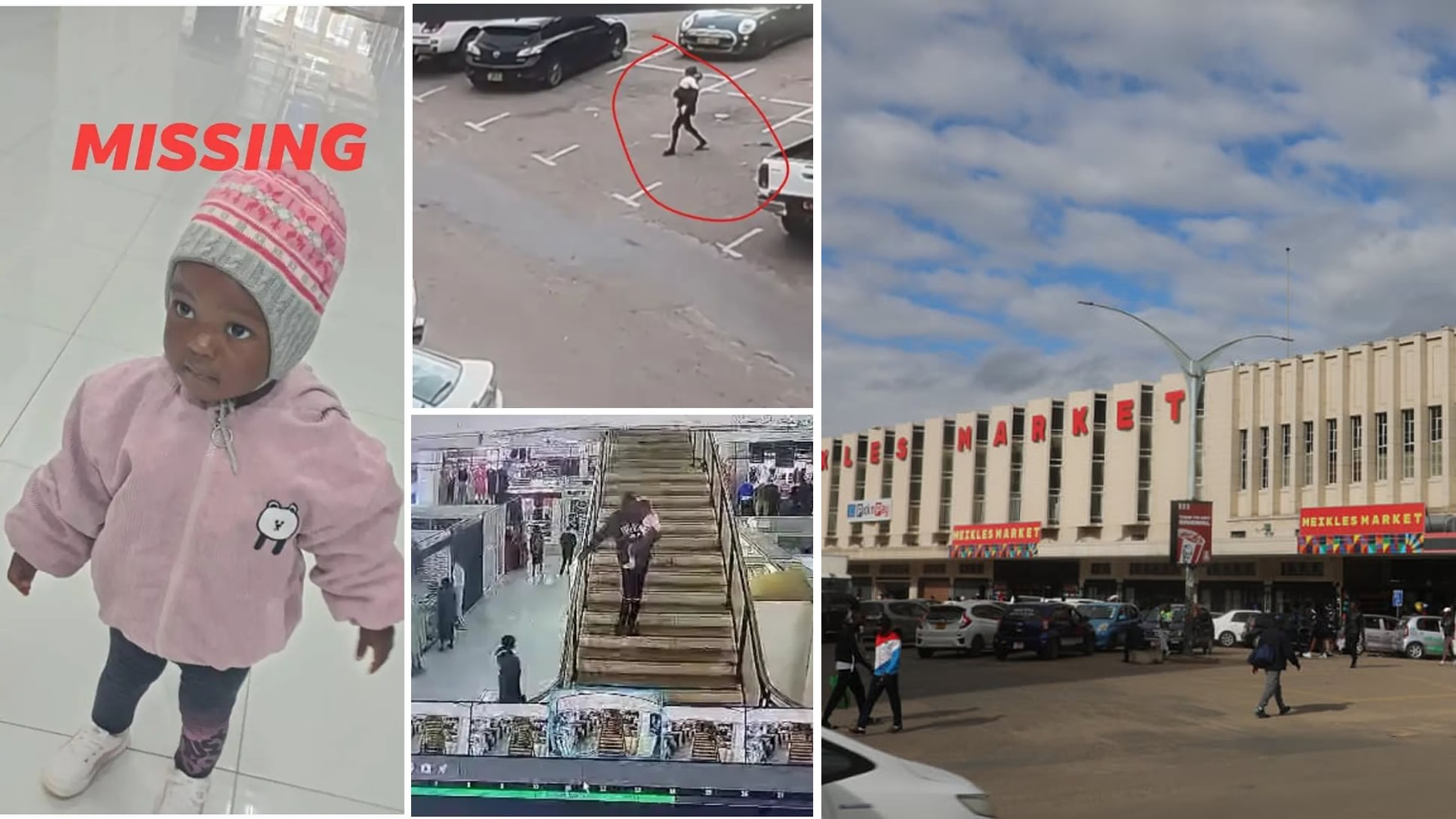
Bulawayo breathed a collective sigh of relief on Thursday, 19 February 2026, as two-year-old Asanda Ndhlovu, who had been snatched from Meikles Mall just two days prior, was found alive and well in a city flat. Her miraculous return brought a dramatic end to a frantic search and ignited celebrations amongst her family and the wider community. However, beneath the surface of this seemingly happy ending, a deeper, more unsettling narrative unfolds. Our investigative team has uncovered glaring security lapses at the shopping centre and hints at a more sinister operation at play, suggesting that Asanda’s swift return may be less a stroke of luck and more a calculated move in a disturbing game.
The Disappearance: A Mother’s Anguish and Missing Minutes
The ordeal began on Tuesday, 17 February 2026, at approximately 9:00 AM, when Asanda was with her mother at Meikles Mall in Bulawayo’s Central Business District. The mother, attending to customers at her stall, momentarily turned away, and in that fleeting instant, her child vanished. The initial confusion quickly escalated into panic as frantic searches yielded no trace of the toddler. Asanda’s aunt, Sandisiwe Sibanda, recounted the harrowing moments, stating, “The mother was attending to a customer, and when she turned back, the child was no longer there. She immediately started asking around at neighbouring stalls, hoping that someone had seen her, but no one could give a clear answer. Panic quickly set in.” The child’s grandfather, Bhekekhaya Hadebe, expressed the family’s profound distress, describing the incident as a “painful tragedy.” He appealed to the public for assistance, saying, “It is devastating to lose a child in such circumstances. We are appealing to anyone who might have information to help us find our granddaughter.”
Bulawayo police spokesperson, Inspector Nomalanga Msebele, confirmed the incident, detailing the initial findings. “The complainant asked her workmates and no one saw the child. She then checked at the mall CCTV office.” It was in the mall’s CCTV footage that the horrifying truth began to emerge. The footage captured an unidentified man, clad in a brown hooded jacket and blue work-suit trousers, lifting the child and exiting the mall. Inspector Msebele noted that “The man’s face was not visible.” This crucial detail, coupled with the ambiguity surrounding the exact time of abduction—some reports citing 9:00 AM, others 10:30 AM—raises immediate questions about the effectiveness and clarity of the mall’s surveillance system. The phrase “missing minutes” from the mall’s CCTV footage, as hinted by sources, suggests potential gaps or blind spots in the security coverage, allowing the perpetrator to operate with a degree of impunity.
The Return: A Calculated Release or a Failed Attempt?
Asanda’s discovery on Thursday morning was a testament to community vigilance and the swift actions of two private security technicians. A tip-off from a vigilant member of the public led these technicians, who specialise in installing Closed Circuit Television systems, to a city flat. One technician explained, “The informer said she suspected the toddler was somewhere at a flat but wanted to get a closer view of the CCTV footage. We showed the informer a clearer footage and she confirmed that it was her she had seen. We immediately contacted CID Homicide who sprang to action and drove to the flat and true to the informant, the toddler was found.” A woman believed to be the kidnapper was arrested at the scene. While the police have confirmed the rescue and arrest, full details are yet to be released, leaving many questions unanswered about the circumstances of Asanda’s return.
The speed of Asanda’s return, just hours after her abduction, is particularly perplexing. Why would kidnappers, having successfully taken a child from a busy public space, abandon their prize so abruptly? This swift release fuels the theory, whispered within local security circles, of a “snatch-and-grab” syndicate. These syndicates, it is believed, may not always intend long-term abduction or trafficking. Instead, they might be testing the response times and capabilities of both private security firms and the Zimbabwe Republic Police (ZRP). A quick abduction followed by an equally quick release, especially if the child is unharmed, could serve as a reconnaissance mission, identifying vulnerabilities in security systems and assessing the efficiency of law enforcement. This chilling possibility suggests that the “happy ending” for Asanda could be a smokescreen, masking a much larger, unresolved threat to child safety in public spaces.
Security Lapses and the Shadow of Child Trafficking
The incident at Meikles Mall has starkly exposed significant security vulnerabilities within urban shopping centres. The initial difficulty in identifying the perpetrator from CCTV footage, coupled with the implied “missing minutes,” points to a need for urgent upgrades in surveillance technology and protocols. The reliance on private security technicians, rather than immediate police action, for the crucial breakthrough in locating Asanda further highlights potential gaps in the coordinated response mechanisms between private entities and law enforcement.
This isolated incident, however, cannot be viewed in a vacuum. It resonates with a terrifying reality of child safety in Zimbabwe, where the spectre of child trafficking looms large. The 2025 Trafficking in Persons Report by the US State Department indicates that Zimbabwe does not fully meet the minimum standards for the elimination of trafficking. The report highlights the exploitation of Zimbabwean adults and children in sex trafficking and forced labour, including in cattle herding, domestic service, and mining. Recent incidents, such as the interception of undocumented minor children at the Beitbridge Port of Entry in January 2026, and the global Interpol operation “Liberterra III” in November 2025, which led to thousands of arrests for human trafficking and migrant smuggling, underscore the pervasive nature of this crime.
While the Beitbridge interceptions were initially linked to high travel costs rather than trafficking, the broader context of vulnerability remains. The ease with which Asanda was taken from a public mall, even if returned, serves as a stark reminder of how easily children can become targets. The “snatch-and-grab” syndicate theory, if proven true, suggests a sophisticated network operating with a clear understanding of security weaknesses and a chilling disregard for human life.
The Uncomfortable Truth: Vigilance is Paramount
The technical aspects of mall surveillance, often perceived as impenetrable, can be surprisingly fragile. A simple hooded jacket can obscure identity, and strategic blind spots can render even extensive camera networks ineffective. The psychology behind such crimes, particularly if they are indeed tests of response times, is deeply disturbing. It implies a methodical approach to exploiting vulnerabilities, with children as collateral in a larger criminal enterprise. This incident forces us to confront an uncomfortable truth: our children might be less safe than we think, even in seemingly secure public spaces.
The swift return of Asanda Ndhlovu is undoubtedly a cause for celebration for her family. Yet, it is imperative that this joyous outcome does not obscure the underlying issues that allowed the abduction to occur in the first place. The “happy ending” may indeed be a smokescreen for a much larger, unresolved threat lurking in our public spaces. It is a call to action for improved security protocols, enhanced inter-agency cooperation, and heightened public vigilance. Only by addressing these systemic weaknesses can we truly safeguard our children from the shadows of such sinister operations.