


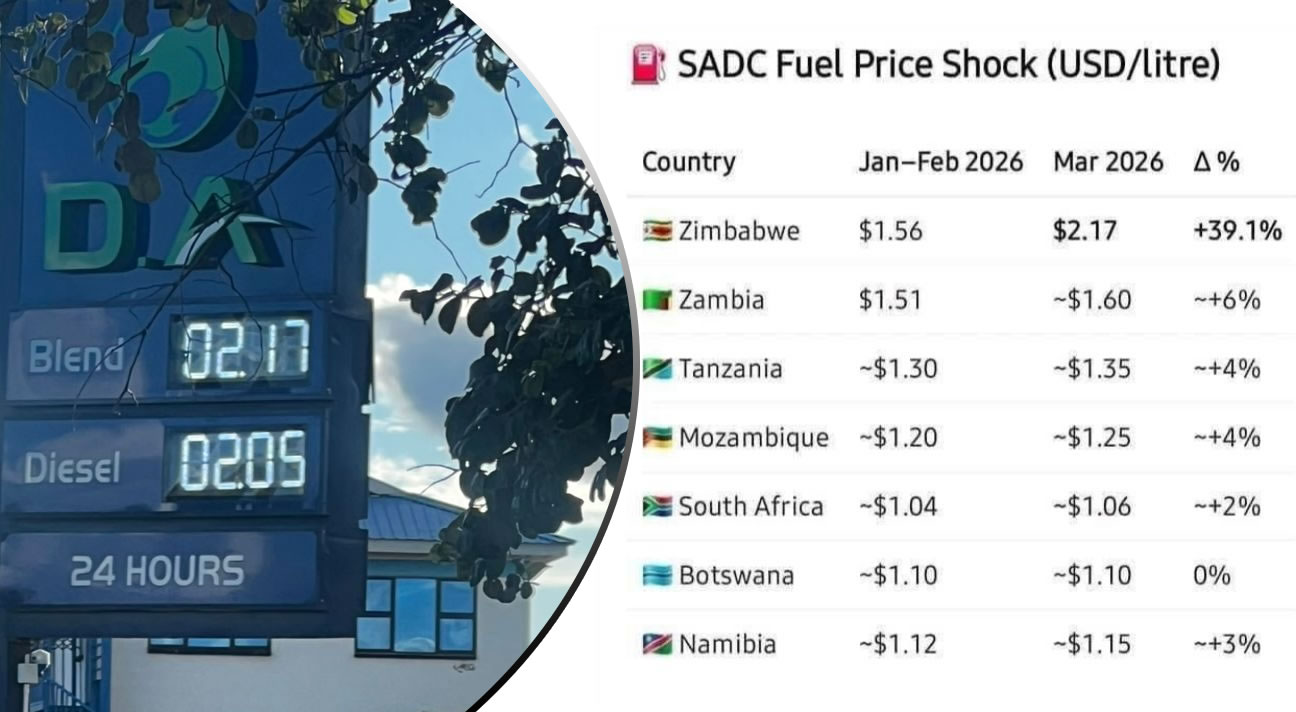
Zimbabweans are once again grappling with soaring fuel prices, a burden that has become a recurring nightmare for a populace already facing immense economic hardship. The latest surge, announced by the Zimbabwe Energy Regulatory Authority (ZERA) on 18 March 2026, pushed diesel to $2.05 per litre and petrol blend to an astonishing $2.17 per litre. These figures represent increases of 15.8% and 26.9% respectively, making Zimbabwe’s fuel among the most expensive in Sub-Saharan Africa, second only to Malawi. This stark reality contrasts sharply with the situation in neighbouring countries, where prices remain significantly lower, prompting a deeper investigation into the true drivers behind Zimbabwe’s exorbitant fuel costs.
The official narrative often points to global factors, particularly the Middle East conflict, as the primary culprit. ZERA, in its justification for the March 2026 hikes, cited rising global oil costs linked to escalating tensions and conflict in the Middle East. However, a closer examination reveals that this explanation may serve as a convenient smokescreen for more insidious domestic issues. Tendai Ruben Mbofana, a prominent social justice advocate and writer, unequivocally states, “The claim that this is due to global conflict is a transparent lie because if the Middle East were truly the primary driver, we would see a uniform surge across the SADC region rather than this localized Zimbabwean catastrophe”. This sentiment is echoed by Equity Axis, which suggests that the government is “using a global cost shock as cover for a domestic fiscal expansion”.
To understand the disparity, it is crucial to compare Zimbabwe’s fuel prices with those of its regional counterparts. While Zimbabweans are paying $2.17 for a litre of petrol, motorists in South Africa are paying approximately $1.27, in Zambia around $1.40 to $1.60, and in Botswana between $1.10 and $1.26. Even landlocked Zambia, which faces similar logistical challenges, manages to maintain significantly lower prices. This regional anomaly strongly suggests that factors beyond global oil prices are at play, pointing towards a complex web of domestic policies, levies, and monopolistic practices.
The Opaque Web of Taxes and Levies
The true burden on Zimbabwean consumers becomes evident when dissecting the fuel price build-up provided by ZERA. For every litre of petrol sold at $2.17, a staggering $0.8570 is attributed to various taxes and levies. This figure alone represents nearly 40% of the pump price, a substantial increase from the $0.5209 in early March 2026. The individual levies that contribute to this exorbitant cost include a carbon tax of $0.04, a Zinara road levy of $0.0200, a petroleum levy of $0.0050, a PZL pipeline levy of $0.0200, and an import duty of $0.3000. These are not single, consolidated taxes but a cumulative stack, each justified by a different policy rationale, yet collectively placing an immense strain on the consumer.
Mbofana critically observes that the government has transformed the fuel pump into a primary taxation instrument, describing it as a “parasitic arrangement where the state secures its revenue by strangling the productive sectors of the economy”. He argues that when such a significant portion of the pump price consists of government-imposed fees, the “cost pressures” cited by the regulator are, in fact, self-inflicted. This situation highlights a fundamental flaw in the pricing model, where the state prioritises revenue generation over the economic well-being of its citizens.
The Ethanol Monopoly: A Domestic Policy Burden
Beyond the multitude of taxes, another significant contributor to Zimbabwe’s inflated fuel prices is the mandatory ethanol blending policy and the associated monopoly. The ZERA build-up for petrol includes an ethanol cost of $1.10 per litre. This figure is nearly double the global market price for fuel ethanol, which typically ranges from $0.55 to $0.60 per litre. This premium, approximately $0.50 to $0.55 per litre of ethanol, when applied to the 5% blend ratio, adds an estimated $0.025 to $0.028 to the pump price of every litre of blended petrol.
This is not a global cost but a domestic policy-protected expense. The ethanol supply market in Zimbabwe is dominated by a duopoly, with Green Fuel and Triangle operating under a captive supply arrangement. This lack of competition, coupled with a government-mandated blending policy, allows these suppliers to charge exorbitant rates. Mbofana asserts that Zimbabweans are “forced by law to subsidize the immense wealth of individuals like Billy Rautenbach at the expense of every Zimbabwean”. The refusal to liberalise the ethanol market or permit cheaper imports is a clear indication that the interests of a select few are prioritised over the broader public good. Opening this market to competition could lead to immediate and substantial savings for consumers.
The Unrehabilitated Feruka Pipeline: A Missed Opportunity
Another critical factor contributing to the high cost of fuel is the underutilisation and unrehabilitated state of the Feruka pipeline, which runs from Beira in Mozambique to Harare. Currently, a significant portion of Zimbabwe’s fuel is transported overland by road from Beira and Durban, incurring additional trucking costs. While the existing operational pipeline contributes $0.0589 per litre to the fuel build-up, a fully rehabilitated Feruka pipeline could reduce the per-litre transport cost by approximately $0.07 permanently.
The estimated capital cost for rehabilitating the Feruka pipeline is around $200 million. Given Zimbabwe’s current fuel consumption, projected to reach 2.5 billion litres in 2026, this $0.07 saving translates to an annual cost relief of $175 million. The payback period for such an investment would be just over one year. Despite these compelling economic arguments, the Feruka pipeline remains unrehabilitated, a topic of discussion for years without concrete action. This inaction suggests a reluctance to disrupt the existing distribution networks, which may benefit those currently controlling the road transport of fuel. The Mozambican government did revoke the concession to operate the Beira-Zimbabwe oil pipeline in November 2023, which could potentially open avenues for new operators or rehabilitation efforts. However, the benefits are yet to be realised by the Zimbabwean consumer.
The “One-Way Ratchet” of Replacement Cost Pricing
ZERA employs a replacement cost pricing model, designed to ensure that fuel is priced based on the current international cost of replacing stock, rather than its historical purchase price. In a rising global oil price environment, this model quickly passes on cost increases to consumers, as observed in February and early March 2026 when the “Iran war premium” pushed Brent crude above $100 per barrel.
The credibility of this model, however, is tested by its ability to pass price decreases through with equal speed when global prices fall. The March 18 price increase occurred even as Brent crude retreated from its peak above $100 towards below $95. If global prices continue to fall and ZERA’s pricing does not reflect this downward trend, it suggests that the replacement cost model functions as a “one-way ratchet”—quick to increase prices but slow to decrease them. This mechanism further exacerbates the burden on consumers, as they absorb global price hikes without fully benefiting from subsequent reductions.
The Cartel’s Shadowy Influence
While the term “fuel cartel” is not explicitly used by ZERA, the evidence points towards a system that benefits a select few at the expense of the broader population. The “middlemen” and “administrative levies” that inflate the cost of every litre, coupled with the government’s apparent hesitation to liberalise the pipeline, paint a picture of entrenched interests. The historical involvement of entities like Sakunda Holdings, previously in partnership with Trafigura, in controlling fuel imports and distribution, further fuels these suspicions. Although Trafigura took 100% control of its Zimbabwe fuel import business from Sakunda Holdings in 2020, the legacy of such arrangements and the continued lack of transparency in the sector raise questions about who truly benefits from the current pricing structure.
Economic Ripple Effects and the Path Forward
The consequences of Zimbabwe’s predatory fuel pricing are far-reaching. Fuel is the lifeblood of any economy, and its exorbitant cost directly impacts transport, manufacturing, and ultimately, the price of basic goods. Mbofana warns of an impending “massive inflationary wave that will wipe out the meager savings of the working class,” leading to increased food insecurity and desperation. The government’s claims of single-digit inflation become hollow in an environment where the most fundamental economic input is the most expensive in the region.
To address this crisis, a radical overhaul of domestic fuel policy is imperative. Firstly, a significant reduction in the taxes and levies that inflate fuel prices is crucial. If other regional governments can maintain lower tax thresholds to protect their citizens, Zimbabwe can and should do the same. Secondly, the mandatory blending policy must be reviewed, and the ethanol monopoly dismantled to foster competition and ensure fair pricing. Finally, there needs to be greater transparency in the fuel procurement process, potentially through a public audit of entities like the National Oil Infrastructure Company of Zimbabwe and Petrotrade, to identify and eliminate leakages. The rehabilitation of the Feruka pipeline also presents a clear, actionable path to long-term cost reduction.
In conclusion, the narrative of global conflict as the sole driver of Zimbabwe’s high fuel prices is incomplete and misleading. A deeper investigation reveals a complex interplay of excessive domestic taxes, monopolistic practices in ethanol supply, and a reluctance to invest in critical infrastructure like the Feruka pipeline. These factors collectively contribute to a pricing structure that disproportionately burdens Zimbabwean citizens, enriching a select few while stifling economic growth. It is time for the authorities to move beyond convenient excuses and implement genuine reforms that prioritise the welfare of the nation over vested interests.