


BEITBRIDGE – The hum of the diesel engines at the Beitbridge Border Post is a constant, rhythmic reminder of Zimbabwe’s economic lifeline. Hundreds of fuel tankers rumble through this gateway every week, their massive silver hulls supposedly carrying the lifeblood of the nation’s industry. Yet, beneath the surface of this logistical dance lies a sophisticated “cyber-economic” crime that is draining the national purse of millions of dollars every month. In a follow-up to our extensive fuel cartel investigation, we can now reveal the “high-tech” side of the smuggling trade — a world where “ghost tankers” vanish into thin air and multi-million dollar scanners are rendered blind by the flick of a switch.
Our sources within the security services and the Zimbabwe Revenue Authority (ZIMRA) have pulled back the curtain on a “new frontier” of crime. Smugglers are no longer merely relying on hidden compartments or midnight border crossings at undesignated points. Instead, they are using “signal jammers” and “cloned documents” to bypass the very technology designed to stop them. This is not just about avoiding taxes; it is a highly coordinated effort involving international syndicates that provide the technology and the “know-how” to local cartels. It is a “conspiracy” of silence that exposes why the government’s “digitalisation” efforts are failing to stop the rot.
The scale of this scandal is not the work of ordinary, desperate individuals trying to make ends meet. It is a trade dominated by the “who’s who” of Zimbabwe—the senior government officials and political elites who possess the intimate knowledge of the state’s internal systems. These are the individuals who know exactly where the loopholes lie because, in many cases, they were the ones who helped create them. While some within the administration are genuinely trying to fix these gaps, others are busy poking more holes to ensure they can continue looting and engaging in illicit activities to further enrich themselves.
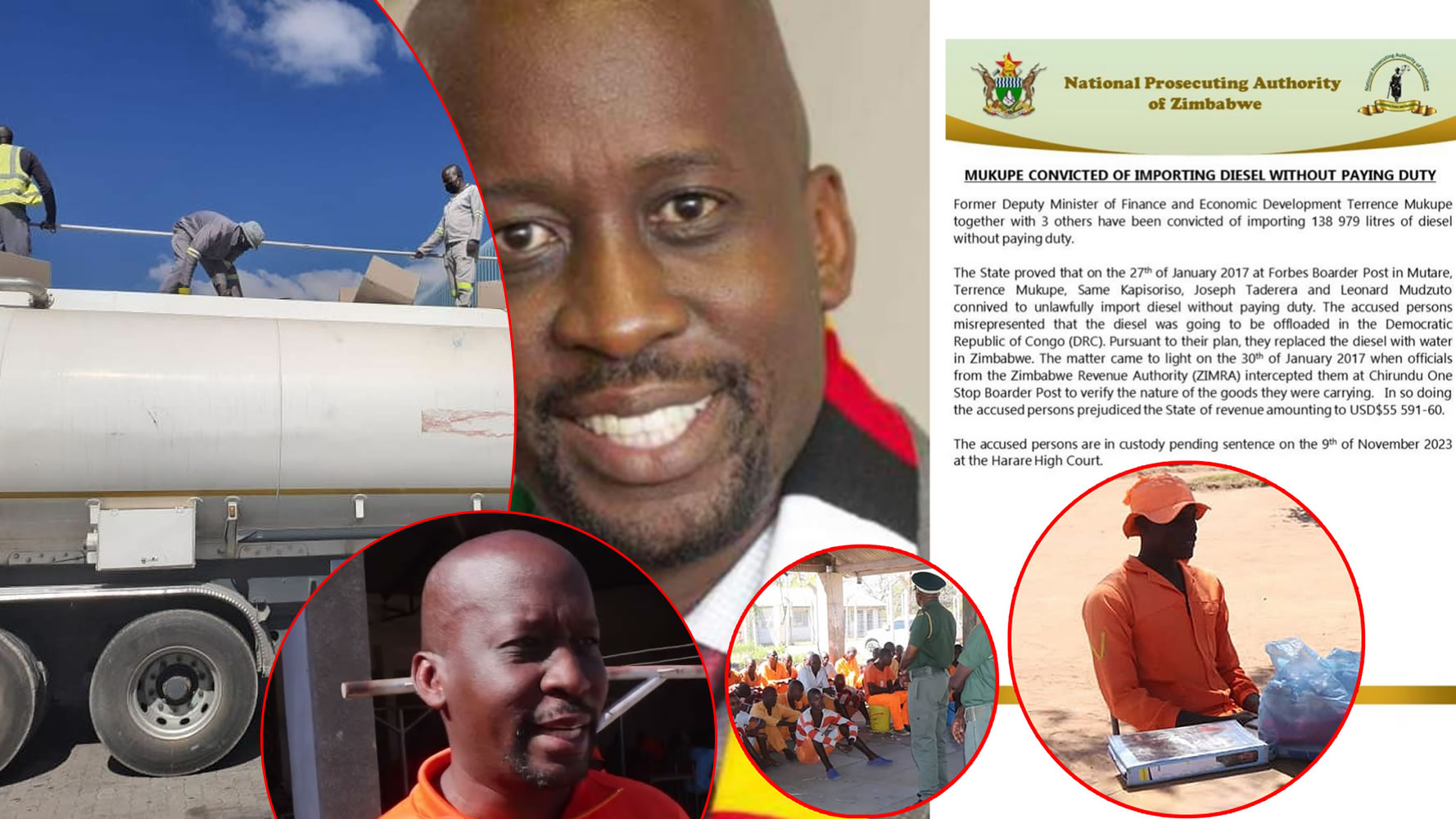
In January 2017 during President Robert Mugabe’s ‘old dispensation’, four tankers carrying a combined 138,979 litres of diesel entered Zimbabwe through the Forbes Border Post in Mutare. The paperwork, however, told a different story. Mukupe and his three accomplices — Same Kapisoriso, Joseph Taderera, and Leonard Mudzuto — misrepresented the destination of the fuel, claiming it was in transit to the Democratic Republic of Congo (DRC). By declaring the fuel as transit cargo, they were able to evade the payment of duty amounting to approximately US$55,600.
The plan was as sophisticated as it was simple: the fuel was to be offloaded in Zimbabwe, where it would be sold at a massive profit, and the tankers would then be filled with water to maintain the appearance of being loaded. When the trucks reached the Chirundu Border Post, ZIMRA officials and been tip-off, so they intercepted them. To their astonishment, the tankers were indeed filled with water. The “ghost tankers” had successfully “vanished” their diesel cargo into the local market, but they hadn’t counted on the vigilance of a few uncorrupted officers.
Mukupe was sentenced to an effective three years in prison and ordered to pay a fine of US$12,780. During the sentencing, High Court judge Benjamin Chikowero noted the gravity of the offence, highlighting that such crimes undermine the very foundations of the national economy. Yet, for many observers, Mukupe’s conviction was the exception rather than the rule. It is widely believed that such high-profile figures only face the “mighty wrath of the law” when they cross the wrong political line or fall out of favour with the powers that be.
To understand the scale of the problem, one must first look at the “ghost tanker” phenomenon. A source close to the border operations explained the process with chilling simplicity: “A tanker enters the country, supposedly in transit to Zambia or Malawi. It is fitted with an electronic seal, part of ZIMRA’s Electronic Cargo Tracking System (ECTS), which is meant to monitor its every move via satellite. But once it clears the initial checkpoint, the ‘ghost’ begins its work.”
The “ghost” is often a signal jammer, a small but powerful device that disrupts the ECTS seal’s ability to communicate with the ZIMRA control room. While the system shows the truck as stationary or moving along a pre-approved route, the driver is actually diverting to a private depot. There, the fuel is offloaded—a process known as “decanting”—and replaced with water or contaminated low-grade oil. By the time the tanker reaches the exit border at Chirundu or Victoria Falls, it appears to be a legitimate transit vehicle. The water inside provides the necessary weight and density to fool basic checks, allowing the “ghost tanker” to disappear from the system without leaving a trace of its true cargo.
The sheer audacity of these operations was further highlighted in November 2021, when ZIMRA launched an advanced mobile fuel testing system. During a test run at the Chirundu One Stop Border Post, officials intercepted a tanker that had declared its load as fuel at the Forbes Border Post. When the new equipment—comprising hydrometers, measuring cylinders, and water-detecting pastes—was applied, the truth emerged: the 39,754-litre tank was filled with water. The state had been prejudiced of over a million dollars in revenue in a single trip.
“The newly acquired fuel testing equipment comprises of hydrometers, measuring cylinders, dip sticks, dipping pastes and water pastes,” ZIMRA stated at the time, hailing it as a “game changer.” Yet, years later, the smuggling continues, driven by the involvement of “insiders” within the revenue authority. Our investigation found that for a “ghost tanker” to successfully navigate the system, it requires more than just a signal jammer; it requires a “cloned document.”
Cloned documents are high-quality forgeries of legitimate import permits and clearing papers. They often use the names of reputable companies or existing consignments to create a paper trail that looks flawless to the naked eye. In some cases, the documents are not even forgeries but legitimate papers reused multiple times through the collusion of corrupt officials who “forget” to stamp them or clear them from the digital ledger. A recent court case in February 2026 highlighted this method, where an individual named Makombe was accused of using company documents on 11 separate occasions between January and May 2025 to misrepresent diesel imports, defrauding the state of US$495,000.
The technology used to bypass the scanners is not locally grown. International syndicates, often with roots in South Africa, Mozambique, and even further afield, are the architects of this “cyber-economic” warfare. They provide the jammers, the software for document cloning, and the strategic planning required to move thousands of litres of fuel across borders without detection. This international connection is what makes the local cartels so resilient. When ZIMRA introduces a new security measure, the syndicates provide a counter-measure within weeks.
The government’s investment in technology has been significant. In 2014, Zimbabwe received high-tech scanners worth US$105 million from China. These mobile and relocatable X-ray scanners were intended to be the ultimate deterrent. “This scanner technology allows ZIMRA to target high risk cargo for examination whilst low risk is quickly released,” a ZIMRA official noted during a modernization update. However, the “high-tech” scanners are only as good as the people operating them.
“If the operator is in on the deal, the scanner image of a fuel tank filled with water can be marked as ‘consistent’ with a petrol declaration,” whispered a former clearing agent who spoke on condition of anonymity. “The technology is there, but the human element is the weak link. The cartels don’t just jam the signals; they jam the minds of the officials with bribes that far exceed their monthly salaries.”
The incentive for smuggling has only increased in recent months. As of April 2026, the price of petrol in Zimbabwe has jumped to US$2.23 per litre, driven by escalating tensions in the Middle East. This price hike has created a massive profit margin for smugglers who bring in cheap, untaxed fuel from neighbouring countries or divert transit fuel meant for export. The “digitalisation” of the border was meant to create a transparent, paperless system that would eliminate corruption. Instead, it has created a new playground for those with the technical “know-how” to manipulate the digital landscape.
The failure of these systems is a sobering look at the limitations of technology in the face of deep-seated corruption. While ZIMRA continues to announce “crackdowns” and “zero tolerance” policies, the reality on the ground is a sophisticated game of cat and mouse. The “ghost” in the machine is not a glitch; it is a deliberate, engineered bypass of the national interest.
“The Authority is in the process of conducting investigations on how the fuel was substituted with water. The investigations will include importers, transporters, Customs Clearing Agents and ZIMRA officials,” ZIMRA promised after the 2021 Chirundu bust. Yet, the “conspiracy” of silence remains largely intact. The millions of dollars leaking out of the national purse every month are not just numbers on a spreadsheet; they represent hospitals without medicine, schools without books, and a nation struggling to breathe under the weight of economic sabotage.
The involvement of senior officials like Mukupe proves that this is not just a border security issue; it is a political one. It shows a systemic failure where those entrusted with the nation’s finances are the very ones leading the charge to deplete them. While the common citizen struggles to pay for a few litres of fuel, the “who’s who” are becoming filthy rich by siphoning off the country’s resources. They move with an air of invincibility, protected by their political connections and their deep understanding of the systems they exploit.
As the sun sets over the Beitbridge border, another convoy of tankers prepares to move. Somewhere among them, a “ghost” is likely waiting to be activated. The scanners will hum, the ECTS seals will blink, and the digital ledgers will record their passage. But in the shadows of the “new frontier” of crime, the truth remains hidden. It is a world where the lines between the regulator and the regulated have blurred, and where the only law that truly matters is the law of political survival.
This story simplifies the complex world of border logistics and revenue collection, but the underlying reality is anything but simple. It is a battle of technology versus greed, and for now, the smugglers appear to be one step ahead. The question remains: how much longer can Zimbabwe afford to let its wealth vanish into the “ghost” world of the fuel cartels? Until the “insiders” are truly purged and the political protection of these syndicates is dismantled, the machine will continue to be haunted by the very ghosts it was built to exorcise. The “mighty wrath of the law” must be applied equally, not just to those who cross a political line, but to everyone who crosses the line of legality.