


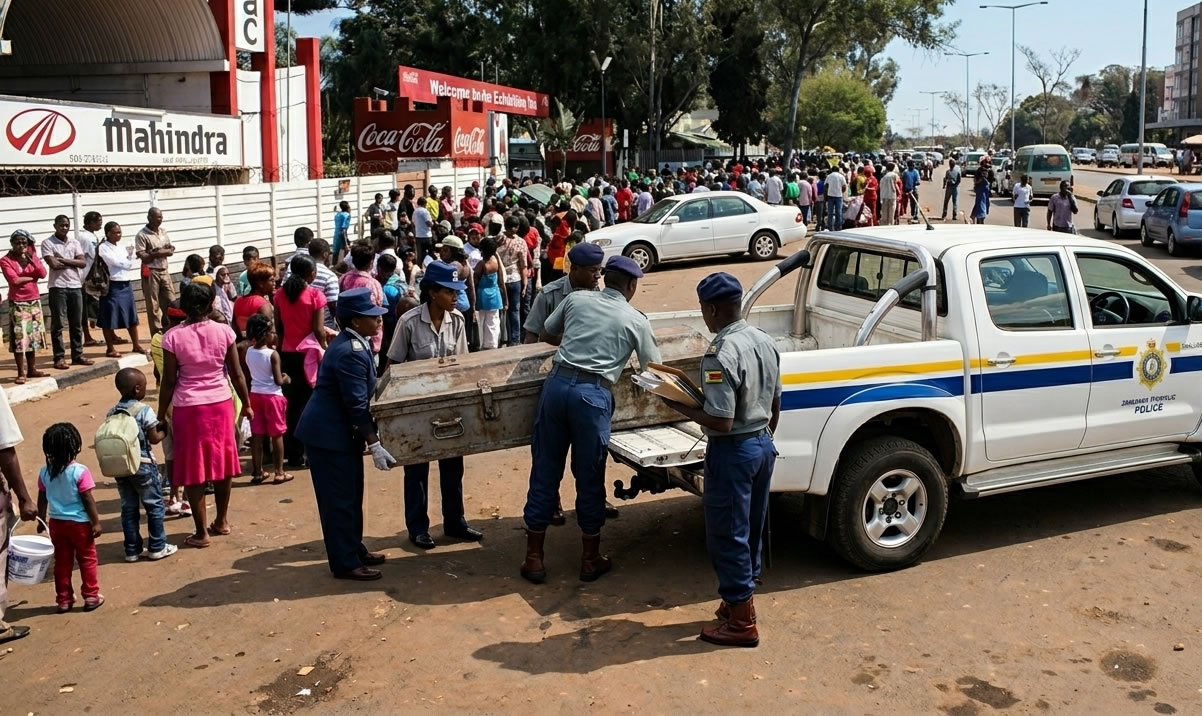
The asphalt on Samora Machel Avenue was still warm when the life of a 45-year-old pedestrian was extinguished in the early hours of 28 March 2026. According to police reports, a Nissan Hardbody swerved violently, striking the man and dragging his body for approximately 20 metres beneath the chassis. The driver did not stop. He did not check for a pulse. He simply accelerated into the dawn, leaving a mangled corpse as a grim testament to a growing national crisis. While 48-year-old Everson Masuka was eventually apprehended two days later, his case is a rare exception in a country where the “hit-and-run” has evolved from a tragic accident into a calculated escape strategy for the well-connected.
Zimbabwe is currently grappling with what can only be described as a hit-and-run pandemic. Recent data from the first quarter of 2025 revealed a staggering 15,263 road accidents, marking a 15 per cent increase from the previous year. Within these statistics lies a darker trend: a surge in motorists fleeing the scene of fatal collisions. Commissioner Paul Nyathi, the national police spokesperson, has publicly expressed alarm over this “culture of impunity,” noting that dozens of fatal hit-and-run cases are recorded during every major holiday period. Yet, for the families of the victims, the arrest of a driver like Masuka offers little comfort when compared to the dozens of “high-profile” names that seem to vanish into the judicial ether.
The “conspiracy of silence” surrounding certain names is not merely a conspiracy theory; it is a lived reality for those seeking justice. Our investigation into the Zimbabwean judicial system reveals a disturbing pattern where cases involving the elite are often “settled” behind closed doors or mysteriously lost in the labyrinth of the courts. This report dives deep into the legal frameworks that some argue are rigged in favour of those with deep pockets, and the stories of the families left to pick up the pieces.
A Two-Tiered Justice System
In the eyes of the law, every person who kills another on the road is liable for prosecution under Section 49 of the Criminal Law (Codification and Reform) Act, which governs culpable homicide. However, the application of this law appears to vary significantly based on the social standing of the accused. For the average Zimbabwean, a fatal accident often results in immediate detention and a harrowing trial. For the elite, the experience is markedly different.
Consider the case of Russell Goreraza, the eldest son of former First Lady Grace Mugabe. In 2015, Goreraza was convicted of culpable homicide after knocking down and killing a pedestrian in Harare. The sentence? A mere $800 fine. At the time, the court’s decision was met with public outrage, yet it set a precedent for leniency that continues to haunt the legal system today. More recently, in early 2026, socialite and car dealer Matthew Musengezi was acquitted of culpable homicide charges, receiving only a 30-day driving ban.
|
Case Study
|
Individual Involved
|
Outcome
|
Penalty Imposed
|
|
Harare Pedestrian Death (2015)
|
Russell Goreraza
|
Convicted
|
$800 Fine
|
|
High-Profile Collision (2026)
|
Matthew Musengezi
|
Acquitted
|
30-day Driving Ban
|
|
Samora Machel Fatality (2026)
|
Everson Masuka
|
Pending Trial
|
Remanded in Custody
|
|
Military Vehicle Crash (2026)
|
Ministry of Defence
|
Civil Liability
|
US$116,000 Damages
|
The disparity in these outcomes suggests that the legal framework for culpable homicide may be too lenient for those who can afford high-end legal representation. Legal experts argue that the courts generally spare offenders from jail time unless “gross negligence” is proven beyond a reasonable doubt. For the wealthy, “reasonable doubt” is a commodity that can be purchased through expensive counsel and out-of-court settlements that effectively silence grieving families.
The Role of the Police: Selective Efficiency?
One of the most pressing questions in this investigation is the role of the Zimbabwe Republic Police (ZRP). Why are some drivers, like Masuka, caught within 48 hours, while others remain “unidentified” for months despite the presence of CCTV and multiple witness accounts?
In many urban centres, particularly Harare and Bulawayo, the proliferation of private security cameras and dashcams should, in theory, make it nearly impossible for a hit-and-run driver to remain anonymous. Yet, time and again, investigations into accidents involving luxury SUVs or vehicles with “influential” plates seem to hit a brick wall. Witnesses often speak of being intimidated or told that the “matter is being handled at a higher level.”
“We saw the car. It was a black Range Rover with no plates,” says one witness to a 2025 accident on the Bulawayo-Plumtree Road, who requested anonymity for fear of retribution. “The police arrived, took some notes, and we never heard anything again. It’s like the person never existed.”
This selective efficiency creates a vacuum of accountability. While the ZRP continues to issue statements urging motorists to stop and assist at accident scenes, the reality on the ground is that those with the right connections know that fleeing is often their best chance of avoiding a criminal record.
The Victims: Fighting a Rigged System
Behind every statistic is a family shattered by loss. We profiled several victims of these “road killers” to understand the human cost of this impunity. The stories are heart-wrenching, characterized by a common thread: a desperate fight for justice against a system that seems designed to fail them.
Ronald Mujuru’s story is particularly poignant. He lost his wife and five children in a horrific road accident. In a move that captured national attention, socialite Sir Wicknell Chivayo stepped in to provide Mujuru with $50,000 and a new Toyota Fortuner. While the gesture was hailed as charitable, critics pointed out that such private philanthropy should never be a substitute for state-delivered justice. For many, it highlighted the “monetisation” of grief—where the loss of life is compensated with cash and cars rather than the imprisonment of the reckless.
The Marerwa family, who lost seven members in a single horror crash, and the family of Enock Chanengeta, killed alongside his wife in Dzivarasekwa, represent the thousands of Zimbabweans who do not receive socialite-funded windfalls. They are left to navigate a judicial system where “lost files” and “postponed hearings” are the norm.
“The leniency of our courts is an insult to the victims and their grieving families. Handing down community service or paltry fines for culpable homicide does nothing to deter the next reckless driver who thinks their money makes them invincible,” stated a recent editorial in The Herald.
A Culture of Impunity
The “hit-and-run pandemic” is not just a road safety issue; it is a symptom of a deeper “culture of impunity” that has taken root in Zimbabwe. When the well-connected are allowed to treat the nation’s roads as a private playground, the message to the public is clear: your life is worth less than their convenience.
The legal framework, as it stands, offers too many loopholes. Section 49 of the Criminal Law Code allows for a wide range of sentencing options, often giving magistrates the discretion to impose fines instead of custodial sentences. For a billionaire or a high-ranking official, a $200 fine is not a punishment; it is a transaction fee for a life taken.
Furthermore, the Road Traffic Act [Chapter 13:11] places a clear duty on drivers to stop and assist. Yet, the penalties for failing to do so are rarely applied with the severity required to change behaviour. If the risk of fleeing is lower than the risk of staying and facing a breathalyser or a background check, the choice for the reckless is obvious.
A Call for Transparency
The solution to this crisis requires more than just police statements and holiday road-safety campaigns. It requires a fundamental shift in how the Zimbabwean state values the lives of its citizens.
- Mandatory Minimums: There must be a push for mandatory custodial sentences in cases of fatal hit-and-runs where the driver is proven to have fled the scene to evade justice.
- Independent Oversight: An independent body should be established to monitor road accident investigations involving high-profile individuals to ensure that evidence is not “lost” and witnesses are not intimidated.
- Public Disclosure: The ZRP should be required to provide monthly updates on the status of all fatal hit-and-run cases, naming the accused and the progress of the trial.
- CCTV Integration: The government must invest in a national traffic monitoring system that is not subject to the whims of local precinct commanders.
Zimbabwe’s roads should not be a hunting ground for the elite. As the 15 per cent increase in accidents suggests, the current approach is failing. Until the “conspiracy of silence” is broken and the “road killers” are held to the same standard as any other criminal, the blood on Samora Machel Avenue will continue to cry out for a justice that remains out of reach for the poor and the powerless.
The arrest of Everson Masuka may be a step in the right direction, but for a nation tired of seeing its children crushed under the wheels of impunity, it is far from enough. The fight for Zimbabwe’s roads is, ultimately, a fight for the soul of its justice system.