


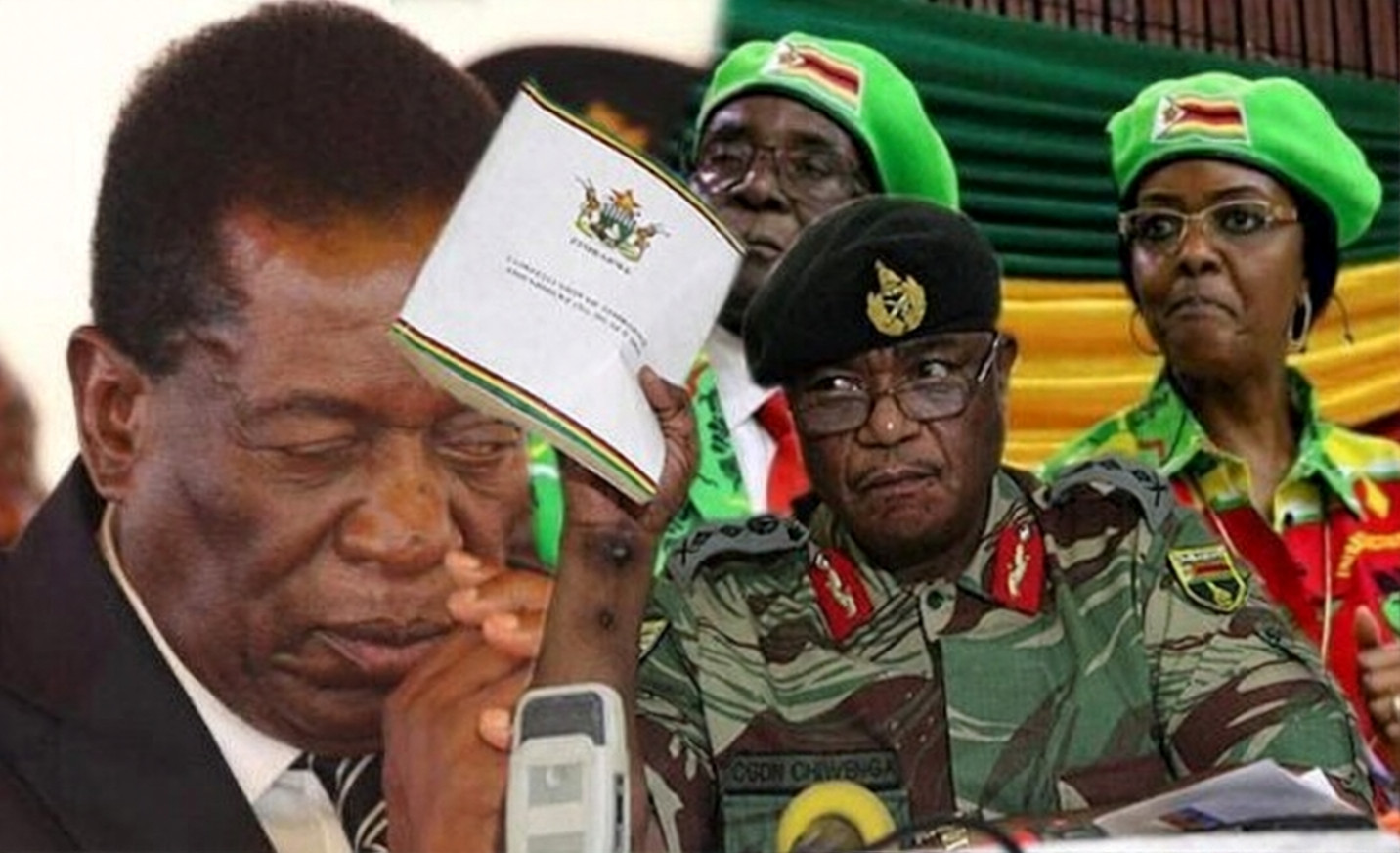
Zimbabwe’s Power Play: Clipping the Military’s Wings Amidst Succession Tensions
Harare – A seismic shift is underway in Zimbabwe’s political landscape, as the government pushes through Constitutional Amendment Bill (No.3), a legislative manoeuvre poised to re-define the Zimbabwe Defence Forces (ZDF)’s long-standing role as the nation’s ultimate political arbiter. This move, ostensibly aimed at strengthening civilian control, is viewed by critics as a calculated effort to coup-proof the current administration and consolidate power amidst an intensifying succession battle within the ruling Zanu PF party.
For decades, the Zimbabwe Defence Forces have been an undeniable force in the nation’s political arena, acting as kingmakers and power brokers. This entrenched influence dates back to the liberation struggle, notably exemplified by the Mgagao Declaration of 1975, which paved the way for Robert Mugabe to ascend to power within Zanu. Under both the late former president Robert Mugabe and his successor, President Emmerson Mnangagwa, the militarisation of politics and professional bureaucracy became a defining characteristic of Zimbabwean governance.
The army’s historical role as the ultimate political arbiter was underpinned by Section 212 of the constitution. This section mandated the ZDF not only to defend the nation’s territorial integrity but also “to uphold” the constitution. This phrasing, critics argue, provided a constitutional pretext for the military to intervene in political affairs, often under the guise of safeguarding the supreme law. A prime example of this was the November 2017 military intervention, which, ironically, brought Mnangagwa to power before he subsequently legitimised his presidency through elections in 2018 and 2023.
Zimbabwe Defence Forces role as political arbiter and power broker removed
By Ruvimbo Muchenje
The Zimbabwe Defence Forces (ZDF)’s role as the country’s political arbiter, power broker and kingmaker is now being decisively removed, changing the country’s political landscape and… pic.twitter.com/sZj6iaTgov— TheNewsHawks (@NewsHawksLive) June 7, 2026
However, Constitutional Amendment Bill (No.3) introduces significant legal alterations to the country’s political and electoral governance framework. While the Bill also proposes extending presidential and parliamentary terms and allowing parliament to elect the President, its most notable and far-reaching change lies in subtly altering the constitutional mandate of the ZDF.
The critical amendment, currently making its way through parliament, involves a seemingly minor yet profoundly impactful change in wording. The phrase “to uphold” the constitution is being removed from Section 212, replaced instead by a mandate for the military to act simply “in accordance with the constitution”. This linguistic shift, according to legal analysts and opposition critics, is a deliberate attempt to limit the military’s discretionary power and prevent future political interventions akin to the 2017 military takeover.
Justice Minister Ziyambi Ziyambi, presenting his key second reading speech on Constitutional Amendment (No.3) Bill to parliament, articulated the government’s rationale. He stated that the army must act “in accordance with the constitution,” rather than possessing a special responsibility “to uphold the constitution,” because “they are not a parallel constitutional authority”.
Ziyambi elaborated on this point, asserting:
“I now turn to the function of the Zimbabwe Defence Forces, Clause 16. Clause 16 amends the words that describe the function of our Defence Forces, replacing the phrase, ‘To uphold this Constitution’ with the phrase, ‘In accordance with this Constitution’. It has been suggested that this weakens the constitutional position of the military. The truth is precisely the opposite. The amendment strengthens the subordination of the military to the constitution and I want to explain why because the point is important and it is widely misunderstood. Consider the question honestly.
“Either the Defence Forces are subject to the Constitution, or they are a core equal guardian of it, standing alongside the elected President, the elected Parliament and the courts. If they are subject to the constitution, as in every constitutional democracy, they must be in accordance with the constitution, which is the correct expression of that subordination and the old wording which cast the military as an independent upholder of the constitution in its own right was the anomaly. The institution whose function is to uphold the constitution, is the elected and appointed civilian institutions. The President takes an oath to uphold it. Judges take an oath to uphold it. Members of this House take an oath to uphold it. The Defence Forces protect the nation within the constitutional framework that those civilian institutions uphold and interpret. They are not a parallel constitutional authority.”
He further dismissed concerns about civilian control being removed, stating:
“To suggest otherwise is to invite exactly the danger our history warns against nor is the constitutional anchor of civilian control removed by this clause, for that anchor was never Section 212; it is Section 208, which has required since 2018, that every member of the Security Services Act in accordance with the Constitution and the law, that none act in a partisan manner and that none further the interests of a political party. Section 208 is not touched by this Bill. It stands entirely. Clause 16 simply harmonises the language of Section 212 with the standard Section 208 already set and in doing so, it reinforces Sections 213 and 214, the provisions that place the deployment of our forces in the hands of the elected President, subject to the oversight of this Parliament. The Bill’s own memorandum sets this purpose plainly. The amendment is intended to reinforce Sections 213 and 214. The civilian and constitutional control of the military is not weakened by Clause 16. It is made textually consistent and thereby strengthened.”
However, the opposition views these changes with deep suspicion. Thomas Muwodzeri, a CCC Ruwa MP, labelled Clause 16 as the “most constitutionally dangerous provision in the entire Bill”. He argued that removing the military’s obligation to uphold the constitution would have profound implications, transforming a constitutionally anchored military into an instrument of executive will.
“A government that disempowers its own military from the constitutional obligation to defend the Constitution is a government that has something to fear from a constitutionally faithful military. And a government that fears a constitutionally faithful military is a government that intends to act unconstitutionally. This House will reject Clause 16 in its totality,” Muwodzeri stated.
He further contended that the obligation to uphold the Constitution provides the legal basis for the Defence Forces to, in extreme cases, resist unconstitutional conduct, including by the Executive. Removing this, he warned, would mean the military’s loyalty would run not to the Constitution, but to whoever issues the command.
Analysts suggest that President Mnangagwa, who himself came to power through a military intervention in November 2017, is using these amendments to “coup-proof” his government and rule. This is particularly pertinent given the public agitation for his political rival, Vice-President Constantino Chiwenga, to potentially seize power amidst an intensifying succession battle within the ruling Zanu PF. Chiwenga’s significant power base and leverage have historically been rooted within the army, which he led for 14 years.
Fissures in their relationship became apparent during the 2018 election campaign. A grenade explosion at a Mnangagwa rally in Bulawayo was officially blamed on remnants of the G40 movement, but Zanu PF officials later hinted at an “inside” military attack, interpreted as a jab at Chiwenga. In August 2018, soldiers opened fire on civilian demonstrators, killing six, an incident that embarrassed Mnangagwa and fuelled perceptions of Chiwenga and the military acting without political restraint.
The power struggle intensified in January 2019 when Mnangagwa, before a foreign trip, announced steep fuel price hikes, leading to widespread protests. With Chiwenga as acting president, rumours of an attempted coup against Mnangagwa circulated, with suggestions that Chiwenga was doing little to quell the unrest, hoping to portray Mnangagwa as weak. Upon his return, Mnangagwa forcefully rebuked the security forces’ behaviour and subsequently retired and reassigned four senior generals, including the commander of the Presidential Guard – all core architects of the 2017 coup.
In 2020, Chiwenga was appointed Minister of Health, a move widely seen as an attempt to politically sideline him. Further, in 2021, Mnangagwa engineered constitutional amendments regarding the presidential running mate, effectively removing Chiwenga as his automatic successor in 2023. Despite campaigning alongside Mnangagwa for his 2023 re-election, the uneasy détente between the two leaders turned into open hostility when Mnangagwa’s supporters began chanting “2030!” at victory parties, signalling a push to extend his rule beyond the constitutional two-term limit.
More recently, in October 2025, a leaked memo, allegedly from Chiwenga, accused Mnangagwa of repeating Mugabe’s mistakes and protecting corrupt businessmen. While the government dismissed it as “treasonous nonsense,” the rift between the two men became undeniably public. Mnangagwa currently controls the party and intelligence networks, but Chiwenga retains significant support within the military and war veteran groups, as well as among some traditional leaders in rural areas.
By dictating that the army must now operate “in accordance with” the constitution within a parliament-led executive, President Mnangagwa’s government is decisively shifting the centre of gravity entirely into civilian political re-engineering. The intention is to isolate the barracks from the boardroom, effectively legislating out of existence the era where generals dictated civilian leadership, as seen in the press conferences before the 2002 presidential election and the 2017 media briefing that heralded the coup.
While the government frames these changes as constructive reforms aimed at ending “election-related toxicity” and ensuring long-term stability, critics view them as a “constitutional coup”. The concern is that these amendments, rather than fostering genuine civilian control, are designed to centralise supreme authority directly within the presidency and parliament, thereby securing Mnangagwa’s hold on power.
Indeed, military and security elites continue to dominate key government ministries, public enterprises, and state institutions. Analysts observe that Zanu PF has increasingly relied on the military and security apparatus to maintain its grip on power. Therefore, legally clipping the wings of the politicised military and reshaping the executive electoral model could signify an end to the brazen militarisation of politics, potentially ushering in a new period of civilian-driven rule and public affairs.
However, the situation remains volatile. The proposed constitutional changes, including the extension of presidential terms from five to seven years and the election of the president by parliament rather than popular vote, have sparked protests from opposition politicians and citizens’ groups. A petition signed by over 25,000 Zimbabweans in 2023, submitted to the Southern African Development Community, called for an inclusive transitional government. Activists, speaking anonymously due to fear of reprisals, describe the situation as “tense and dangerous,” with Mnangagwa’s actions “fuelling the crisis”.
Some within the diaspora believe that many in the army support a transitional government, creating conditions for a potentially explosive confrontation between Mnangagwa and the intelligence establishment and the military. The coming weeks and months will be crucial in determining whether Zimbabwe moves towards entrenched one-man rule, reminiscent of the Mugabe era, or a fragmented, weakened country, threatening regional stability.