


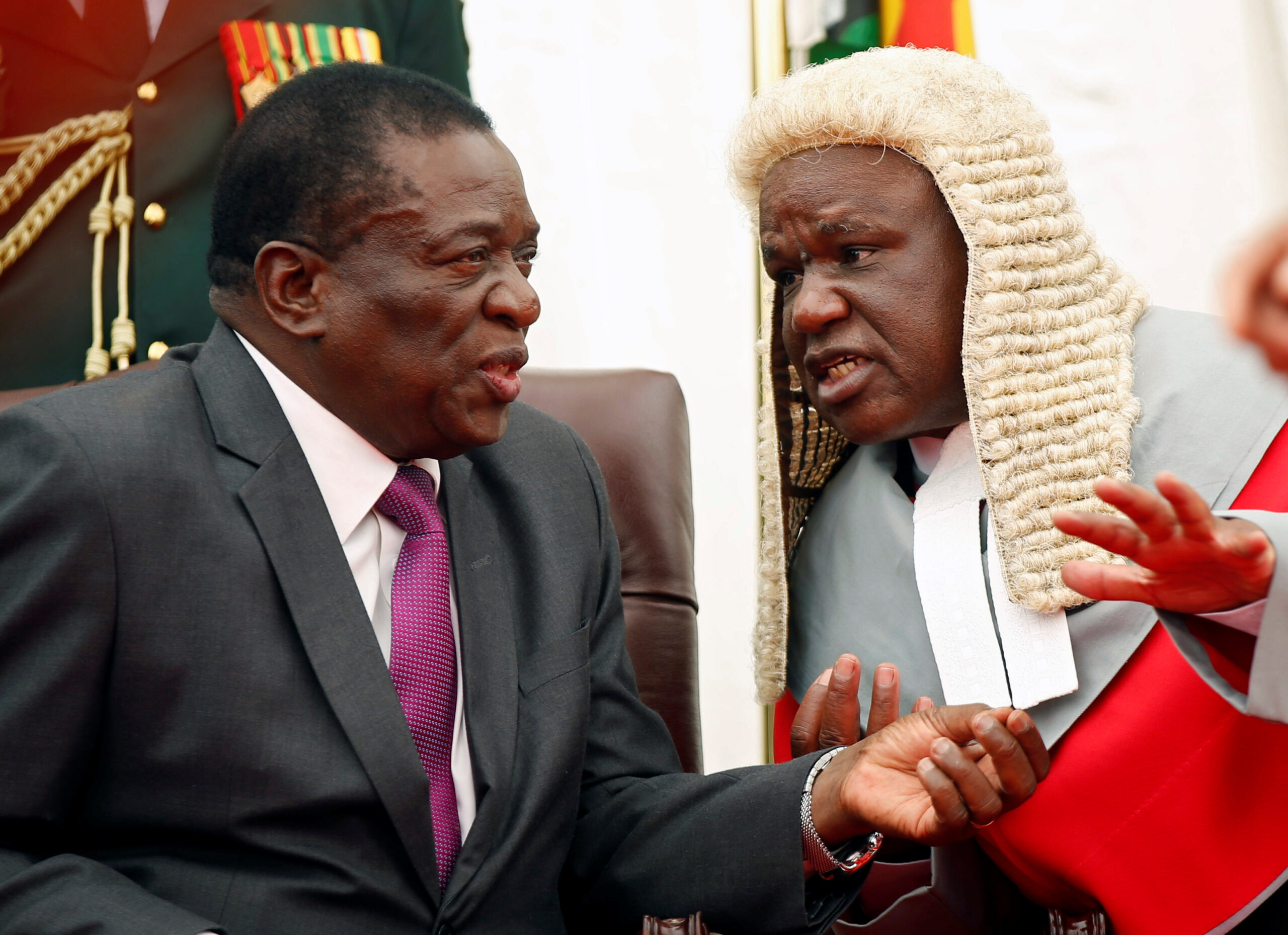
RETIREMENT REWARDS: The Shocking Farming Gift For Zimbabwe’s Ex-Chief Justice!
The retirement of a high-ranking official is usually a quiet affair, but not in the case of Zimbabwe’s former Chief Justice, Luke Malaba. Reports have surfaced that President Emmerson Mnangagwa has “gifted” the retired judge a massive consignment of state-of-the-art farming equipment. This isn’t just a simple gold watch; we are talking about high-end tractors, combine harvesters, and irrigation systems that would make any commercial farmer green with envy. While the government frames this as a “thank you” for years of service, our investigative team is asking: is this a reward for judicial loyalty or a “golden handshake” to keep the secrets of the bench safe?
We simplify the complex relationship between the judiciary and the executive in Zimbabwe. For years, critics have argued that the courts have been “captured” to serve the interests of the ruling elite. By analysing the timing of this gift, we look at the “hidden details” of how patronage works at the highest levels of government. The conspiracy theory here is that such gifts are used to ensure that even in retirement, former officials remain “grateful” and silent about the inner workings of the state.
For the average citizen, who is currently facing severe water shortages and a crumbling economy, the sight of a retired judge receiving US$100,000 worth of “gifts” is a bitter pill to swallow. We break down the cost of this equipment and show how many boreholes or hospital beds it could have funded.
A Golden Handshake in Green
Less than a month after vacating the highest judicial office in the land, former Chief Justice Luke Malaba was welcomed at State House by President Emmerson Mnangagwa. The occasion was not merely a polite farewell. Instead, the President presented Malaba with an extensive agricultural mechanisation package. According to official statements, the package comprises a tractor, a Nissan UD truck, a boom sprayer, and a planter.
President Mnangagwa publicly framed the gesture as a token of appreciation. “In recognition of his outstanding service spanning decades, unwavering commitment, and exemplary legal leadership within the Zimbabwean judiciary, I presented him with an agricultural mechanisation package to facilitate his transition into post-retirement life,” the President stated. He further encouraged Malaba to “leverage his vast expertise in the agricultural sector,” adding that “our land is a vital asset, and productivity must persist at all levels”.
However, the sheer scale and value of this “retirement package” have raised eyebrows across the nation. While the exact models of the equipment were not officially disclosed, market estimates for brand new agricultural machinery in Zimbabwe paint a staggering picture. A new mid-range tractor can cost upwards of $20,000 to $30,000 USD, while a new Nissan UD truck easily exceeds $35,000 USD. When factoring in the boom sprayer and planter, the total value of the gift is estimated to be well over $100,000 USD.
The Shadow of Judicial Capture
To understand the controversy surrounding this gift, one must look back at Malaba’s tenure, which was frequently marred by allegations of judicial capture. Critics have long argued that under his leadership, the judiciary often ruled in favour of the ruling ZANU-PF party, particularly in politically sensitive cases and election disputes.
Despite fierce legal challenges from civil society and human rights lawyers who argued that the extension undermined judicial independence, the Constitutional Court ultimately upheld the amendment. Malaba remained at the helm until his eventual retirement in May 2026.
Given this history, the recent gift of farming equipment is viewed by many not as a benign retirement present, but as a delayed reward for years of perceived loyalty. It fuels the narrative that the executive branch uses state resources to maintain a patronage network, ensuring that key figures remain beholden to the ruling elite even after they leave public office.
The Cost of Patronage
The optics of a retired official receiving such lavish gifts are particularly damaging in the context of Zimbabwe’s current socio-economic climate. The country is grappling with severe economic challenges, including hyperinflation, a crumbling healthcare system, and widespread water shortages.
To put the value of Malaba’s gift into perspective, consider the alternative uses for those funds. The estimated $100,000 USD spent on the farming equipment could have financed the drilling of approximately 80 to 100 boreholes, providing clean and reliable water to thousands of citizens currently struggling with water scarcity. Alternatively, it could have purchased dozens of fully equipped hospital beds, desperately needed in public health facilities that are often forced to turn patients away due to a lack of basic resources.
For the average Zimbabwean, the contrast is stark and infuriating. While citizens queue for water and struggle to afford basic necessities, the political and judicial elite exchange high-value assets funded by the taxpayer. It highlights a pervasive “culture of entitlement” that alienates the leadership from the lived realities of the populace.
A Legacy Questioned
As Luke Malaba embarks on his new life as a farmer, his legacy remains deeply contested. To the government, he is a dedicated public servant who guided the judiciary through challenging times. To his critics, he is a symbol of a compromised institution, a judge who allowed the scales of justice to be tipped by political pressure.
The pricey farming gift serves as a fitting, if controversial, capstone to his career. It encapsulates the blurred lines between the executive and the judiciary in Zimbabwe, where loyalty is allegedly rewarded with state resources, and independence is often questioned. As the nation watches the former Chief Justice till his land with state-of-the-art equipment, the questions surrounding the true cost of his service — and who ultimately pays for it — will continue to linger.