


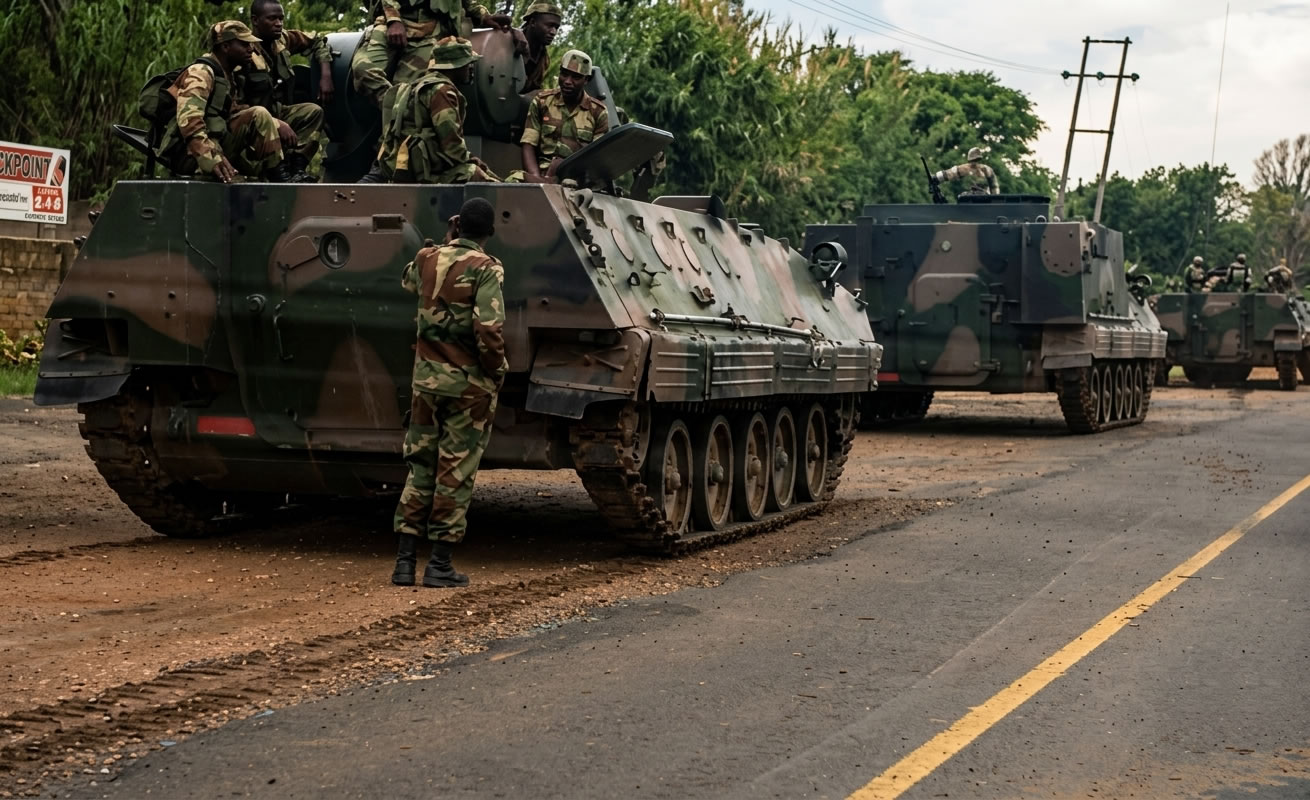
MARONDERA – Four Zimbabwe National Army soldiers were killed and three others injured when a military vehicle crashed along the Harare–Mutare Road, adding another fatal entry to a grim run of road accidents recorded across Zimbabwe in July and August.
The soldiers were travelling from Harare to Mutare in a BAW military vehicle when it was involved in the crash at the 45-kilometre peg along the Harare–Mutare Road. The four died at the scene, according to a death notice issued by the ZNA. Zimbabwe Broadcasting Corporation reported that the accident occurred in Bromley, near Marondera, and that it happened on Friday, 7 August.
The dead were identified as Warrant Officer Class 1 Philimon Chamisa, Warrant Officer Class 2 Chindowa Lydia, Sergeant Mundicho Wellington Wonder and Lance Corporal Mupemhi Edmore.
Three other members of the army were injured. Two were admitted to Marondera District Hospital, while the third was taken to 2 Referral Hospital at Josiah Magama Tongogara Barracks, formerly known as KG6, in Harare. ZBC said the injured soldiers were receiving treatment and were in stable condition.
The circumstances of the crash had not been established publicly by the time of publication. Investigations by the Zimbabwe Republic Police in Marondera were under way, and the ZNA said burial arrangements would be announced later.
“The ZNA extends its deepest condolences to the families, relatives, friends and colleagues of the four members who lost their lives in this tragic accident. May their souls rest in eternal peace,” reads the death notice from ZNA.”The ZNA wishes the injured members a speedy and full recovery.”
The deaths came just as the Government was stepping up its road-safety campaign before the Heroes and Defence Forces holidays, a period when large numbers of people travel between Zimbabwe’s cities, towns and rural areas. In a report published on 7 August, ZBC said authorities were targeting reckless driving, unroadworthy vehicles and other violations as holiday traffic increased.
Transport and Infrastructural Development Minister Felix Mhona said the country’s daily road death toll had risen to between seven and eight fatalities, compared with the five-a-day figure previously used to describe the scale of the crisis.
“We are quite saddened as a nation . . . with the prevalence of accidents that we are witnessing, which are quite disturbing in the sense that we used to talk about five per day, but now we are actually reaching seven to eight fatalities per day. But one precious life is so important that even if we talk of one per day, it’s so precious,” he said.
The Minister’s warning gives the army crash a wider significance. The victims were members of a disciplined state institution travelling in an official vehicle, yet the accident occurred on a road that carries ordinary commuters, long-distance buses, haulage trucks and private cars every day. It is a reminder that road danger is not limited to one class of vehicle or one type of traveller. The causes may differ from crash to crash, but the consequences are often shared by families, hospitals, employers and communities.
The ZNA has not said whether speed, mechanical failure, road conditions, driver fatigue or another factor was involved in the Bromley crash. Until the investigation is completed, none of those possible explanations should be treated as established fact. The police inquiry will be important not only for the families seeking answers, but also for determining whether any preventable failure contributed to the deaths.
The recent record shows why such investigations matter. On 17 July, six people died in a head-on collision between a Toyota Probox and a commuter omnibus near the Chinhoyi Provincial Heroes Acre along the Harare–Chirundu Highway. The crash occurred at the 110-kilometre peg, according to a police statement reported by The Herald. Several other passengers were injured and taken to Chinhoyi Provincial Hospital.
Police sources told The Herald that the Probox was suspected of operating as a pirate taxi and that it had allegedly failed to comply with an order to stop before the collision. Those claims were attributed to police sources and were not presented as a final finding. The national police statement confirmed the deaths but said the number of injured victims was still being established.
“The ZRP confirms a fatal road traffic accident which occurred this (yesterday) afternoon on 17/07/2026, at the 110 kilometre peg along the Harare-Chirundu Road near (the Provincial) Heroes Acre, in which six people were killed.”The number of injured victims is still to be established. More details to be released in due course.”
Six days later, on 23 July, another fatal crash claimed the lives of three Highlanders Football Club executives and an unidentified woman. The accident occurred along the Harare–Bulawayo Highway at Mbembesi, about 64 kilometres from Bulawayo, according to ZBC. The dead included Highlanders chairman Kenneth Mhlophe, vice-chairman Fiso Siziba and treasurer Nkani Khoza.
That crash placed another busy national route at the centre of public attention. The Harare–Bulawayo Highway is a major north–south corridor, used by passenger vehicles, commercial traffic and travellers moving between the capital and the country’s second-largest city. The incident also showed how road deaths can affect institutions far beyond the immediate families of those involved, in this case leaving a football club to mourn three senior leaders at once.
On 27 July, five more people were killed and nine injured in a head-on collision involving two Isuzu D-Max vehicles along the Harare–Nyamapanda Road. One vehicle had one passenger while the other carried 14 people. Two days later, on 29 July, six people were killed when a commuter omnibus veered off the Harare–Bulawayo Road and plunged into a deep, concrete-lined gully containing water at the Tynwald Rail Road Flyover near the Harare Drive junction.
The Tynwald crash exposed the confusion that can arise in the first hours after a major accident. The Herald’s report said six people died and 11 were injured, but the police account reproduced in the same report said six people were injured. The discrepancy remains important because casualty figures are not a minor detail: they affect families searching for relatives, hospitals managing admissions and authorities compiling national safety statistics.
The police account placed the Tynwald crash at about 10pm at the nine-kilometre peg. It said the kombi, carrying 11 passengers, left the road and entered the water-filled gully. The bodies were taken to Parirenyatwa Group of Hospitals mortuary, while injured people were admitted to the same hospital. The police also said efforts to identify and notify next of kin were continuing.
“The Zimbabwe Republic Police confirms a fatal road traffic accident which occurred on July 29, 2026 at around 10 pm at the nine-kilometre peg along the Harare-Bulawayo Road at Tynwald Rail Road Flyover near Harare Drive junction.”
The sequence of crashes in July helps explain the urgency behind the Government’s campaign. Within less than three weeks, fatal collisions were reported on the Harare–Chirundu, Harare–Bulawayo, Harare–Nyamapanda and Harare–Mutare corridors. The incidents involved commuter omnibuses, utility vehicles, a private car and a military vehicle. Their variety makes it difficult to reduce the problem to a single cause.
Yet officials say human behaviour remains a central concern. ZBC reported that the police planned to take firm action against motorists who disregard road rules, impound unroadworthy vehicles and act against pirate taxis. ZRP spokesperson Commissioner Paul Nyathi said enforcement would be strengthened during the holiday period.
“The Zimbabwe Republic Police will take stern action against any driver who will be found to be flouting the current road rules and regulations,” he said.
The Traffic Safety Council of Zimbabwe has also called for greater responsibility from motorists. Board chairperson Kura Sibanda said the country loses about 2,000 lives to traffic accidents each year, while ZBC reported that road crashes cost the economy close to US$500 million annually.
“As a nation, we lose about 2 000 lives to traffic accidents annually. It is our desire to see this figure being addressed and it starts with responsible driving,” said Traffic Safety Council of Zimbabwe Board Chairperson Kura Sibanda.
The figures are stark, but they can also conceal the human detail of each death. A national total does not show the names of the soldiers killed on the Harare–Mutare Road, the families waiting for the return of loved ones, or the injured members recovering in hospital. It does not show the effect on the Highlanders football community, the passengers at Tynwald or the people who travelled the Harare–Chirundu road that July afternoon.
Last year’s holiday statistics offer another warning. At least 194 people were killed in road traffic accidents during the Heroes and Defence Forces holidays, according to ZBC. The Government’s stated challenge this year is to prevent the same pattern from being repeated through stronger enforcement and public awareness.
That challenge now includes the investigation into the deaths of Chamisa, Chindowa, Mundicho and Mupemhi. The eventual findings should establish what happened at the 45-kilometre peg and whether any action is needed to prevent a similar crash. For the families, colleagues and friends of the four soldiers, however, the official explanation will come after the loss has already become permanent.
For travellers, the immediate message from the authorities is familiar but urgent: obey speed limits, avoid driving while tired or under the influence of alcohol, do not use unroadworthy vehicles and follow police instructions. Those measures cannot undo Friday’s deaths. They can, however, determine whether the next journey along Zimbabwe’s highways ends safely.