


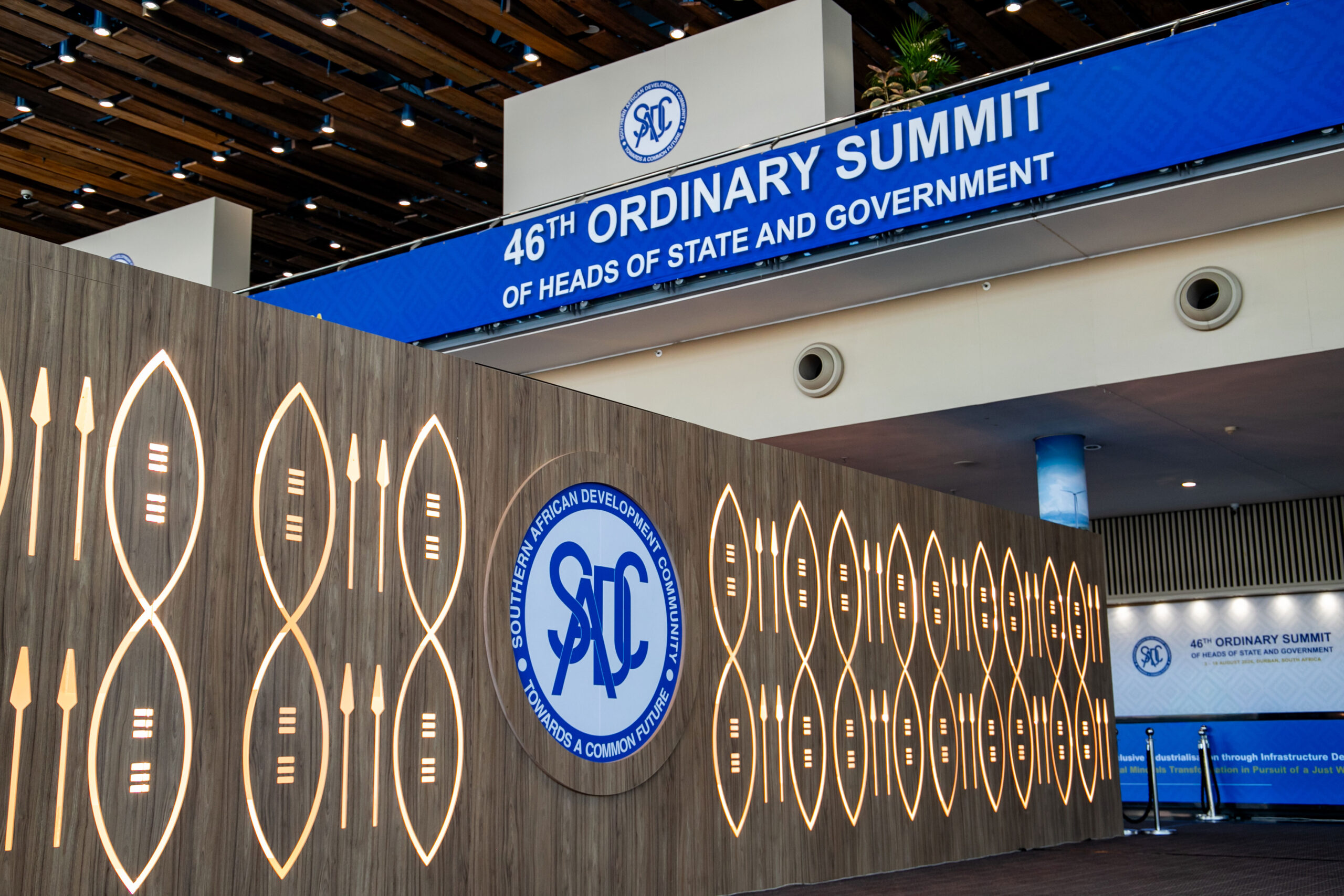
The humid air in Durban usually carries the scent of the Indian Ocean and the relaxed energy of a coastal holiday destination. However, as the 46th Ordinary Southern African Development Community (SADC) Summit opens this week, the atmosphere is decidedly different. The city is not celebrating; it is bracing itself. The Durban International Convention Centre (ICC) has been transformed into a fortress, surrounded by steel barriers, armoured vehicles, and a heavy presence from the National Joint Operational and Intelligence Structure (NATJOINTS).
While the official programme speaks of “regional integration” and “SADC Vision 2050,” the reality on the ground feels more like a military occupation. Walnut Road is entirely closed, and rolling roadblocks on Bram Fischer Road have brought the central business district to a standstill. This is what locals are calling the “VVIP lockdown,” a security measure so intense that it suggests the regional leaders are more afraid of the people they represent than any external threat.
The tension is not merely a result of logistics. It is the physical manifestation of a political phenomenon many are calling the “export of fear.” The shadow of Zimbabwe’s 2024 crackdown on activists is looming large over the proceedings, dictating a regional security posture that prioritises the survival of incumbents over the rights of citizens. Two years ago, as Harare prepared to host the 44th Summit, the world watched in horror as democracy activists were dragged from planes and tortured. Today, the “ghost” of those abductions has crossed the Limpopo River, haunting the streets of Durban.
To understand the current siege, one must look back to the winter of 2024. In July of that year, Namatai Kwekweza, a prominent human rights defender, along with Robson Chere and Samuel Gwenzi, were forcibly removed from a departing flight at Robert Gabriel Mugabe International Airport. They were held incommunicado, allegedly tortured, and later charged with “disorderly conduct.” Their crime? Protesting the detention of fellow activists.
That incident was part of a massive pre-emptive strike by the Zimbabwean authorities, which saw over 160 people arrested in a matter of weeks. The goal was simple: ensure that the SADC Summit in Harare was not embarrassed by public dissent. Although Kwekweza and her colleagues were eventually acquitted in August 2025 after a year-long legal battle, the message had been sent. The SADC region had entered a new era where “security” meant the silencing of any voice that dared to question the status quo.
In Durban, we are seeing a sophisticated evolution of these tactics. Activists report that pre-emptive arrests are no longer just a Zimbabwean speciality. Across the region, from Eswatini to the outskirts of Johannesburg, individuals known for organising protests have been visited by security agents or detained on minor charges in the weeks leading up to this summit.
“We are seeing a regionalisation of repression,” says one human rights lawyer who asked to remain anonymous for fear of retribution. “The protocols that were supposed to protect our rights are being used as a manual for how to suppress them. SADC is increasingly looking like a ‘Dictators’ Club’ where leaders trade tips on how to keep their populations under control.”
This security paranoia is colliding with a genuine domestic crisis in South Africa. The summit takes place against the backdrop of a massive migration upheaval. Since the beginning of 2026, South Africa has been gripped by a fresh wave of anti-migrant protests. A self-imposed deadline of 30 June 2026, set by various local movements for undocumented migrants to leave the country, has led to a chaotic and often violent exodus.
According to recent data, more than 178,000 immigrants have fled or been deported from South Africa in the last few months alone. The images of crowded border posts and abandoned shops in Durban’s Point area tell a story of regional integration in reverse. While the heads of state inside the ICC discuss the free movement of goods and people, the streets outside are filled with the remnants of a failed migration policy.
The diplomatic double-speak inside the summit is staggering. The SADC Treaty and the Protocol on Politics, Defence, and Security Cooperation explicitly aim to promote democracy, human rights, and the rule of law. Yet, the agenda in Durban seems focused on “protecting the incumbents from a rising tide of regional dissent.” The summit’s organisers have been quick to point to “external interference” as the cause of local unrest, a classic diversionary tactic used to avoid addressing the root causes of poverty and political exclusion.
The human stories of those being silenced are often lost in the talk of high-level diplomacy. Consider the case of Bhekimpilo Mbedzi, a human rights defender who was arbitrarily detained in July 2026. His arrest follows a pattern that is now all too familiar: a sudden pick-up by plainclothes officers, a period of disappearance, and then a court appearance on charges that seem designed to keep him out of circulation until the summit is over.
Mbedzi’s story is a mirror of what happened to the Harare Three in 2024. It is a cycle of state-sponsored repression that uses the law not as a shield for the innocent, but as a sword for the powerful. The “pre-emptive” arrests happening across the region are a clear signal that the SADC leadership has decided that regional stability is only possible if the voices of the youth and the working class are muted.
South Africa, as the host nation, finds itself in a difficult position. For years, Pretoria has attempted to play the role of the regional mediator, the “big brother” who promotes democratic values. However, the current domestic pressure regarding migration and the economy has weakened its moral standing. The question on everyone’s lips in Durban is whether South Africa will take a stand for human rights or if it will simply provide the venue for the further consolidation of authoritarian power.
The SADC Migration Instagram account recently posted a series of infographics highlighting the “benefits of regional movement.” The comments section, however, tells a different story. It is filled with South Africans complaining about job losses and Zimbabweans pleading for an end to the abductions back home. This digital divide reflects the physical barriers around the ICC—a leadership that is completely disconnected from the digital and physical reality of its citizens.
The 46th SADC Summit is a turning point for the bloc. If it continues to ignore the “ghosts” of its past and the crises of its present, it risks becoming an irrelevant relic of a bygone era. The VVIP security lockdown in Durban might keep the leaders safe for a few days, but it cannot protect them from the long-term consequences of failing their people.
As the sun sets over the Durban skyline, the lights of the ICC shine brightly, a beacon of power in a city that feels increasingly like it is under siege. The activists who are being silenced today will not remain quiet forever. The “export of fear” may work for a season, but the demand for dignity and accountability is a regional force that no amount of security can truly contain.
The story of Durban 2026 is not just about a summit; it is about the soul of Southern Africa. Will the region choose the path of integration and rights, or will it remain haunted by the ghosts of abduction and the walls of exclusion? For now, as the armoured cars patrol the beach-front, the answer seems to be written in the silence of those who have been told they have no voice.
|
Event
|
Date
|
Location
|
Description
|
|
Abduction of Harare Three
|
July 2024
|
Harare, Zimbabwe
|
Namatai Kwekweza, Robson Chere, and Samuel Gwenzi removed from plane and tortured.
|
|
Anti-Migrant Deadline
|
30 June 2026
|
South Africa
|
Deadline set by protesters for undocumented migrants to leave, sparking mass exodus.
|
|
Mass Migration Exodus
|
Aug 2026
|
Regional
|
Over 178,000 migrants flee South Africa due to protests and deportations.
|
|
Durban VVIP Lockdown
|
Aug 2026
|
Durban, SA
|
Total closure of Walnut Road and Bram Fischer for the 46th SADC Summit.
|
|
Detention of B. Mbedzi
|
July 2026
|
Regional
|
Pre-emptive arrest of human rights defender ahead of the Durban summit.
|