


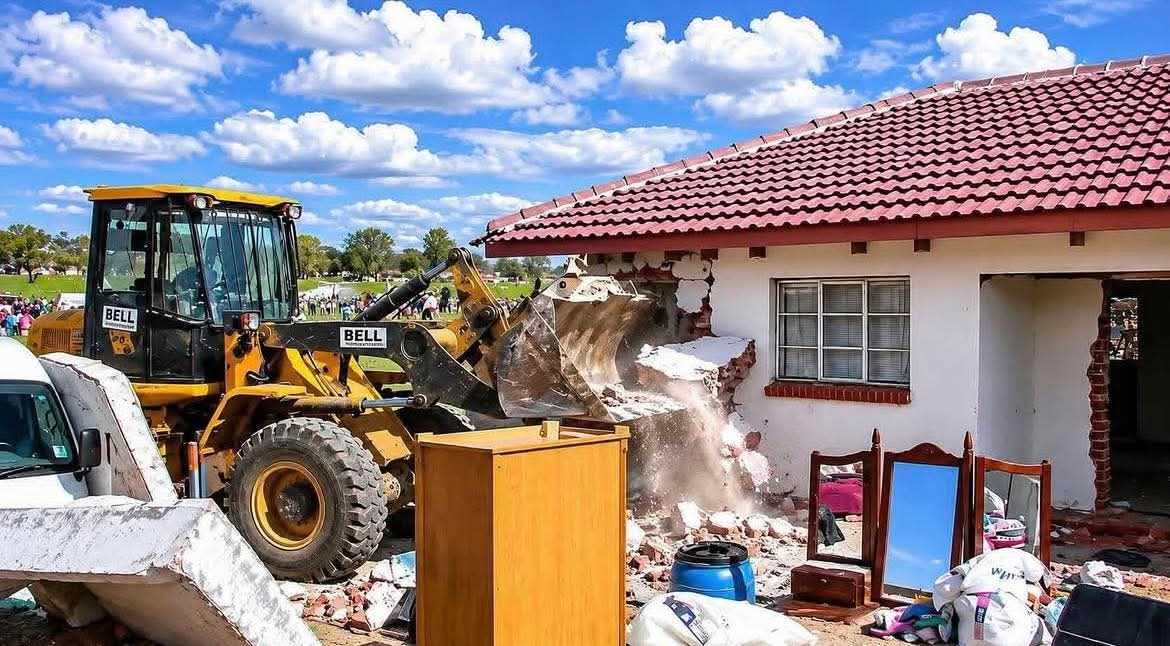
Zimbabwe’s Government has directed local authorities to stop demolishing homes and shift their focus towards regularising informal settlements and prosecuting illegal land barons, as pressure mounts over housing clearances in Harare and other parts of the country.
The order, issued on November 9, follows warnings from the Zimbabwe Human Rights Commission (ZHRC) that demolitions are deepening the country’s urban housing crisis and putting families who bought stands through informal arrangements at risk of losing both their homes and savings.
The directive puts a halt on active demolition campaigns, while directing councils to assess whether existing settlements can be brought into formal planning systems. The Government has also called for enforcement efforts to target the people and syndicates accused of unlawfully acquiring public or private land, subdividing it and selling stands to home seekers.
The announcement comes against a backdrop of two distinct Harare council actions. The figure of more than 5,000 homes relates to an earlier plan by the City of Harare to clear structures in unauthorised settlements under 37 court orders. Separately, in October 2026, the council issued a 14-day ultimatum to residents in partially regularised settlements, warning that some properties could face demolition if owners failed to complete the required steps.
The distinction is important for residents trying to understand what the latest order means. The 5,000-plus figure was not the council’s estimate for the properties covered by the October ultimatum. City officials said their initial assessment suggested that fewer than 100 properties across Harare could be affected by demolitions after that deadline, with the final number depending on compliance.
The earlier plan involved homes in high-density areas, including Kuwadzana, Budiriro, Glen View and Mabvuku. Some of the structures were said to occupy land reserved for public amenities such as schools and clinics. Harare’s 2024 plan cited 37 court orders obtained by the council and private parties, but it met resistance from central Government and was not the same enforcement exercise as the recent regularisation notice.
Under the October notice, affected residents were told to complete paperwork, settle penalties and meet planning and infrastructure requirements. The minimum penalty was set at US$1,500 or its equivalent in ZiG, with the exact amount depending on the nature and extent of the breach. The council said payment plans could be arranged and that deadlines for paying penalties had been extended.
City of Harare Corporate Communications Manager Stanley Gama said the council wanted to regularise settlements rather than remove homes. “The City of Harare has no appetite to demolish people’s homes. We want to regularise them.”
Gama said some properties might not qualify for regularisation because they were built in sensitive areas. “Our initial assessment indicated that less than 100 properties across the City can be affected but the exact number will be informed by compliance levels and demolitions will commence at the expiry of the 14 day compliance period but as a last resort.”
The council’s stated approach also included stopping new unauthorised construction and preventing fresh land invasions. Residents were told to pay the local authority directly, rather than housing cooperatives or pay-scheme intermediaries. The council warned that those groups had no authority to collect regularisation charges on its behalf, raising concerns that people already caught up in disputed land transactions could be asked to pay twice or lose more money.
The Government’s latest directive shifts the emphasis further towards formalising settlements and pursuing land barons. Such operators are accused of taking state, council or private land, dividing it into residential plots without approval and selling it to people who may not know that the transactions are unlawful. The Government has instructed local authorities to work with law enforcement agencies to investigate and prosecute those responsible.
The ZHRC has urged authorities to tackle the causes of informal settlements as well as the structures themselves. In a statement issued in early November, it called for more affordable residential stands, clearer information about approved housing schemes and transparent allocation systems. “Local authorities should adopt a more proactive and anticipatory approach to housing provision within their respective jurisdictions,” the commission said.
It also called for stronger housing delivery plans, with measurable targets and realistic timelines, and asked law enforcement agencies to investigate fraudulent land sales, unlawful allocations and corruption. The commission’s position was that policing unauthorised development and protecting residents’ rights must be pursued together.
“We acknowledge the responsibility of government and local authorities to enforce planning laws and protect public spaces, including wetlands, from unlawful occupation and development. However, demolitions have consequences beyond the physical removal of structures, including emotional distress, financial hardship and social disruption, particularly for children, older persons and other vulnerable members of society,” the ZHRC said.
The commission has stressed that settlements lacking roads, water, sewerage, schools and health facilities leave residents exposed to hardship, while also placing pressure on cities. It urged councils to reduce housing waiting lists and make approved land and housing schemes easier for residents to identify. Prospective buyers were advised to check land ownership, residential zoning and planning approvals with local authorities before paying for a stand or starting construction.
Recent disputes have shown how quickly the policy debate can turn into a crisis for households. Demolition and eviction activity has been reported at Warwick Farm near Lake Chivero and around Rydale Ridge, while residents in Ushewokunze, also known as Saturday Retreat Farm, have faced a separate threat of removal connected to the land. These cases involve different land and planning circumstances, but each has added urgency to calls for a consistent process that does not leave families without shelter or a clear path to resolve their status.
Zimbabwe’s Constitution sets out protections around both administrative conduct and evictions. Section 68 says administrative conduct must be lawful, prompt, efficient, reasonable, proportionate, impartial, and substantively and procedurally fair. Section 74 states that no person may be evicted from their home, or have their home demolished, without a court order made after consideration of all relevant circumstances.
Those provisions sit alongside the Government’s responsibility to enforce planning rules and protect public land and environmentally sensitive areas. The new halt does not erase those planning obligations. Instead, the direction is for councils to stop demolitions and prioritise regularisation, while illegal land sales and unauthorised allocations are investigated.
For Harare residents, the immediate questions are how the national instruction will be carried out, what happens to the council’s existing notices and court orders, and which settlements can meet the conditions for formal recognition. The City has said some developments on private land have made progress where developers co-operated, including Chiremba Park, Masasa Park and Audor Investment in Southlea Park. It has also acknowledged slower progress on municipal and state land.
The national shift puts responsibility on councils to identify which homes can be regularised, what services and planning changes are required, and how residents will be protected from further fraudulent transactions. It also places renewed focus on whether action will reach the people who profit from illegal land deals, rather than ending with the demolition of homes built by those who bought into them.