


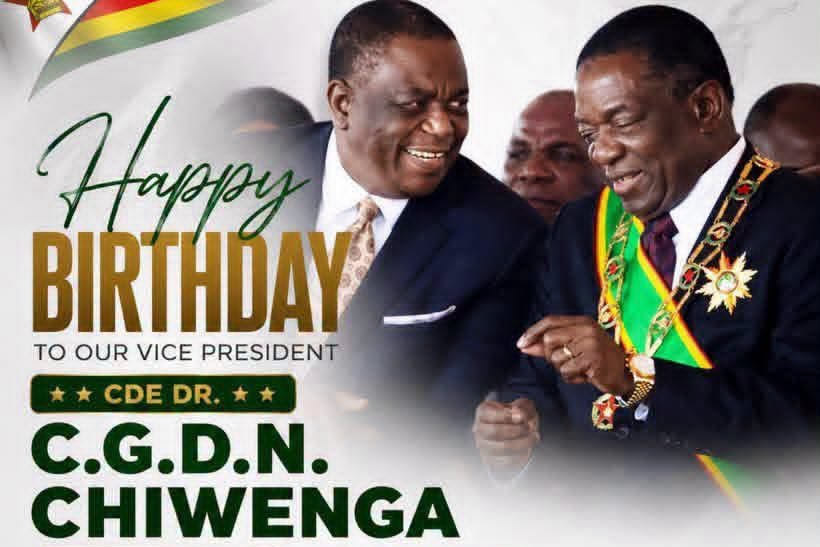
The velvet curtains of Zimbabwe’s high-stakes political theatre were pulled back this week, revealing a scene that has left the corridors of power in Harare chilled to the bone. At a private residence on the outskirts of the capital, General (Retired) Constantino Chiwenga, the country’s formidable Vice President, celebrated his 70th birthday. Yet, it was not the vintage champagne or the opulent decor that became the talk of the town. Instead, it was the empty chairs—a calculated “conspiracy of silence” that spoke louder than any celebratory toast.
In the world of ZANU-PF politics, where every handshake is a contract and every absence is a declaration of war, the guest list for Chiwenga’s milestone bash was a manifesto. Reports from within the inner sanctum suggest that those aligned with President Emmerson Mnangagwa were conspicuously absent. The “Lacoste” faction, the men who have spent the last year chanting the “ED 2030” slogan with religious fervour, found their invitations lost in the post. In their place stood a phalanx of Chiwenga’s own loyalists—a group of military hardliners and disgruntled veterans who appear to be drawing a line in the Zimbabwean sand.
General Chiwenga’s wife, Minnie Baloyi, a Colonel in the Zimbabwe Defence Forces, organised what was intended to be a “small family birthday dinner”. However, videos shared widely on Facebook showed the intimate gathering transforming into a lively celebration with music, dancing, and laughter. This was not merely a party; it was a parade of the “General’s” faction. The optics were unmistakable. While the state media has spent months attempting to project an image of a united Presidium—even leading a public celebration during a ZANU-PF Central Committee meeting on July 2—the reality behind the closed gates of the private birthday bash tells a story of a deepening rift that threatens the very stability of the nation.
The fragile political alliance between President Emmerson Mnangagwa and Vice-President Constantino Chiwenga has come under renewed scrutiny. Their relationship has collapsed into an intense, public battle for control of the levers of state power. After collaborating in November 2017 to orchestrate the military coup that ousted the late former president Robert Mugabe, Zimbabwe’s long-time dictator, their partnership has deteriorated into a political tussle due to broken succession pacts and recent contentious moves to extend Mnangagwa’s rule.
In November 2017, Chiwenga, then commander of the Zimbabwe Defence Forces, ordered tanks onto the streets of Harare. The military intervention forced Mugabe out, preventing him from installing his own successor. At that time, Chiwenga deliberately stepped back from taking the presidency directly, choosing instead to install his long-time liberation war comrade, Mnangagwa, who had fled to South Africa for a brief exile. Behind closed doors, a critical gentleman’s agreement was forged. According to political and military insiders, including the late Foreign Affairs and International Trade minister Sibusiso B. Moyo, a retired Lieutenant-General, Mnangagwa was supposed to serve only one full term and hand over the presidency to Chiwenga ahead of the 2023 elections.
However, once in office, Mnangagwa systematically consolidated power and entrenched himself. He altered constitutional running-mate laws to block Chiwenga’s automatic path to power and went on to claim a second term in 2023. He further amended the constitution to consolidate his position, purging most of those who brought him to power and isolating Chiwenga. The final betrayal occurred when Mnangagwa’s faction launched the “2030 Agenda,” designed to extend his rule beyond his 2028 constitutional two-term limit to 2030.
As a result, the relationship between the two leaders has fractured into a bitter “two centres of power” contest, splitting ZANU-PF and security organs into hostile factions. Mnangagwa has used presidential powers to neutralise Chiwenga’s base, repeatedly reshuffling the top command of the Zimbabwe National Army, retiring critical pro-Chiwenga generals, and deploying key military allies to distant diplomatic posts abroad. Concurrently, several shake-ups of the security services, police, and intelligence have sidelined officers linked to the Vice President.
The tension has moved beyond mere snubs at social gatherings. In the dark corners of the Central Intelligence Organisation (CIO), the stakes have turned dangerous. Intelligence sources have confirmed a secret move to monitor the Vice President’s every move. The CIO, largely seen as being under the thumb of the President’s loyalists, has reportedly stepped up surveillance on Chiwenga’s private meetings with serving and retired army generals. These clandestine gatherings, often held under the guise of “consultations with liberation war peers,” are being viewed by the President’s camp as the blueprint for a “slow coup.”
The names surfacing in these intelligence reports are a “who’s who” of the military establishment. Figures such as Retired Air Vice-Marshal Henry Muchena and other high-ranking commanders are said to be frequenting the Vice President’s inner circle. The President’s men were particularly unsettled by the presence of these military stalwarts, fearing that the “General” was preparing for a 2028 run that would dismantle the “ED 2030” movement before it even gains full momentum.
“The atmosphere in the Politburo is toxic,” whispered one unnamed source who attended a recent high-level meeting. “There is a feeling that the party is being held hostage by two men who can no longer stand to be in the same room. When the Vice President talks about ‘one man, one vote,’ everyone knows he is aiming directly at the President’s plan to bypass a referendum for his term extension. It is a battle for the soul of the liberation struggle.”
This ideological chasm was laid bare during a confrontation in the Politburo between Chiwenga and State Security Minister Lovemore Matuke. The clash, which reportedly left the room in a stunned silence, was triggered by the Vice President’s insistence that any revision to presidential term limits must be subjected to a national referendum. Matuke, a staunch Mnangagwa loyalist, reportedly rounded on the Vice President, accusing unnamed individuals of “contradicting the party position.” The fact that Defence Minister Oppah Muchinguri and ZANU-PF Commissar Munyaradzi Machacha reportedly sided with Matuke also served to further isolate Chiwenga within the civilian structures of the party.
Yet, Chiwenga remained undeterred, leaning heavily on his military credentials. His recent public appearances, sometimes in military uniform, have sparked intense speculation about his intentions. To his supporters, he is the guardian of the “3rd Chimurenga” — a movement aimed at saving ZANU-PF from what they term “capture” by corrupt business interests. Chiwenga has been vocal in his attacks on the “Zvigananda” — a term he uses to describe the “leeches” and “newly rich” tenderpreneurs who have flourished under the Second Republic.
At the heart of this “Zvigananda” controversy is the billionaire businessman Kudakwashe Tagwirei. The Vice President has reportedly been a thorn in the side of attempts to co-opt Tagwirei into a policy role within the Central Committee. “The party is not for sale,” Chiwenga is said to have warned during a heated discussion in October 2025. He argued that co-opting “businessmen with questionable motives” would fundamentally undermine the revolutionary character of ZANU-PF. Despite his objections, the Politburo eventually endorsed the co-options, a move seen as a significant defeat for the Chiwenga faction and a clear indication of Mnangagwa’s ability to consolidate power through his business allies.
The President’s camp, however, is not sitting idly by. The “Move on Chiwenga” is a coordinated strategy designed to systematically diminish the Vice President’s influence. This includes the strategic promotion of loyalists within the security apparatus. The recent promotion of Sean Mnangagwa to the rank of Lieutenant Colonel in 2026 is viewed by many as a clear signal of the President’s intent to secure his family’s legacy and maintain a firm grip on the military, traditionally Chiwenga’s stronghold.
The “ED 2030” movement, which has been seeking to extend the President’s rule by two years, has become the ultimate litmus test for loyalty within ZANU-PF. While Mnangagwa’s allies argued that the extension is necessary to complete his developmental projects, Chiwenga’s faction viewed it as a betrayal of the 2017 agreement that brought the President to power. The Vice President’s supporters point to the funeral of Kumbirai Kangai’s wife as a turning point, where Chiwenga invoked the principle of “one man, one vote” in a speech that was widely interpreted as a direct challenge to the “2030 agenda.”
“South Africa is no example at all,” Chiwenga reportedly snapped at the Attorney General during a cabinet meeting discussing the shift to an indirect presidential election system. His dismissal of the South African and Botswanan models underscores his deep-seated opposition to any move that he believes removes the choice of the leader from the hands of the ordinary Zimbabwean.
The birthday bash in Harare was a microcosm of this ZANU-PF factional crisis. As the “General’s” loyalists toasted to his 70th year, the absence of the President’s men hung in the air like a thick fog. It was a clear indication that the “social lives” of the elite are no longer insulated from the political warfare that is tearing the party apart. The celebration was a show of strength, a gathering of those loyal to the military hierarchy rather than the civilian purse strings. Because the 2017 coup brought the deep state directly into politics and governance, any conflict within ZANU-PF is inherently a conflict within the security apparatus itself.
This bitter and intense standoff, characterised by deadly assassination, coup, and poisoning plots, leaves Zimbabwe trapped in an explosive political loop. The relentless focus on internal party survival continues to eclipse the pressing needs of the country, leaving the population to bear the brunt of economic hardships. Mnangagwa recently signed Constitutional Amendment Bill No.3 into law, and Chiwenga has openly broken ranks to intensify his fight to oust Mnangagwa. That battle manifests itself every time and everywhere, including on birthdays.
As Zimbabwe hurtles towards 2028, the question remains: is Chiwenga preparing for a final showdown, or is he being successfully sidelined by a President who has mastered the art of political survival? The “conspiracy of silence” between the two most powerful men in the country cannot last forever. The cracks in the Presidium are widening, and the tremors are being felt from the boardrooms of Harare to the barracks of the Zimbabwe Defence Forces.
The birthday party may be over, but the fallout has only just begun. In a country where history has a habit of repeating itself in the most dramatic of fashions, the snub of Mnangagwa’s men at Chiwenga’s 70th bash might just be remembered as the moment the “Cold War” turned hot. The struggle for the future of ZANU-PF is no longer a whisper in the corridors; it is a battle being fought in the open, one birthday invitation at a time.