


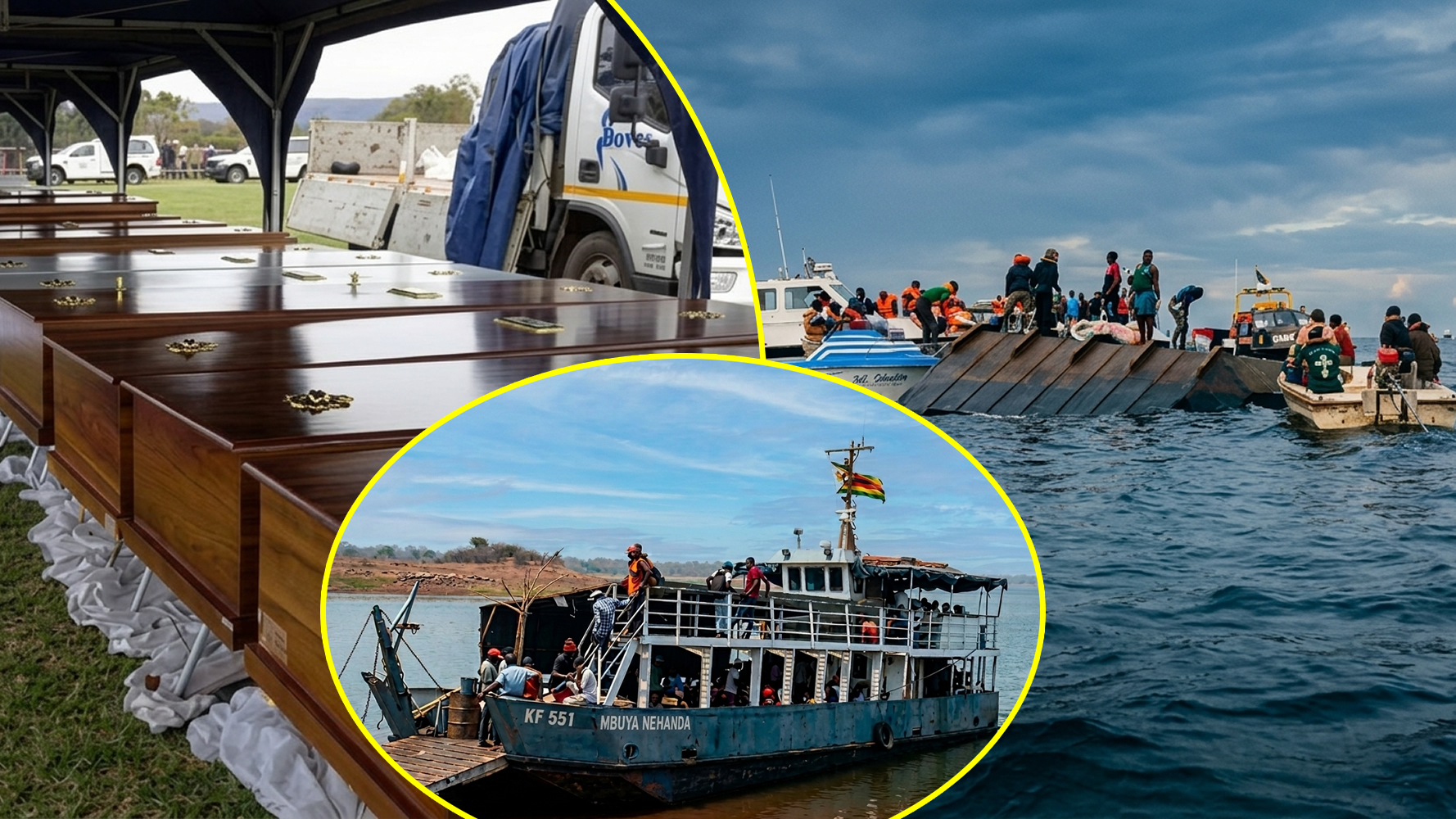
KARIBA – The death toll from the Mbuya Nehanda ferry disaster on Lake Kariba has risen to 80 after recovery teams retrieved eight more bodies, deepening a tragedy that has left families waiting for news of relatives still missing across the vast reservoir.
The latest bodies were recovered on Sunday, August 16, as police divers, soldiers, local fishermen, wildlife officials, transport authorities, community volunteers and Civil Protection Unit teams continued searching the lake. The operation has been complicated by strong winds, rough water and the possibility that some victims were carried towards the Zambian side of the lake.
Minister of State and Devolution Affairs for Mashonaland West Marion Chombo confirmed that 80 bodies had now been recovered since the ferry capsized on Tuesday, August 11. She said 67 people survived the accident, while the number of people who were on board remained under verification.
“The search will continue and I urge the nation to work as a team. We have so far recovered 80 bodies since Tuesday and 67 people survived the accident,” Chombo said.
The recovery figure has climbed rapidly since the vessel overturned while travelling from Kariba towards Chalala and nearby rural and fishing communities. Authorities recorded 13 bodies on Tuesday, 31 on Wednesday, two on Thursday, none on Friday, 26 on Saturday and eight on Sunday.
The vessel, operated by the Rural Infrastructure Development Agency and identified as the Mbuya Nehanda KF551, had a stated capacity of 90 passengers. Authorities previously reported that it was carrying at least 114 adults and five crew members, while other estimates put the total number on board at 153. The final passenger count has remained difficult to establish because children below ticketing age may not have been included in the ticket records.
The ferry was carrying people as well as goods when it left Kariba. It served communities scattered around the lake, providing a link to food supplies, markets, health services and other basic needs. For many residents along the remote shoreline, the service was more than a means of transport; it was one of the few regular connections with Kariba town.
Survivors said the journey changed quickly when the boat moved into open water. Strong winds created choppy waves, and water began entering the vessel. Goods shifted and fell overboard, while passengers became increasingly alarmed about the boat’s ability to remain afloat.
Other survivors said passengers had raised concerns before the ferry travelled far from the harbour. One woman described an argument with the captain as the vessel prepared to leave.
“We argued with him right at the harbor. We told him the waves were too dangerous,” she said. “A bag fell overboard before we had even left, and we pointed it out, but he refused to listen.”
A further account described passengers pleading for the ferry to turn back after the conditions worsened.
“About 30 minutes in, we begged again to abort and return, more goods were falling, the wave was getting worse and water was gushing into one side of the boat, but (the captain) just said, ‘My boat has never sunk anyone.’ He even refused to call for help,” another survivor said.
Seventy-seven people were rescued soon after the ferry capsized, with many taken first to a nearby island before being transferred to health facilities in Kariba. The latest local update recorded 67 survivors, reflecting the continuing difficulty of matching rescue records, passenger lists and family reports while the recovery operation remains under way.
Some families have lost several relatives. Solomon Machipisa, speaking about the impact on households in the affected communities, described the scale of the grief.
“It has been difficult to know who to console first, as almost every homestead has lost a relative, and the worst cases more than five relatives at once,” Machipisa said.
The search has now extended beyond the immediate area where the ferry overturned. Lake Kariba is shared by Zimbabwe and Zambia, and authorities believe some of the missing may have been swept towards Starvation Island, which falls under Zambian jurisdiction. Zimbabwean officials have called for the operation to include waters on the Zambian side, where search teams may be able to find additional bodies or information about people who were carried away by the current and wind.
Deputy Director in the Ministry of Transport and Infrastructure Development Capt. Lameck Chitenga appealed for urgent engagement between the two countries.
“We are appealing to the government and all stakeholders to engage our Zambian counterparts so that the current search efforts can include Zambian waters,” Chitenga said.
Chombo said Zimbabwe and Zambia already had an agreement allowing cooperation during emergencies on Lake Kariba. She said the two sides had discussed the search and that Zambia could provide information if bodies were found across the border.
“We have a Memorandum of Understanding with Zambia and we are free to search even across the Zambian borders. We have also talked with our Zambian counterparts to assist us with information should they discover a body across the borders,” she said.
It was not immediately confirmed whether Zimbabwean teams had formally expanded the search into Zambian waters. The uncertainty has added urgency to the calls for coordination, particularly as the recovery operation moves further from the point where the vessel capsized.
The teams working on the lake include Zimbabwe Republic Police divers, Zimbabwe National Army personnel, officials from the Zimbabwe Parks and Wildlife Management Authority, Ministry of Transport and Infrastructure Development staff, Civil Protection Unit personnel and community volunteers. Local fishermen have also assisted because of their knowledge of the lake’s channels, currents and shoreline.
Recovery work has continued in difficult water and weather conditions. Divers have had to search beneath and around the wreckage, while teams on boats have scanned the surface and shoreline. Each body recovered has brought relief to some families waiting for confirmation, but has also renewed the pain of those who had continued to hope that their relatives might still be found alive.
President Emmerson Mnangagwa declared the accident a national disaster, allowing the government to mobilise additional resources and provide assistance to affected families and survivors. Welfare agencies have been involved in distributing food and supporting households in communities that have lost several members.
The disaster has also disrupted the movement of supplies around the lake. Shops and communities that depended on the ferry to carry food and goods to remote areas have faced shortages since the vessel sank. The interruption has affected families already dealing with bereavement, as the ferry had been an important part of daily life for people living far from Kariba town.
Authorities have urged boat operators to exercise extreme caution during the windy season. They have also stressed the need for vessels to carry enough life jackets and reliable communication devices. Questions raised by survivors about the number of people on board, the availability of life jackets and the decision to continue into rough water are expected to form part of the official examination of the disaster.
For now, the immediate priority remains the recovery of those still missing. Officials have not announced a final number of passengers, and the death toll could change as teams continue to search the lake and work through family reports, survivor accounts and transport records.
At 80 confirmed deaths, the Mbuya Nehanda disaster is already one of Zimbabwe’s deadliest boat accidents in decades. Behind the figure are families waiting at mortuaries, communities searching the shoreline and survivors carrying memories of the moments when the ferry began to fill with water. The recovery teams remain on Lake Kariba, working across a border shared by 2 countries, as Zimbabwe seeks to bring more people home and establish the full scale of the tragedy.