


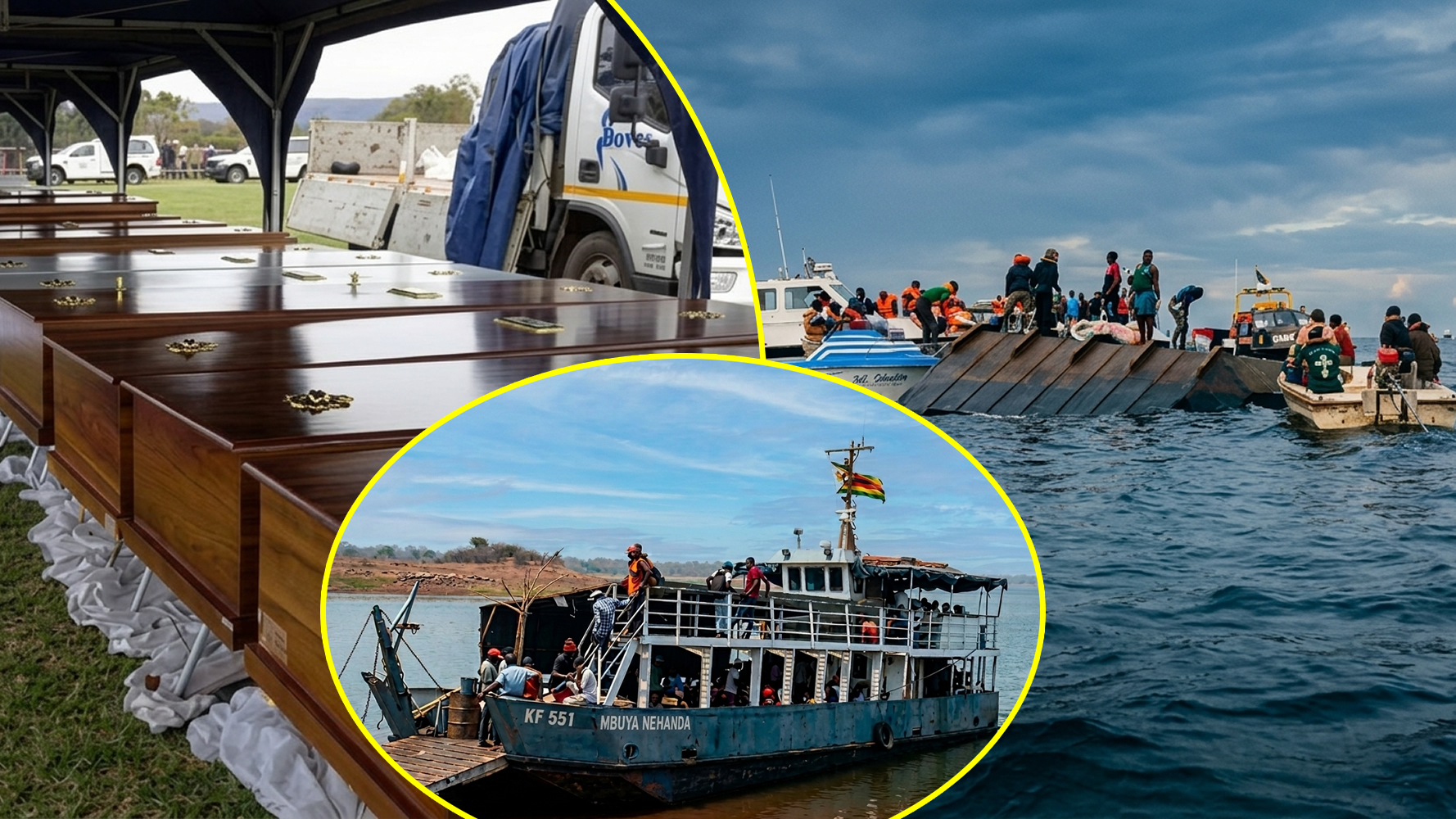
The death toll from the Lake Kariba ferry disaster has risen to 92, as recovery teams continue searching the vast reservoir for bodies and families wait for reliable information about relatives who were on board.
The ferry overturned on August 11 during a journey used by people from rural communities around Lake Kariba to reach the town of Kariba. The trip normally takes about five hours. What began as an ordinary crossing became one of Zimbabwe’s worst recent water disasters, leaving survivors clinging to an overturned hull and families gathering at Kariba District Hospital in search of names, news and explanations.
The final number of passengers remains one of the first unanswered questions. The vessel was designed to carry 90 people. Disaster officials confirmed ticket records for 114 adult passengers and five crew members, but warned that children below ticketing age might not have been included. One surviving crew member, Anyway Chambati, said he was responsible for ticketing and counted 153 people on board, including crew and infants.
That gap between the vessel’s stated capacity, the ticket records and the survivor’s count is now central to the investigation. It will determine not only how many people were travelling, but also whether the ferry was allowed to leave with more passengers and cargo than it could safely carry.
The disaster unfolded in rough conditions. A strong wave struck the ferry and the vessel overturned. Survivors say the warning signs appeared before the boat had travelled far from the harbour. They describe bags, dishes and beer bottles sliding or falling into the water as waves grew stronger, while water began entering the vessel.
One woman who survived said: “We argued with him right at the harbor. We told him the waves were too dangerous. A bag fell overboard before we had even left, and we pointed it out, but he refused to listen.”
Another survivor alleged that passengers raised the same concern again about half an hour into the journey. “About 30 minutes in, we begged again to abort and return, more goods were falling, the wave was getting worse and water was gushing into one side of the boat, but (the captain) just said, ‘My boat has never sunk anyone.’ He even refused to call for help,” the survivor said.
The allegation that the captain made that remark will form part of the questions facing investigators. The captain died in the disaster, leaving passengers’ accounts, the testimony of surviving crew members, the condition of the ferry and official records as important evidence about what happened before the capsizing.
Chambati, one of two crew members who survived, described the moments after the ferry went over. “Some of us survived by standing on top of the capsized hull,” he said. “Before it went down, passengers were screaming at us that the boat was flooding, water was pouring into the engine room and goods were spilling out.”
Passengers then searched for life jackets beneath their seats as the ferry took on water. Some people were seen in the lake holding sacks of goods. A witness at the scene, Maxton Kanhema, said: “People were in distress… there were bodies in the water and it was a sad situation to witness. Those that could be rescued were rescued.”
The delay before help reached some passengers is another issue that requires a clear account. Survivors said assistance did not arrive for nearly an hour. At least 77 people were rescued in the early operation, with some reaching a small island before boats brought them back. Speedboats, a helicopter, an army boat squadron and a police sub-aqua unit were sent to the area as the search widened.
Lake Kariba is shared by Zimbabwe and Zambia, with the international boundary running through the water. The search therefore brought a cross-border challenge into an already difficult rescue. Zimbabwe sought access to Zambian waters while teams worked to locate bodies and possible survivors. Officials must now set out how rescue crews communicated, who had command of the operation, which boats and divers were available, and whether permission was needed before teams could cross into the other side of the lake.
Those questions matter because Lake Kariba is enormous. It stretches for more than 220 kilometres and is up to 40 kilometres wide in some places. Its waters support transport, fishing and electricity generation for the region, but distance and changing weather can make an emergency difficult to manage. A rescue plan that works close to shore may not be enough for a ferry travelling through open water on a five-hour route.
The ferry was operated by the Rural Infrastructure Development Agency (RIDA). Investigators may have to examine its registration, inspection records, maintenance history and operating licence. They will also need to establish who checked the vessel before departure, who determined that it was safe to travel in the prevailing weather, and who was responsible for counting passengers and controlling cargo.
The number of people on board also carries a human cost. If ticketing records do not include children, families may struggle to prove that a child was travelling. If passenger lists were incomplete, relatives may depend on rumours, social media posts or word of mouth to learn whether someone is missing. At Kariba District Hospital, families have complained about relying on unofficial updates while they wait for formal information.
For mourners, the uncertainty is not an abstract administrative problem. It determines whether they travel to the hospital, a mortuary or the lake. It affects the timing of burial, the identification of bodies and the ability to notify children, employers, schools and relatives. Authorities must provide one reliable contact point, publish regular updates and explain why names are released in stages. They must also guard against mistaken identification, which can cause further harm to families already facing a devastating loss.
The government has announced US$100 in assistance for registered next of kin and others affected by the disaster. Families now need to know what that payment is intended to cover and whether it is an immediate emergency grant, funeral assistance or the first part of a wider support programme. The amount will not meet the full cost of a death or a prolonged search. Families may have to pay for transport, food, accommodation, medical care, funerals, identity documents and the care of children who have lost a parent. Some people who depended on those who died may not be included in official compensation arrangements at all. That is why the response cannot end when the last body is recovered.
The search for bodies may eventually end. The search for answers will not. The people who travelled on Lake Kariba that morning were not figures in a disaster statement. They were parents, children, workers, traders and relatives whose lives depended on a ferry that was expected to carry them safely across the lake. The responsibility now is to identify every victim, support every survivor and establish, in clear terms, how the journey became so dangerous and why no one stopped it before the water rose.