


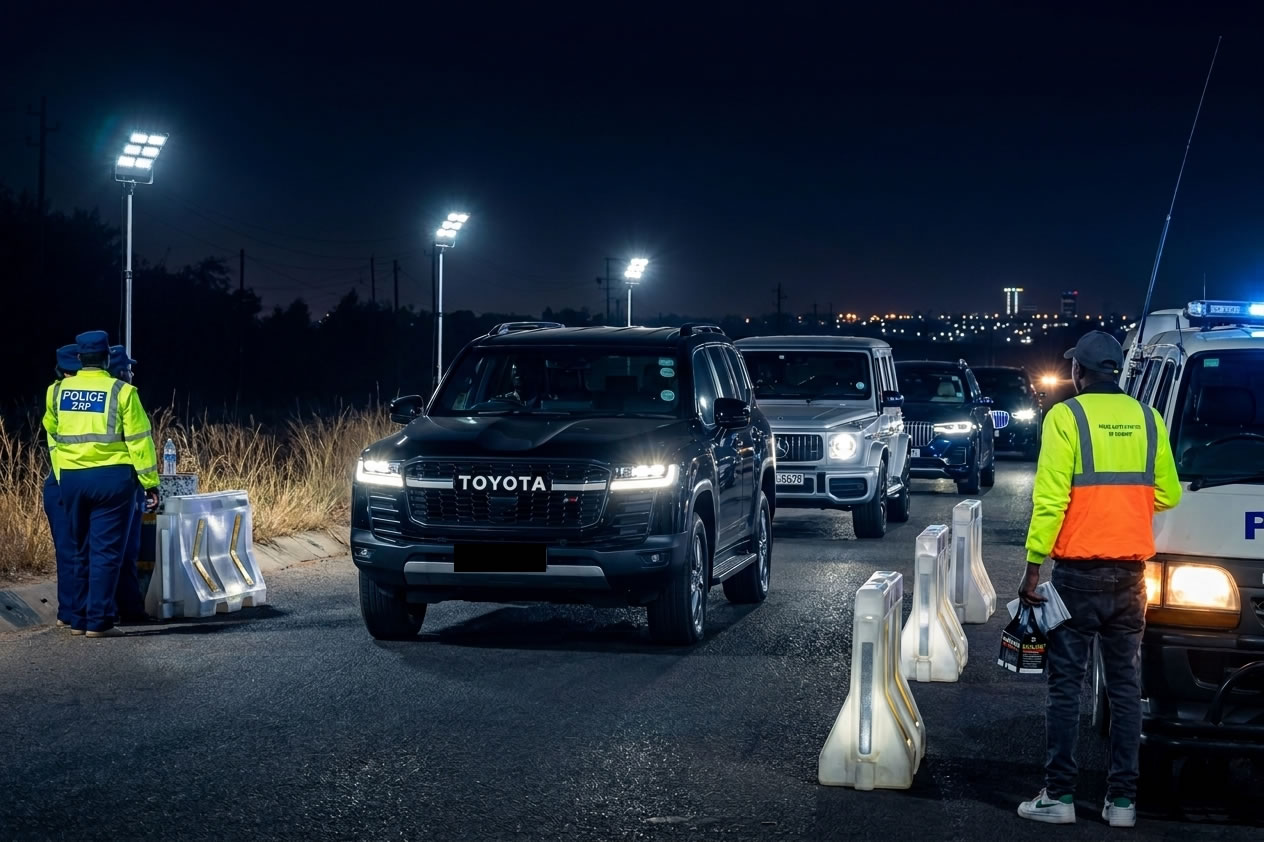
HARARE — Motorists who breach traffic rules after 10pm at four crime hotspots in Harare will have their traffic fines automatically cancelled under a special police arrangement introduced in response to smash-and-grab attacks targeting drivers at night.
The Zimbabwe Republic Police has identified the intersections as places where motorists can face serious danger when they stop at red lights after dark. The arrangement is intended to recognise situations in which drivers may move through a junction to escape criminals, rather than deliberately disregard road rules.
The four locations are Seke Road and Cripps Road; Samora Machel Avenue and Abdel Gamal Nasser Road; Remembrance Drive and Cripps Road near Mupedzanhamo market; and Jason Moyo Avenue and Abdel Gamal Nasser Road.
The exemption applies to traffic violations committed after 10pm at the named intersections. Police have said offences that fall within the arrangement will be automatically invalidated. The announcement did not set out a separate procedure for motorists to follow, and the police have not indicated whether every type of violation will qualify or whether the exemption will depend on the circumstances recorded by the cameras.
The decision comes as Harare introduces a wider electronic traffic enforcement system designed to record violations, identify vehicles and issue motorists with electronic notifications. The system is already operating at 20 sites in the capital, with more locations expected to be added as the programme expands to other cities.
At the centre of the new enforcement system are high-definition cameras and technology capable of recording traffic offences and identifying vehicles through their registration details. Police say the cameras are being used to enforce road rules, support officers on the ground and help identify suspicious activity, including robberies and smash-and-grab incidents.
National police spokesperson Commissioner Paul Nyathi said the system was intended to improve discipline on the roads rather than punish motorists and pedestrians.
“The system is not there to punish motorists and pedestrians, but to bring sanity to our roads and stop reckless driving that endangers other road users,” said Comm Nyathi.
The cameras are monitoring offences including overtaking at traffic lights, driving without seatbelts, picking up or dropping off passengers at undesignated points and other forms of reckless driving. Pedestrians who cross roads outside designated areas and motorcyclists who ride dangerously are also being placed under scrutiny.
Police have warned that the new system will make it harder for motorists to avoid responsibility after being captured on camera. Vehicle owners, including companies and Government departments, can be identified through registration records. Officers have also reminded drivers that the rules apply equally to Government vehicles and private cars.
Motorists who receive an electronic notification will have seven days to respond to the recorded offence. They will then have another seven days to pay the fine, making a total compliance period of 14 days.
Those who fail to respond or settle the fine within the stated period risk being blacklisted, placed on a police wanted list and prosecuted. The police have also warned that the most serious offences can lead to a driving ban or the cancellation of a driving licence.
“Every motorist found on the wrong side of the law will be given the opportunity to view the recorded video and will have the choice of paying the fine or appearing in court,” Nyathi stated.
The video evidence is intended to give motorists a clear record of the incident before they decide how to proceed. Police say the system will reduce unnecessary face-to-face encounters between officers and drivers, limiting opportunities for bribery, extortion and manipulation during roadside stops.
“The system is shifting towards technology-driven law enforcement,” he said.
The four-intersection exemption reflects the difficult conditions faced by motorists in parts of Harare after nightfall. Drivers who stop at traffic lights can become targets within seconds, particularly where roads are poorly lit and criminals have easy escape routes through surrounding streets.
In recent months, motorists have described attackers approaching vehicles as they slow down or wait at red lights. In some cases, one person smashes a window while another reaches inside to seize a handbag, phone, laptop or other valuables. The attackers then run into nearby streets before drivers or bystanders can respond.
One motorist, Taurai Muropa, described being attacked while waiting for a traffic signal to change. He said the experience left him unwilling to stop at intersections at night, even though doing so creates a new danger for other road users.
“Since then, I have vowed never to stop at any intersection at night. The challenge, however, is that we are now in a dilemma. If you run a red light, cameras will capture the violation, and you will be in trouble with the authorities.”
Other drivers have reported similar incidents along major routes, including roads around the central business district, Chisipite, Liberation Legacy Way and Harare Drive. Mupedzanhamo has also been identified as an area where people can be attacked after 10pm.
A marketing executive who was attacked near Chisipite said two men appeared from the roadside as she slowed down at traffic lights. One broke the passenger window while the other took her handbag, which contained a mobile phone, bank cards and cash.
“I was shocked. Before I could even hoot for help, they had already disappeared.”
Another motorist said a laptop bag was taken near Abdel Gamal Nasser Road after he stopped at a red light while driving home. A nurse who works night shifts also described having her phone taken from the dashboard when she stopped at a traffic light on her way home.
Security specialists have said the attacks are often carried out by small groups. One person watches approaching vehicles, another identifies a likely target and others move in when the vehicle stops. Cars with visible handbags, laptops and mobile phones are particularly attractive to the attackers.
The expansion of camera enforcement has therefore created a direct conflict for drivers at the four named locations. Motorists are expected to obey traffic lights, but police have now acknowledged that stopping at certain junctions after 10pm can expose them to criminal attack. The special arrangement is meant to remove the threat of an automatic traffic penalty when a driver chooses to move through an intersection to avoid that immediate danger.
The arrangement has prompted calls for a stronger police presence at the affected junctions. Residents and motorists have said that cancelling fines may help drivers who are forced to make a split-second decision, but it does not remove the criminals who are waiting near the roads.
There have also been concerns that allowing drivers to pass through red lights could create risks for pedestrians, cyclists and vehicles travelling across the junction. The affected intersections could become more dangerous if motorists interpret the exemption as permission to drive through without slowing down or checking for other road users.
Police have said the camera network will assist officers rather than replace them. Footage can help investigators identify movements around crime scenes, while live monitoring can support quicker responses to suspicious activity. Authorities have also said patrols and deployments are being increased in areas identified as crime hotspots.
Local authorities have been urged to repair malfunctioning traffic lights and improve road markings. Police and motorists have both pointed to road infrastructure as an important part of the safety problem, particularly at junctions where poor lighting, damaged signals or unclear markings make it harder for drivers and pedestrians to move safely.
The electronic traffic system is expected to expand beyond Harare, with Bulawayo being considered for the next phase. Before the wider rollout, police plan to conduct public awareness campaigns explaining how the system works and what motorists, pedestrians and motorcyclists must do when they receive a notification or are recorded committing an offence.
The campaigns are also expected to explain the process for viewing video evidence, responding within seven days and completing payment during the following seven days. Vehicle owners will be expected to keep registration and ownership records up to date so that electronic notices reach the correct person or organisation.
Police have urged all road users to comply with traffic regulations and have warned that repeat offenders could face severe penalties, including the loss of their licences. At the same time, the four-intersection exemption marks an unusual adjustment to normal enforcement rules, recognising that some drivers may be trying to escape an attack rather than gain an advantage on the road.
“Let everyone respect the sanctity of life, respect other road users and observe traffic rules and regulations,” Comm Nyathi said.
For Harare motorists, the new policy means that the four named intersections will be treated differently after 10pm, while the rest of the electronic enforcement network will continue to record violations. Drivers who receive camera notifications will have 14 days to respond and pay or face blacklisting, a police wanted listing and possible prosecution. Serious and repeated offences could also end with a driving ban or the cancellation of a licence.