


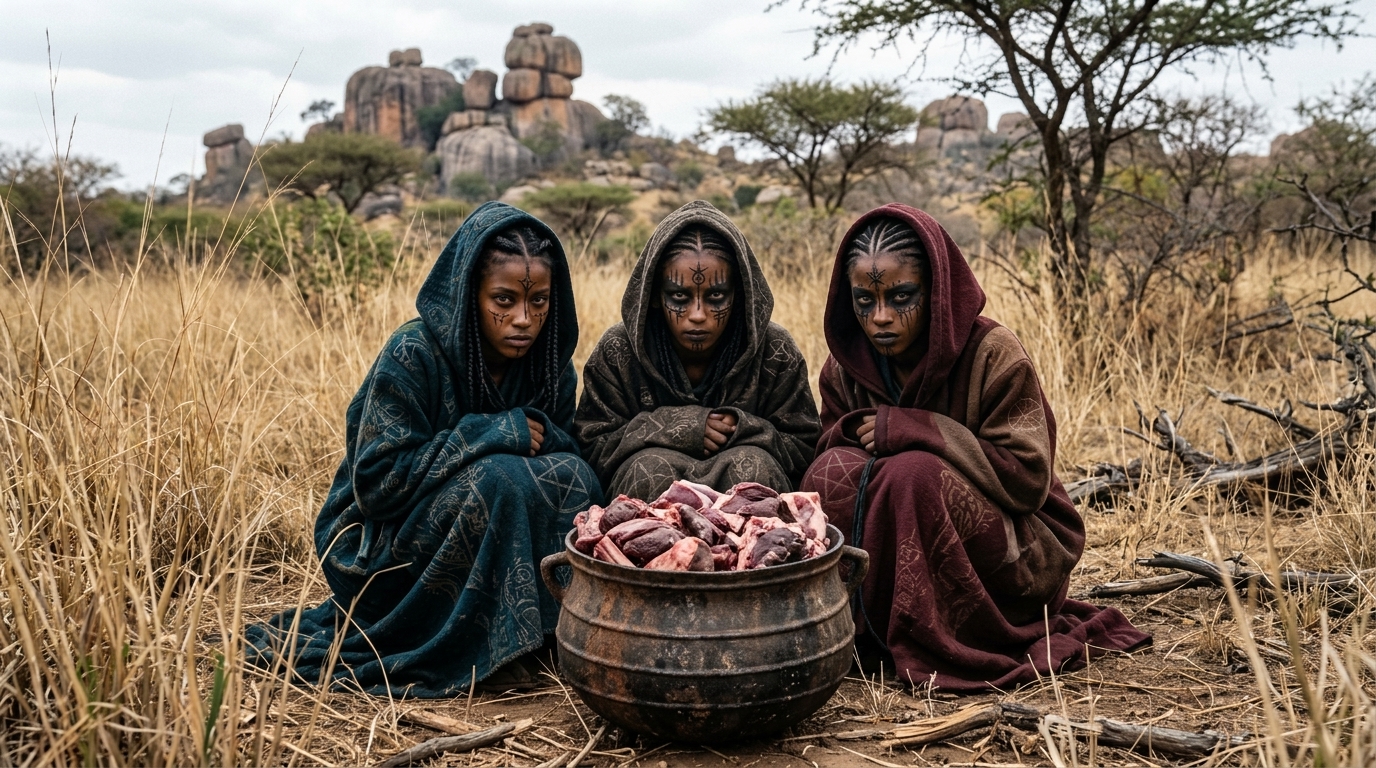
Three women from Chipinge have appeared before a magistrate in Shurugwi over allegations that they kidnapped a 24-year-old woman and forced her to eat meat dripping with blood and drink urine as part of an initiation into Satanism.
Vinolia Mlambo, 21, Primrose Gwenzi, 21, and Beatrice Chimingira, 24, are accused of taking Tashinga Mavhoro into a gum-tree plantation and keeping her there until nightfall. The women were remanded in custody pending a medical report.
The accused are from Mabhiza Village in Chief Musikavanhu’s area of Checheche, Chipinge. Mavhoro comes from Musara 2 Village under Chief Nhema in Shurugwi. Chimingira is also said to reside at Tongogara Business Centre, where Mavhoro was heading when she encountered the trio.
The State alleges the incident happened at about 4pm on October 17. Mavhoro was on her way to Tongogara Business Centre to have her cellphone repaired when she met the three women. They greeted her and began walking alongside her.
Their route took them towards a thick gum-tree plantation. Once there, the third accused allegedly grabbed Mavhoro by the hand and forced her into the trees. She was told that the women wanted her uterus, according to the account presented in court.
The State alleges the women made Mavhoro sit down and questioned her. She remained in the plantation as the afternoon turned to evening. As darkness fell, the three allegedly told her that “the time had arrived.”
The alleged initiation involved giving Mavhoro meat dripping with blood and urine to consume. The women then told her they had initiated her into Satanism, the State alleges. They left her in the plantation, from where she went to report what had happened to other people.
A search was conducted and the three women were arrested. They face a kidnapping charge as well as a second count relating to the alleged forced consumption of the meat and urine.
Shurugwi Magistrate Tadiwanashe Nyanda heard the matter. Matidaishe Pavazvira prosecuted. The court account said the trio were remanded pending a medical report.
The allegations describe a sudden encounter on a journey to a business centre, followed by an hours-long ordeal in a plantation. Mavhoro had been walking towards Tongogara when the women joined her, the State alleges. The accusation that she was held against her will and forced to consume the substances forms the core of the case.
The account does not set out what prompted the alleged questioning or why Mavhoro was singled out. It does, however, place the alleged events at a specific location and time: a gum-tree plantation near Tongogara, after 4pm on October 17. The alleged demand for her uterus and the claimed initiation were made while she was there, according to the State’s outline.
The women are all in their early twenties. Mlambo and Gwenzi are 21, while Chimingira is 24. Mavhoro is also 24. Their home areas are in Chipinge, in Manicaland, while the complainant is from Shurugwi, in Midlands. Chimingira is reported to be living at Tongogara Business Centre, close to the place Mavhoro was travelling to.
The report of the alleged initiation comes amid a history of Zimbabwean criminal cases in which Satanism or ritual claims have featured in accounts of serious offences. The details of those cases differ, and the allegations in the Shurugwi matter remain specific to the events described in court.
In a separate Bulawayo case, a man was sentenced to an effective 15 years in prison after being convicted of murdering Patience Ndlovu at Silver Sands Lodge. Ndlovu, 35, was found dead at the lodge in June 2019. The case drew public attention after reports that the number 666 had been marked on her abdomen.
Wisdom Mpilwenhle Ndlovu was arrested in 2021, after being sought for about 2 years. At his 2022 trial, the High Court convicted him of murder and imposed the 15-year sentence. The court account said Ndlovu had strangled Patience after a dispute, then taken her money and cellphone before hiding her body beneath a bed. The murder case was distinct from the current Shurugwi allegations, which concern an alleged kidnapping and forced consumption during a claimed initiation.
In the Shurugwi matter, the State’s account places Mavhoro’s report to others after she was left behind in the plantation. That report led to a search and the arrest of the three accused. The case now centres on the events alleged to have taken place between the roadside encounter and the moment she was left alone in the trees.
Zimbabwe’s Constitution and laws do not explicitly name or ban “Satanism” as a distinct crime, though the legal system approaches the issue through constitutional freedoms and public order or criminal provisions.
Constitutional Framework
- Freedom of Religion and Conscience: Section 60 of the Zimbabwe Constitution of 2013 guarantees every person the right to freedom of thought, conscience, religion, and belief.
- Non-Discrimination: Section 56 of the Constitution protects citizens from discrimination on the basis of their beliefs or religion.
- No Specific Anti-Satanism Law: Government and justice ministries have historically noted that there are no specific statutory laws criminalizing or banning Satanic organizations or worship itself.
How the Law Intersects with Satanism and Witchcraft
- Not Recognized as a Legal Faith: While constitutional freedoms are broad, legal scholars and authorities have pointed out that practices associated with Satanism (such as alleged blood-drinking or acts causing public hysteria) are not officially recognized as standard or accepted public religions.
- Public Order and Safety: Individuals attempting to form Satanic groups or cults have faced scrutiny or detention not strictly for private belief, but when their actions breach public safety, cause community panic, or violate general public order regulations.
- Witchcraft and Related Acts: Zimbabwe’s legal framework—such as the Criminal Law (Codification and Reform) Act and related statutes—deals with practices commonly associated with witchcraft or falsely accusing others of witchcraft, rather than providing a formal legal definition or mechanism to prosecute “Satanism” per se. Belief in witchcraft cannot be used as a legal defense for crimes like murder or assault, though courts may treat it as a mitigating factor during sentencing.