


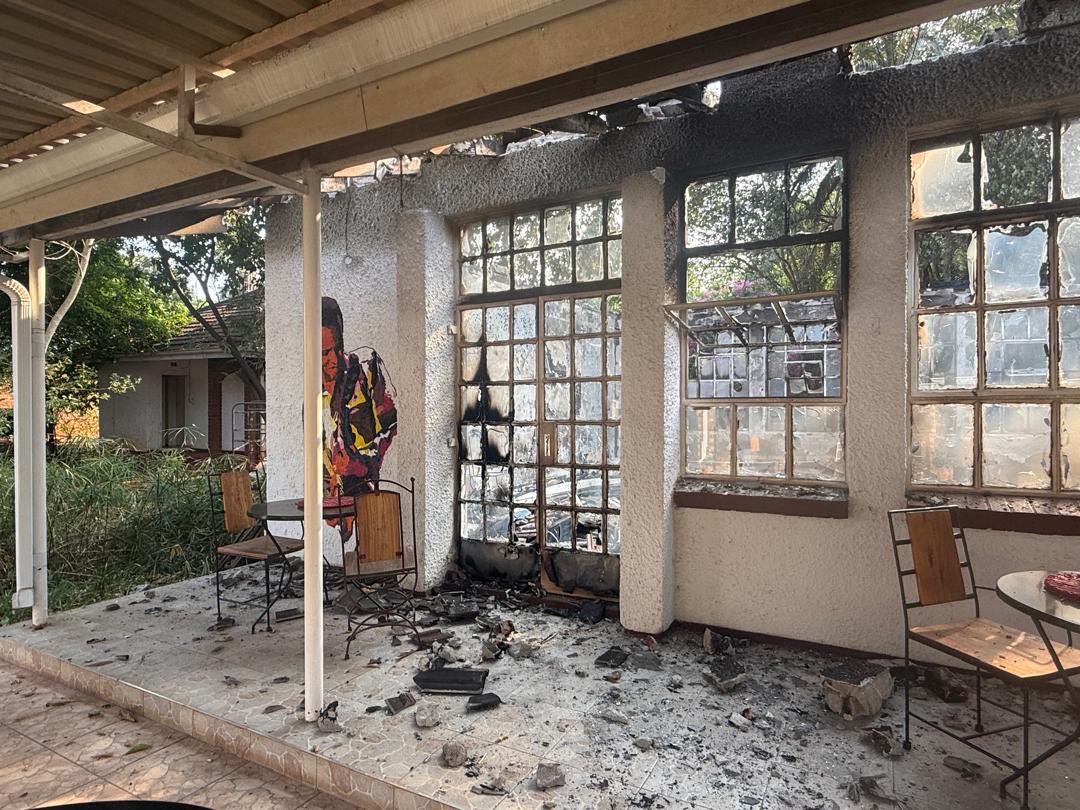
Harare – A wave of anger is sweeping across Zimbabwe following the ruling Zanu-PF party’s endorsement of a constitutional amendment to allow President Emmerson Mnangagwa to remain in office beyond his current term, a move perceived by many as a slide towards deeper authoritarianism. This comes as premises belonging to Professor Ibbo Mandaza were bombed and a security guard abducted.
Zanu-PF, which has been in power for 45 years and is often accused of corruption and misrule, declared its support for the “2030 agenda” at its annual congress a week ago. This agenda would require legislative changes to keep Mnangagwa in power until 2030.
In response to this development, prominent lawyer Tendai Biti has vowed to “defend the constitution against its capture.” Opposition figures organised a press conference to address what they term a “constitutional crisis”.
Adding to the tension, the Southern Africa Political Economy Series (SAPES) Trust’s premises were targeted in a suspected arson attack. SAPES Trust Director, Ibbo Mandaza, reported that the attack occurred around midnight, with the seminar room – a regular venue for meetings and press conferences – being the primary target. A security guard was allegedly abducted by the assailants, who locked the gate with two padlocks.
Mandaza took to X to share the news, stating: “This is to announce that there’s been another arson attack (the first was in August 2023 ahead of the elections) at SAPES Trust at midnight, with the PanAfrika Restaurant on fire and the security staff overtaken by a group of armed attackers… It was an organised attack at 12:40 am today: the main target was the SAPES Trust Seminar Room, the usual venue for meetings, which has been left gutted to the ground by fire; and then they abducted the guard on duty after locking up the gate with two padlocks.”
SAPES Trust was scheduled to host a National Press Conference against ZANU PF’s Agenda 2030. Mandaza has affirmed that the press conference will proceed despite the setback.
Top Harare lawyer, Thabani Mpofu, condemned the attack on SAPES Trust, calling it “a cowardly act” and writing on X: “This is just not right. This cowardly act must be condemned in the strongest terms possible. How can we live in a country that fears words?”
Self-exiled former Cabinet Minister, Saviour Kasukuwere, echoed this sentiment, describing the bombing as “shameful” and adding, “A leopard cannot change its spots! We have to choose hope over fear.”
In a similar incident, the home of Gilbert Bgwende, a key member of the Constitutional Defence Forum, a civic group opposing the subversion of the constitution, was set ablaze in Highfield township. This occurred around 1:30am, shortly after the attack on SAPES Trust.
Mnangagwa, who assumed power in 2017 following a military-backed coup that ousted Robert Mugabe, has faced accusations of enabling widespread corruption and suppressing human rights. Despite claims of economic growth, many Zimbabweans continue to struggle with hardship.
Moses Msipa, a former soldier residing in Bulawayo, expressed his disapproval, stating, “As Zimbabweans, we must say ‘no’ to this. One of the main reasons Mugabe became reviled is because he became a dictator and overstayed, and now they want to take us back to that.”
The “2030 agenda” has been a topic of discussion for months. Previous attempts to protest against the plan have been met with police crackdowns, resulting in numerous arrests.
Musa Kika, director of the Institute for Human Rights and Development in Africa, believes that “only mass popular expression of dissent may change course, but prospects of such are low at the moment on account of weak grassroots organising and mobilising.”
Political analyst and university professor Eldred Masunungure told AFP that “resistance is highly unlikely under such circumstances, notwithstanding the public anger that they harbour.”
The Amalgamated Rural Teachers Union of Zimbabwe (ARTUZ) and the Zimbabwe Solidarity Movement have also voiced their opposition to Mnangagwa’s term extension bid, vowing to fight what they call a “constitutional coup”.
ARTUZ released a statement saying: “Our rejection of the 2030 agenda is informed by the hopes and aspirations of our constituency, the masses of our people and the broader working class… During his tenure of office, Mnangagwa has robbed of our bill of rights. Zimbabwe has seen a shocking 50 000 learners dropping out of school in one calendar year… Mnangagwa has further denied Zimbabweans their freedoms of association and assembly guaranteed in sections 58 and 59 of the constitution… Allowing Mnangagwa to stay in office beyond will upgrade him from been common dictator to a feudal lord… As working people, we reject 2030 because Mnangagwa is already a failed, anti-working people President. We further reject 2030 because extending term limits defiles our constitution and erodes our democracy. Never again shall we allow Zimbabwe to regress to Mugabeism… The octogenarian leader is advised to salvage what remains of his tainted legacy by going home peacefully at the conclusion of his term in 2028.”
The constitutional limit of two five-year presidential terms was introduced in 2013. Any amendment would require approval from two-thirds of both houses of parliament and a national referendum.
Stephen Chan, a professor at the School of Oriental and African Studies in London, believes that “if the term extension agenda was put to a referendum, it would be defeated.” He added, “The Zimbabwean people also want No Kings.”
Chan suggests that resistance within Zanu-PF, potentially from a faction backing Vice President Constantino Chiwenga, could join forces with the opposition to block the constitutional amendment.
Analysts caution that Zanu-PF may attempt to bypass constitutional safeguards. Kika argues that the party “uses the law as a tool to achieve its ends, never as a boundary for compliance and accountability,” and is “good at manipulating the institutions that operationalise the law through coercion and capture.”
Kika believes that the efforts to keep Mnangagwa in office are driven by “self-serving” party elites seeking “immunity from accountability for past and present wrongs, and assurance for continued accumulation of wealth.” Masunungure adds that Mnangagwa is useful for party members who “abuse state power and its resources more or less unhindered.”
With a fragmented opposition, Tafadzwa Moyo, an unemployed university graduate from Bulawayo, understands the reluctance to challenge the government. However, he believes it is time for citizens to unite across political divides and “fight to reclaim democracy.”
While Mnangagwa presents himself as a constitutionalist and has not explicitly stated his intention to remain in power beyond 2028, he has done little to discourage those advocating for his continued rule. These calls have reportedly caused divisions within Zanu-PF, with analysts suggesting they are a strategy to undermine Vice President Chiwenga’s succession prospects.