


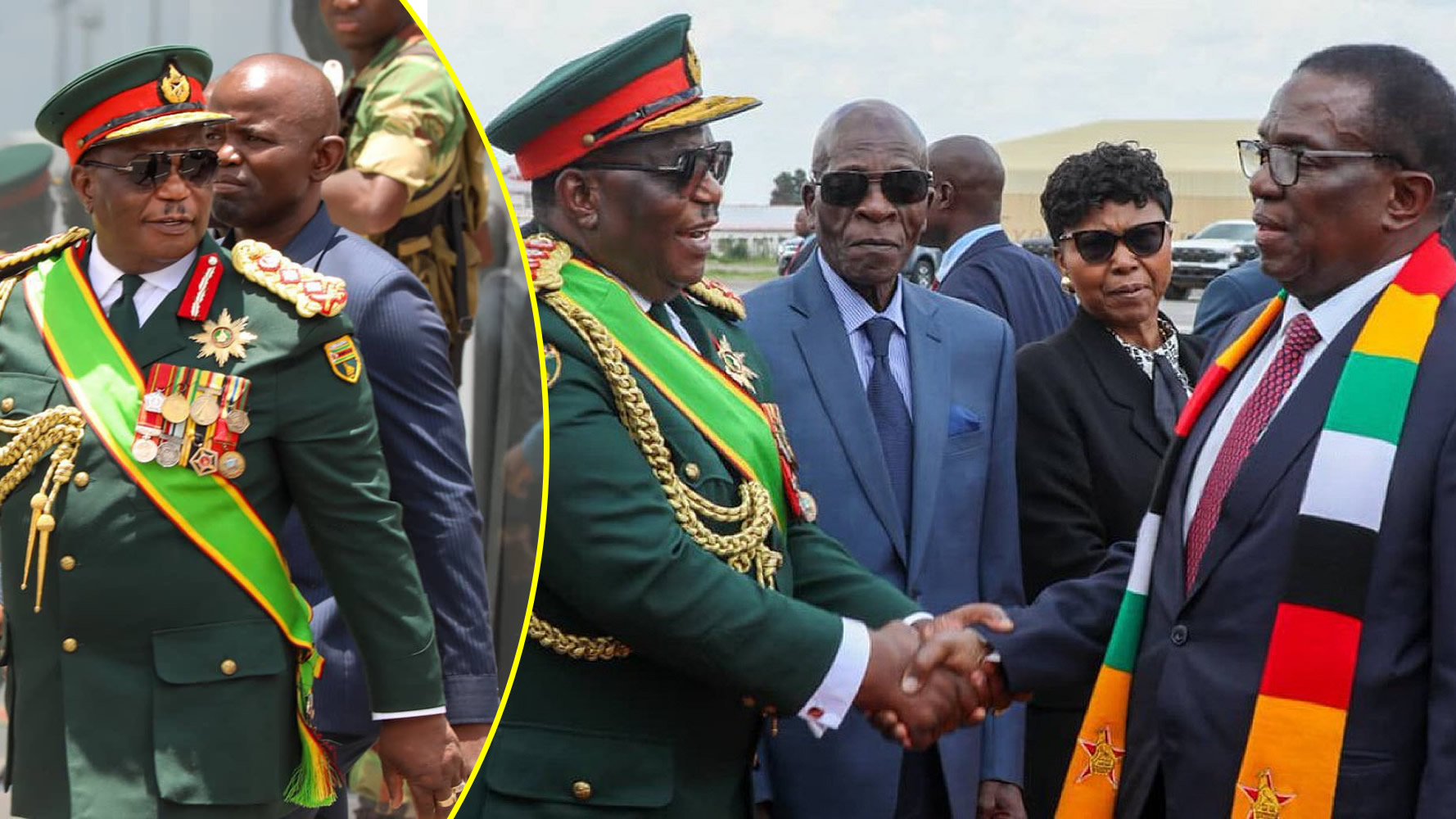
HARARE – A recent military handover ceremony has ignited a firestorm of speculation and unease within Zimbabwe’s ruling ZANU-PF party, as Vice President Constantino Chiwenga and Minister of Sports, Arts and Recreation Anselem Sanyatwe made striking appearances in full military uniform. The move, ostensibly a display of respect for outgoing Zimbabwe Defence Forces (ZDF) commander General Phillip Valerio Sibanda, has been interpreted by many as a calculated power play amid growing tensions over the country’s future leadership.
The handover-takeover parade, held at Charles Gumbo Barracks (formerly One Commando Barracks) in Cranborne, saw General Emmanuel Matatu formally assume command of the ZDF, replacing General Sibanda after 51 years of service. President Emmerson Mnangagwa, who is currently on a visit to Angola, delivered the keynote address as the chief witnessing officer and commander-in-chief. He urged General Matatu to uphold the high standards associated with the country’s armed forces and ensure continuity of programmes initiated under General Sibanda’s command.
“I am confident that you are equal to the task and that you will use your vast experience to effectively and professionally lead the ZDF, as was the case with your predecessor,” Mnangagwa said. “I urge you to continue maintaining the discipline and professionalism that the ZDF is renowned for and ensure that there is continuity of the programmes and plans that your predecessor has been undertaking.”
Mnangagwa also emphasised that although leadership changes, the mission of the military remains constant, calling on officers to remain loyal, disciplined and supportive of the new commander. “I implore you to render the same support and professionalism to the new Commander as you have always done,” he added.
However, the event was overshadowed by the presence of Vice President Chiwenga and Minister Sanyatwe, both decked out in their military regalia. Chiwenga, who served as ZDF commander for over a decade before retiring in 2017, stood alongside senior military chiefs as General Matatu took the oath of command. Sanyatwe, once one of the most powerful commanders within the Zimbabwe Defence Forces, played a central role in the 2017 coup as head of the Presidential Guard Brigade. He arrived at Charles Gumbo Barracks flanked by his wife, Deputy Home Affairs Minister Chido Sanyatwe.
While it is standard operating procedure and considered a privilege for honourably retired military commanders, including generals and any other retired personnel, to wear their uniforms which they got upon retirement at state military occasions and formal ceremonies, the timing of Chiwenga’s decision to don his military uniform was particularly symbolic. It came exactly eight years after Mnangagwa was sworn in as President, a rise made possible by the military intervention Chiwenga led. Since then, the Vice President has worked to present himself as a statesman, favouring suits and traditional attire. His choice to reappear in uniform was therefore deliberate. In Zimbabwe’s political culture, military uniforms convey authority, legitimacy, and the power to command. For a retired general and sitting Vice President, putting on that uniform at a public event is an unmistakable political signal.
The sight of Chiwenga and Sanyatwe in uniform sent shivers down the spines of Mnangagwa and his close allies at the event. Looking glum and ashen-faced, Mnangagwa, Defence minister Oppah Muchinguri-Kashiri, State Security minister Lovemore Matuke, Harare Minister of State for Provincial Affairs and Devolution Charles Tawengwa and others were visibly shaken and uncomfortable at the sight of Chiwenga throwing his height around like a military colossus. The timing of him as Acting President and Mnangagwa going out of the country made a bad situation worse. Their body language and faces showed they were not amused and bemused, while also shaken as Chiwenga reminded them in army uniform of the 2017 military coup which ousted the late former president Robert Mugabe after 37 years in power; 40 years as Zanu PF leader. Mnangagwa and Chiwenga are at loggerheads and at each other’s throats over succession, with the latter warning the former not to forget 2017.
Presidential spokesman George Charamba, however, dismissed the interpretations as misplaced. “The narrative on succession fears is fictional,” Charamba said on Tuesday. “What yesterday’s event did was to spark ignorance on an innocent story. It is a long-standing tradition in the military that when a full general exits and another comes in, all generals of the same rank re-emerge from retirement to don their uniforms as a mark of respect. That happens all the time when there is a change of guard at the military apex.”
Despite Charamba’s attempts to downplay the significance of the event, the optics of Chiwenga and Sanyatwe in military uniform have fuelled speculation about a potential power struggle within ZANU-PF. The military changes were widely seen as part of a coup-proofing strategy by Mnangagwa currently under a growing and intensifying succession challenge from Chiwenga.
Relations between Chiwenga and Mnangagwa have grown increasingly strained over the past five years. Mnangagwa has systematically weakened Chiwenga’s military base by retiring or reassigning loyalists such as Sanyatwe, Engelbert Rugeje, and the late Perrance Shiri. The rise of FAZ as the ruling party’s electoral machinery has also sidelined war veterans and disrupted traditional military patronage channels aligned with Chiwenga. Added to this are tensions over Mnangagwa’s suspected third-term ambitions, which clash directly with the informal 2017 agreement that he would serve one term before handing over power to Chiwenga. The Vice President’s recent admission that the 2017 transition was a coup further embarrassed Mnangagwa’s camp and aggravated internal rifts.
Sanyatwe’s appearance was equally significant. After Mnangagwa took office, Sanyatwe was moved out of the military and posted as ambassador to Tanzania, a move widely interpreted as an attempt to weaken Chiwenga’s influence. His return to Zimbabwe in 2024 and swift appointment as Sports Minister marked a surprising resurgence that many insiders interpreted as part of a broader consolidation of Chiwenga’s loyal networks. Seeing him back in military attire beside Chiwenga underscored the re-emergence of the alliances that shaped the 2017 military transition.
Outspoken war veteran and former ZANU-PF Central Committee member Blessed Geza has defended Vice President Constantino Chiwenga for wearing full military uniform during the Zimbabwe Defence Forces (ZDF) handover ceremony. “I’ve heard various comments about General Chiwenga wearing a military uniform at yesterday’s handover ceremony. I wish to clarify that retired military personnel are allowed to wear military attire at selected functions, but only with the President’s approval as Commander-in-Chief of the Defence Forces. General Chiwenga’s actions were therefore in line with protocol,” Geza posted on X. He urged Zimbabweans to avoid divisive rhetoric and instead focus on nation-building. “General Chiwenga and the President have a strong bond forged during the liberation struggle, and it’s essential to recognize the President’s seniority in both security and governance systems. General Chiwenga acknowledges this hierarchy; he respects the established order,” Geza added.
For Chiwenga, the uniform is a reminder of the authority he once held — and a signal that he still sees himself as the architect of Zimbabwe’s current political order. For Sanyatwe, it symbolises the revival of a military faction that felt marginalised under Mnangagwa’s restructuring of the security establishment. The visual message was unmistakable: the military networks that delivered Mnangagwa to power in 2017 are reasserting themselves ahead of the ruling party’s looming leadership battles.
The images have unsettled many in the ruling elite. To some, they reflect confidence and renewed momentum within Chiwenga’s camp; to others, they point to desperation and the escalation of a high-stakes struggle for power. For ordinary Zimbabweans, the sight of senior politicians in military attire recalls the unresolved traumas of 2008, 2017 and the army’s involvement in electoral and political affairs.
As Zimbabwe approaches the next election, the events at Charles Gumbo Barracks serve as a stark reminder of the ever-present influence of the military in the country’s political landscape. The question now is whether this display of military might will translate into a tangible shift in the balance of power within ZANU-PF, or whether it will simply remain a symbolic gesture in a complex and ever-evolving political drama.