



Harare – In the bustling, digital-first era of the mid-2020s, the boundary between fame and infamy has never been thinner. For Nadia, a young Zimbabwean woman known to millions as “Queen Nadia TV,” that line has not just been crossed—it has been obliterated. From the dusty streets of Mbare to the high-rise apartments of South Africa, her meteoric rise to digital stardom has culminated in a national scandal that has forced a reckoning between traditional Zimbabwean values and the lawless frontier of social media monetisation.
The numbers are, by any metric, staggering. In a country of approximately 17.4 million people, Queen Nadia managed to amass over 3.1 million followers on Facebook in less than three months. Even more shocking is the engagement: one billion views in a single 28-day period. To put that in perspective, her content has been viewed more times in a month than many global pop stars’ entire catalogues. But it is the nature of that content—short, “view-once” clips featuring brief, calculated flashes of her private parts—that has brought her to what many believe is the end of the road.
The Broadcasting Authority of Zimbabwe (BAZ) has finally broken its silence, issuing a stern warning that has effectively placed a target on the backs of creators who trade in explicit material. While the BAZ statement did not explicitly name Queen Nadia TV, the public consensus was immediate and unanimous. “The Authority reiterates that all broadcasting and digital content consumed within Zimbabwe is subject to the country’s legal and constitutional framework, irrespective of the platform through which such content is distributed,” the regulator declared. They further noted that while freedom of expression is protected under Section 61 of the Constitution, it must be exercised with “due regard to the rights of others,” as mandated by Section 86.
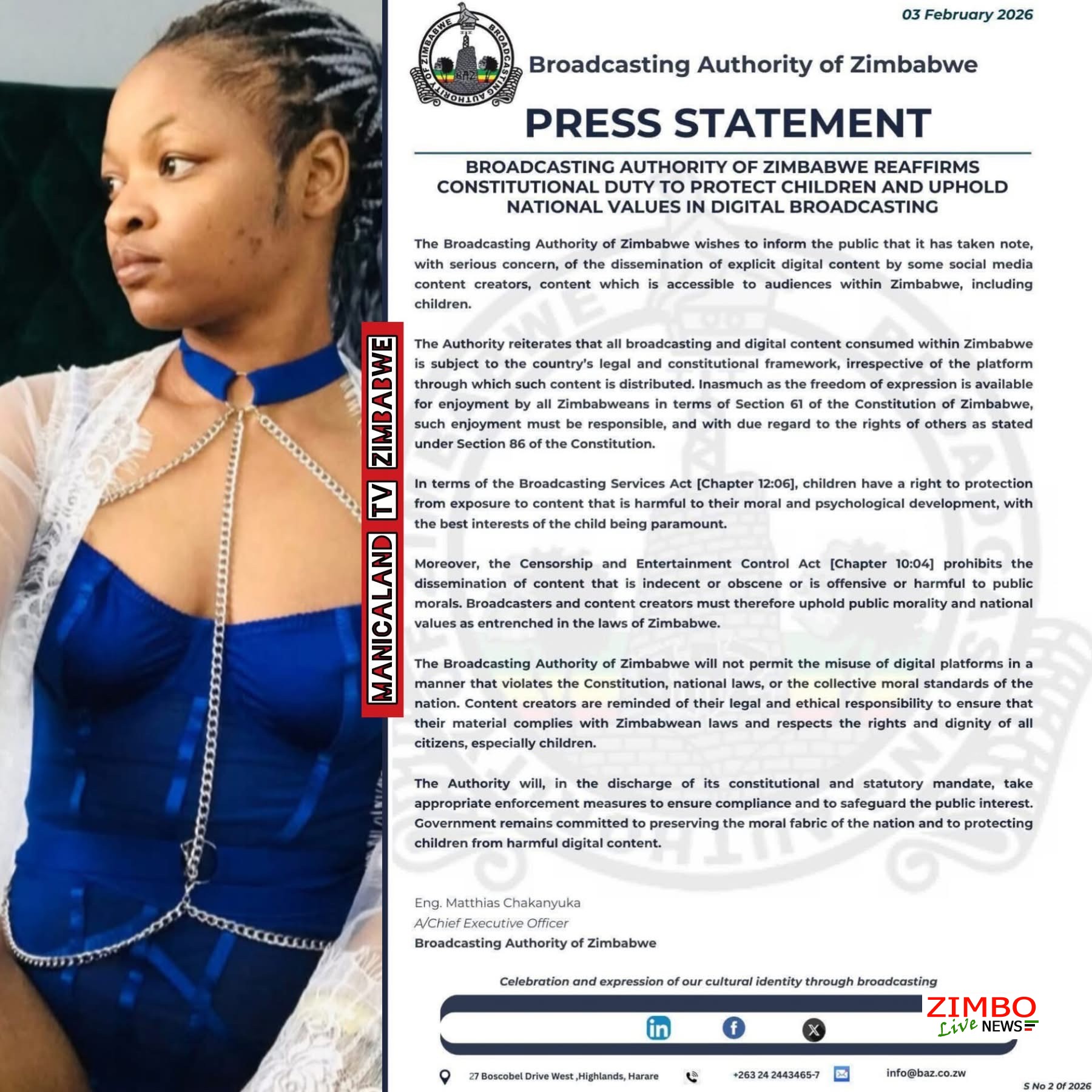
The backlash has been visceral, cutting across generations and social classes. For many, Queen Nadia represents a “digital Sodom and Gomorrah,” a sentiment echoed by Peter Chauke, a vocal critic who argued, “Posting ‘nudes’ on public platforms must be forbidden. Most of people who post such content are low lives who do not respect their bodies. Just imagine if one would take off their clothes completely in public, surely they would be arrested. The same laws must apply to those who post ‘nudes’ on public platforms.” This sentiment is shared by many who feel that the digital space has become a breeding ground for moral decay, where the quest for “likes” and “views” has superseded the basic tenets of human dignity. “This kind of content is dangerous,” wrote one concerned user, Tsitsi Gumbo. “Children are on these platforms. There has to be a line.”
The controversy took a deeply personal turn this week when a woman identifying herself as Nadia’s mother issued an emotional national apology. In a video that has since gone viral, the woman spoke of the profound embarrassment and social ostracisation she has faced because of her daughter’s actions. “I am very embarrassed as a mother,” she stated, her voice heavy with distress. “People are sending me WhatsApp messages every day. Others are coming to my home to show me the videos of my daughter and telling me to counsel her.” She described a life under siege, where her daughter’s digital exploits have become a source of daily humiliation in her physical community. “Some are not just sending messages,” she added, “They come personally to show me what my daughter is doing.”
Perhaps the most revealing part of the mother’s testimony was the glimpse into the cold economics of viral nudity. She claimed she had attempted to intervene, only to be rebuffed by a daughter who has prioritised digital currency over cultural capital. “I advised her many times,” the mother lamented. “But my words fell on deaf ears. She tells me this is where her bread is buttered.” Nadia had even gone as far as blocking her own mother on Facebook to hide the content, a move that only failed when neighbours and strangers began bringing their phones to the mother’s doorstep to show her the evidence. This revelation paints a stark picture of the generational divide: a mother clinging to traditional notions of honour, and a daughter who sees her body as a commodity in a global marketplace.
In a rare interview with the Kumusha Podcast Show, Queen Nadia herself labelled her posts as “view-once” content—material that disappears almost as quickly as it appears, but not before being widely viewed, shared, and debated. This “view-once” strategy seems to be a calculated attempt to bypass automated moderation while still capturing the massive engagement that drives revenue. She even shared a screenshot claiming that a single video had generated 122 million views, with estimated earnings of roughly $1,142.37 (approximately R18,430).
This “bread and butter” argument is not without its supporters, however. In an economy where traditional paths to success are often blocked, some see Nadia as a “brave” entrepreneur responding to a system that rewards controversy. A user posting under the name Flame Lily argued, “The Kardashians made their fortune from this sort of content. While it’s not normal, let’s allow that rare gem that’s brave enough to do it. If it results in sexual feeling for the viewer, that is not her problem. They are the ones with dirty filthy minds. And Facebook is not a baby sitter for your kids.” Another supporter, Lilian Peta, added, “Kids phone should have parental controls that’s all as a parent you’re responsible for what you child sees on socials media.”
But the legal reality is far more perilous than the court of public opinion. Under Zimbabwe’s Cyber and Data Protection Act, the distribution of “intimate images” without consent or in a manner that violates public decency carries heavy penalties, including significant prison time. Authorities are now under immense pressure to act, with some citizens calling for a total ban on social media for those under the age of 18 to protect them from the “X-rated content” churned out by platforms like Queen Nadia TV. “Our children are at risk, the world is evolving in bad ways, things that people are normalising these days will shock you,” said Trix Petroy, reflecting a widespread fear that the digital age is eroding the moral fabric of the nation.
The reach of her content is not limited to Zimbabwe. Analytics show that while she is a Zimbabwean native, her audience is global, spanning the Middle East, the United States, Nigeria, and the Philippines. This international footprint has complicated enforcement, as Nadia is currently based in South Africa. Yet, the BAZ has made it clear that the location of the creator does not grant them immunity if their content is consumed within Zimbabwean borders. The regulator’s stance is a clear signal to all “diaspora influencers” that they are still within the reach of Zimbabwean law if their content impacts the domestic audience.
This incident is part of a broader, more troubling trend. Other Zimbabwean women, such as Ever Mahushi, have previously navigated similar controversies, highlighting a growing tension between the traditional concept of hunhu or ubuntu—which emphasises modesty and communal respect—and the individualistic, attention-seeking nature of the “attention economy.” Seasoned content creator Admire “Bhutisi” Kuzhangaira pointed the finger back at the public, stating that consumers are ultimately to blame for the proliferation of such material. “If the views didn’t exist, the content wouldn’t be profitable,” he noted, suggesting that the problem lies as much with the audience as it does with the creator.
The scale of Nadia’s success—celebrating the purchase of a new car and receiving payouts from Meta (Facebook) reportedly worth US$1,120—has only added fuel to the fire. “Mark Zuckerberg, thank you,” she reportedly joked in one post, a comment that many saw as a slap in the face to the cultural values of her homeland. To her critics, this was not just a celebration of success, but a public endorsement of the very behaviour that was causing her family and nation such distress. It reinforced the idea that in the digital world, infamy is just as spendable as fame.
The debate has now shifted towards the responsibilities of the platforms themselves. Despite thousands of reports from Zimbabwean users, Meta has largely declined to take action, reportedly advising those who find the content offensive to simply scroll past it. This has sparked a debate about “digital colonialism,” where Western tech giants impose their own liberal standards of what is acceptable on cultures that have much stricter codes of public morality. Media analysts note that the saga highlights a broader issue: algorithms that prioritise engagement above all else, regardless of the social harm they may cause.
The rise of Queen Nadia is also a mirror to the economic desperation that drives many to extreme measures. In a country where formal employment is scarce, the allure of “easy money” through social media is powerful. Nadia herself has alluded to this, urging critics not to judge her because they do not know what she has endured. “Don’t judge me,” she has pleaded, “you don’t know my story.” This defence, however, has done little to satisfy those who believe that no amount of hardship justifies the public display of nudity on a platform accessible to children.
As the authorities prepare their next move, the story of Queen Nadia serves as a cautionary tale for the digital age. It is a story of how a girl from Mbare used a smartphone to command the attention of a billion eyes, only to find that the price of that attention might be her very place in the society she left behind. Whether she is a victim of economic circumstance or a willing architect of her own downfall, one thing is certain: the road she has been travelling has reached its end. The government’s vow to crackdown on such creators is a clear indication that the “wild west” era of Zimbabwean social media is coming to a close.
The question that remains for Zimbabwe is not just what to do with Queen Nadia, but how to govern a digital space that knows no borders and respects no traditions. As one social media user, Mukoma Dunnie, put it: “Australia, Britain and UAE have taken serious action to ban juveniles to have access to social media… we need to see the dangers in this.” For now, the nation watches and waits, as the digital collision of culture, law, and public morality continues to unfold in the palm of every Zimbabwean’s hand.
In the final analysis, the “Queen Nadia” phenomenon is more than just a scandal; it is a symptom of a world in transition. It is a world where the old rules of modesty and privacy are being rewritten by algorithms that reward the most provocative behaviour. For Nadia, the billion views and the new car may have seemed like a victory, but the cost—a mother’s public shame, a nation’s condemnation, and the looming threat of legal action—suggests that in the end, the road she chose was a dead end.
As the sun sets on this chapter of Zimbabwean digital history, the lessons learned will likely shape the country’s approach to social media for years to come. The call for stricter regulations, age limits, and more robust enforcement of decency laws is growing louder by the day. Whether these measures will be enough to stem the tide of explicit content remains to be seen, but for Queen Nadia, the verdict is already in: the road has ended, and the cost of her fame has finally come due.