


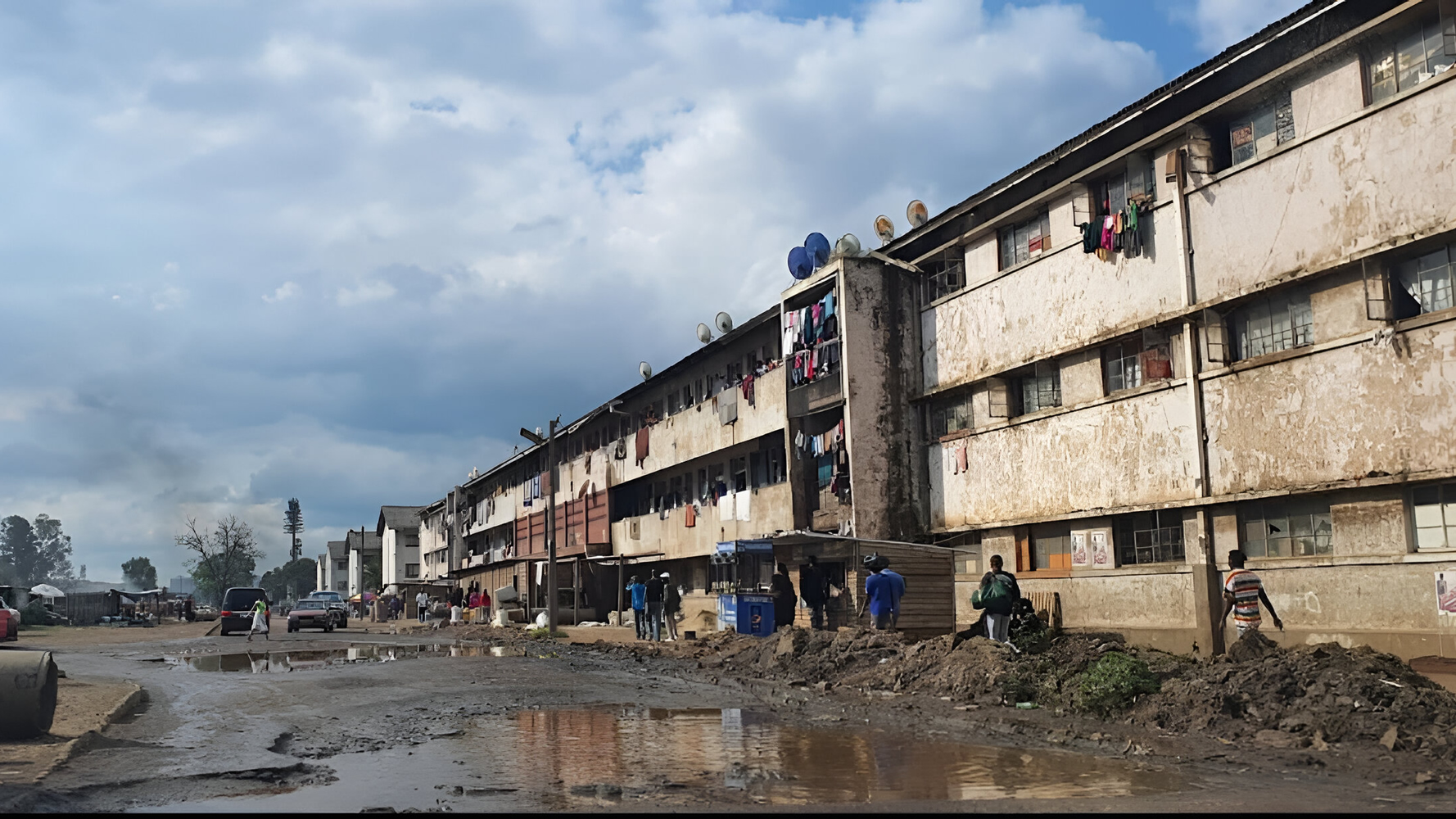
HARARE – A recent visit by the Zimbabwe Human Rights Commission (ZHRC) to Mbare’s Matapi flats has cast a harsh spotlight on the catastrophic state of living conditions in Harare’s oldest high-density suburb. What was intended as a fact-finding mission on Friday became a raw, unfiltered confrontation with years of systemic neglect, as residents actively resisted attempts by Harare City Council officials to present a sanitised version of their reality. Instead, they guided commissioners through a landscape of decay, demanding that the full extent of their daily suffering be witnessed.
The tour, led by ZHRC chairperson Jessie Majome, was prompted by a stream of disturbing images and videos circulating on social media, alongside concerns from commissioners who had passed through the area. It revealed a crisis of governance that has left thousands of people living in conditions described by the commission as a serious violation of fundamental human rights. The inspection laid bare a chasm between the lived experiences of residents—characterised by squalor, disease, and overcrowding—and the council’s narrative of resource constraints and resident non-compliance.
As the delegation navigated the crumbling corridors of the Matapi flats, they were met with a visceral assault on the senses. Raw sewage flowed openly in the pathways between blocks, mingling with mountains of uncollected rubbish that have become breeding grounds for pests and disease. The air was thick with an overpowering stench that, as Majome later noted, “no technology can capture.” Walls, cracked and crumbling, offered little protection from the elements, while leaking roofs ensured that the misery continued indoors during rainfall. Blocked drainage pipes and persistent electricity blackouts completed the picture of a community abandoned by its custodians.
Residents, desperate for their voices to be heard, crowded the commissioners, each with a story of hardship. They pointed to open pits from which they are forced to draw water for drinking, cooking, and washing, a direct result of the municipal water supply having failed more than a decade ago for many. This daily gamble with their health has become a grim routine, a stark illustration of the collapse of basic services. The scenes of residents doing laundry were ironically highlighted by council officials as proof of water availability, a claim that was met with derision by those who must haul every drop from contaminated sources.
The crisis extends beyond the visible decay of the infrastructure. The Matapi flats are dangerously overcrowded, a ticking time bomb of social and public health challenges. Rooms originally designed for single occupancy during the colonial era now house entire families, with some single rooms accommodating up to 13 people. In some instances, two separate families are forced to share a single, cramped space. Council officials confirmed that the population of the flats has swelled to approximately 12,800 residents, a figure more than four times the intended capacity of around 3,000. This extreme overcrowding exacerbates the already dire sanitation problems and has contributed to a series of public health emergencies.
In April 2025, the flats were gripped by a severe bed bug infestation that made life unbearable for the residents of Matapi and the nearby Matererini flats. The City of Harare was forced to launch a fumigation campaign, but for many, it was too little, too late. This came just four months after a landmark High Court ruling on December 11, 2024. Justice Nyaradzo Munangati-Manongwa had ordered the City of Harare and the national government to refurbish the Matapi, Matererini, Mbare, Nenyere, and Shawasha hostels, compelling them to restore essential services and make the buildings fit for human habitation. The ruling was a victory for the Combined Harare Residents Association (CHRA) and resident Israel Mabhoo, who had sued the authorities for dereliction of duty. Yet, the continued deterioration and the bed bug crisis underscored a glaring lack of enforcement and political will.
The squalid conditions have also made Mbare a hotspot for deadly waterborne diseases. Throughout 2024 and into 2025, Zimbabwe has battled a significant cholera outbreak, with over 35,000 cases and 600 deaths recorded nationally in 2024 alone. Mbare, with its collapsed water and sanitation infrastructure, has been a significant contributor to these statistics. Block 13 of Matapi flats was specifically identified as a source of cholera cases, a tragic but predictable outcome of forcing people to live amidst flowing sewage and to drink from unprotected wells. The situation was further compounded by a severe El Niño-induced drought, which placed even greater strain on the nation’s already precarious water supply.
During the tour, Jessie Majome did not mince her words, describing the situation as a profound failure of public administration. “What we observed here is no longer merely alarming; it has been normalised and that in itself is deeply troubling,” she stated, visibly moved by the experience. “And it’s not in Mbare alone. If the capital is in this state, then you can imagine what will be happening in other towns and cities.”
Majome emphasised that the conditions constituted a grave violation of the residents’ right to dignity. “There is no running water at all. The conditions are dirty and unhygienic, and the smell is overwhelming,” she said. “Even standing there is not for people of nervous disposition… In the toilets, there is no water and we observed accumulated sewage. It is really painful.”
Confronted with the overwhelming evidence of their failure, Harare City Council officials, represented by housing development officer Edgar Dzehonye and acting Region One manager Farai Mtawa, offered a familiar litany of excuses. They blamed residents for failing to pay rates, claiming that revenue collection in the hostels was as low as 4%, leaving the council without the resources needed for maintenance. They also accused residents of negligence and vandalism, suggesting they were partly responsible for the dilapidated state of their own homes.
Mtawa attempted to shift the focus to future promises, highlighting the city’s newly launched master plan. “As a city, we have just launched our master plan, which, when finalised, will guide development until 2045. Mbare is included in the urban renewal strategy,” she explained. “The long-term plan is to construct new flats with proper ablution facilities for each family, so we can move towards a world-class city with decent housing for everyone. We are yet to finalise the business proposal and we will work with the government to ensure we provide decent housing for all residents.”
However, these long-term promises ring hollow for residents who have heard them before. Edgar Dzehonye admitted as much, stating, “The initiatives we have to address the situation in Mbare were not influenced by the recent preparation of the master plan. These plans have been in place way back.” He recounted a failed partnership with a local bank that was meant to improve conditions and described a strategy of constructing new blocks and demolishing old ones, a plan that has been perpetually stalled by the inability to secure capable partners.
The cycle of broken promises, administrative inertia, and the normalisation of inhumane living conditions has left the residents of Mbare in a state of perpetual crisis. The ZHRC’s visit has once again documented the emergency, but the question remains whether this latest exposure will finally catalyse the political will and decisive action needed to restore dignity and basic human rights to the thousands of people trapped in the squalor of Mbare’s flats. For now, they continue to wait, their lives hanging in the balance amidst the filth and decay of a city that has forgotten them.