


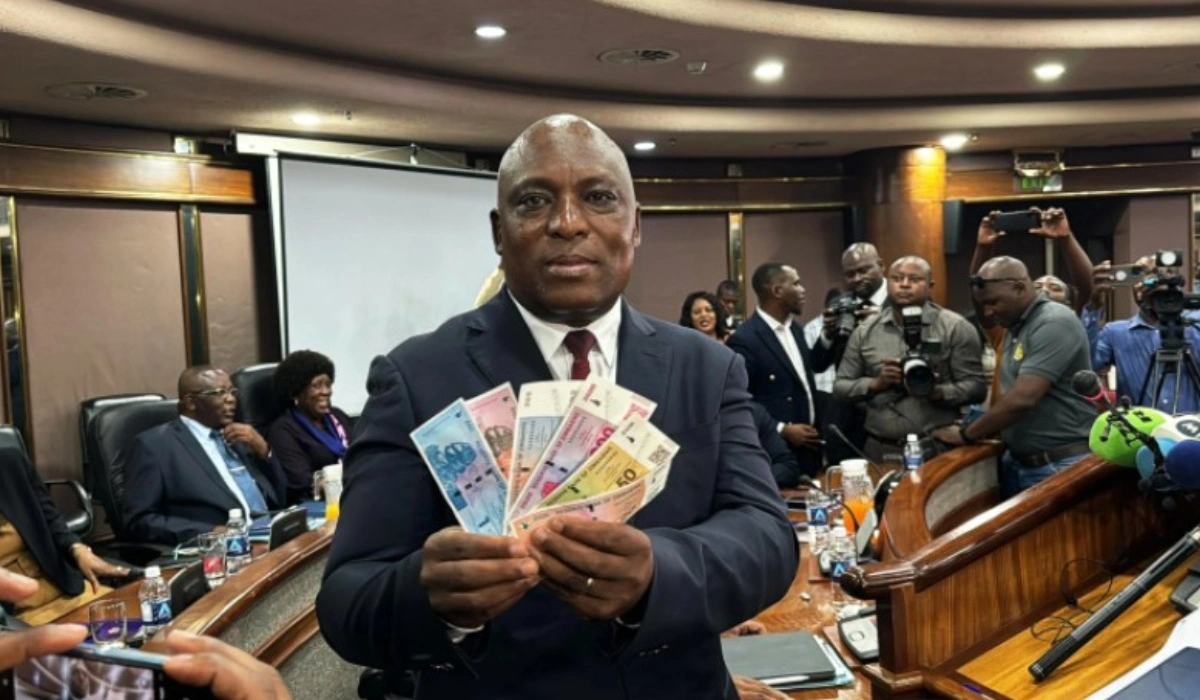
HARARE – Zimbabwe’s annual inflation rate has plummeted to 4.1%, a figure that marks the first time the nation has seen single-digit inflation since 1997. Authorities have hailed the development as a landmark achievement, attributing the success to a cocktail of stringent policies and the introduction of a new currency, the Zimbabwe Gold (ZiG), in April 2024. However, beneath the celebratory headlines lies a far more complex and precarious economic reality, as the government embarks on an ambitious and perilous journey to de-dollarise its economy by 2030.
The dramatic drop in inflation, which stood at 15% just a month prior, was no accident. It is the result of a concerted effort by the Reserve Bank of Zimbabwe (RBZ) to impose stability on a notoriously volatile economy. A key driver has been a tight monetary policy designed to curb the excessive money creation that has historically fuelled hyperinflation. By severely restricting the growth of ZiG liquidity and limiting the direct financing of government spending, the central bank has managed to put a leash on inflationary pressures.
In a statement, Zimbabwe’s Finance Minister, Mthuli Ncube, celebrated the outcome, stating, “The implementation of prudent fiscal policy over the past few years, and complementary monetary policy since the introduction of ZiG in April 2024, has resulted in macroeconomic stability.”
This newfound stability has also been reflected in the exchange rate. While the ZiG has not seen a significant appreciation in value, its relative stability against the US dollar in recent months has been a crucial factor. In Zimbabwe, inflation has always danced to the tune of the exchange rate. Historically, any sharp depreciation of the local currency would trigger immediate and aggressive price hikes as businesses scrambled to shield themselves from losses. The recent period of calm has discouraged such speculative pricing, contributing to the slowdown in inflation.
Furthermore, the government has deployed a range of administrative measures to enforce the use of the ZiG. The payment of taxes and other domestic transactions have been mandated in the local currency, and authorities have intensified their monitoring of pricing behaviour, cracking down on businesses that reference the parallel market exchange rate. Confidence, however fragile, has also been bolstered by a significant increase in the foreign assets backing the ZiG. According to Minister Ncube, these reserves swelled from just $276 million at the currency’s launch to $1.2 billion by December 2024, helping to allay fears of an imminent currency collapse.
Yet, this apparent success story is but one side of a multi-faceted coin. The government’s ultimate goal extends far beyond mere inflation control. On 8 January 2026, the RBZ unveiled its Five-Year Strategic Plan, a roadmap that places the transition to a mono-currency economy at its very core. The plan signals a determined push to phase out the US dollar, which has been the lifeblood of the Zimbabwean economy for the better part of two decades, and restore the ZiG as the sole legal tender by 2030.
The government argues that this move is essential for regaining monetary sovereignty, allowing the central bank to fully control currency supply and implement independent economic policies. Proponents believe a local currency will enhance the competitiveness of local manufacturing by lowering production costs and enable the government to pay for critical infrastructure projects without relying on scarce foreign currency.
However, the path to de-dollarisation is fraught with monumental challenges, leading many analysts and ordinary Zimbabweans to view the 2030 target with deep-seated scepticism. The nation is caught in what economists term a “dollarisation trap.” Having officially adopted a multi-currency system in 2009 following the catastrophic hyperinflation of 2007-2008 which rendered the original Zimbabwe dollar worthless, the economy has become deeply intertwined with the US dollar. Over 80% of all transactions, from grocery shopping to corporate procurement, are conducted in US dollars. The greenback is not just a medium of exchange; it is the primary store of value, a safe haven for savings in a country where trust in domestic financial institutions has been systematically eroded over two decades.
The memory of past economic traumas looms large. Zimbabweans have endured a painful history of failed currency experiments. Since 2009, the country has seen no fewer than four local currency initiatives crumble, including the bond coins (2014), bond notes (2016), and the RTGS dollar (2019), which was declared the sole legal tender only to collapse within a year, plunging the nation back into a hyperinflationary spiral. This history of broken promises and wiped-out savings has cultivated a profound and understandable trust deficit. As recently as 27 September 2024, the RBZ devalued the ZiG by a staggering 43% overnight, reinforcing the public’s preference for the stability of the US dollar.
This deep-seated lack of confidence is a formidable obstacle. The RBZ’s strategy acknowledges that the transition must be “market-driven,” yet the market continues to vote with its wallets, overwhelmingly favouring the dollar. While the headline ZiG inflation rate has fallen, US dollar inflation within Zimbabwe remains stubbornly high at an estimated 12.3%, a figure far exceeding the 2.7% inflation rate in the United States itself. This discrepancy highlights the structural inefficiencies, import dependencies, and supply constraints that plague the Zimbabwean economy, issues that a change in currency alone cannot resolve.
The very tools used to achieve the current single-digit inflation figure have come at a significant cost. The RBZ’s tight monetary policy, with a benchmark interest rate held at a punishing 35%, has created an acute liquidity crisis. Businesses across all sectors, from large corporations like OK Zimbabwe and Khaya Cement to small and medium-sized enterprises, are struggling to access credit. This liquidity squeeze is stifling growth, delaying expansion plans, and choking economic activity. In an economy where the local currency accounts for less than 20% of transactions, such a blunt monetary instrument has limited reach and risks strangling the very productive sectors the government aims to support.
Furthermore, fiscal policy remains a significant source of instability. While the government has made efforts to clean up the central bank’s balance sheet, persistent delays in payments to government contractors and suppliers have become a form of implicit fiscal adjustment. This practice shifts the liquidity burden onto the private sector, creating a vicious cycle. Contractors who are not paid on time in ZiG have little incentive to accept the local currency, further weakening its transactional demand and reinforcing the dominance of the dollar.
The de-dollarisation agenda is also highly vulnerable to external shocks. Zimbabwe’s economy is heavily reliant on commodity exports, particularly gold. The recent surge in global gold prices, which surpassed $5,500 per ounce in January 2026, has been a significant boon, contributing to a record trade surplus of $240.2 million in December 2025. However, this reliance is a double-edged sword. Any downturn in global commodity prices, whether triggered by an easing of geopolitical tensions or a slowdown in global demand, would severely impact foreign currency inflows, deplete the nation’s reserve buffers, and undermine the very foundation of the mono-currency plan.
Zimbabwe’s predicament is a stark illustration of the immense difficulty a nation faces when trying to extricate itself from the grip of the US dollar. Once a country is fully dollarised, the path back to monetary sovereignty is treacherous and uncertain. The process requires not just sound economic policies but also the rebuilding of trust, a commodity that is far harder to earn than foreign currency. As Zimbabwe pushes forward with its ambitious 2030 vision, it may well become a test case for the world, demonstrating the profound challenges of de-dollarisation in an economy that has long since adopted the world’s most preferred currency as its own. The road ahead is long, and the stakes could not be higher.