


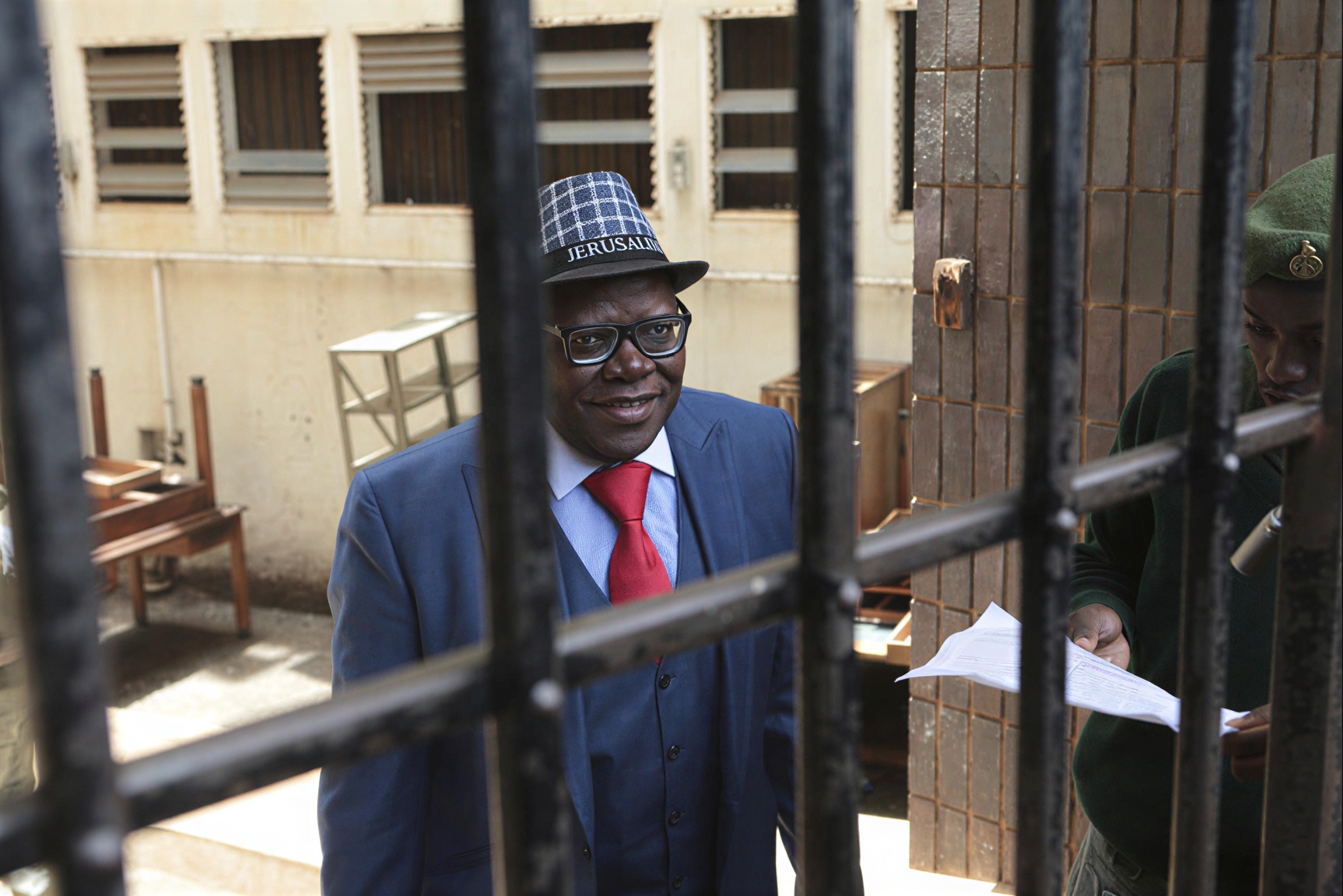
HARARE — In the leafy suburb of Milton Park, a ten-ton police truck sits permanently stationed across from a law office. Inside the vehicle, officers are armed to the teeth with AK-47 rifles, truncheons, and tear smoke canisters. This is not a scene from a war zone, but the daily reality for Tendai Biti, one of Zimbabwe’s most prominent legal minds. Across the city at Bumbiro House, Professor Lovemore Madhuku, another titan of the constitutional bar, still bears the physical scars of a brutal assault carried out by men in balaclavas while the police watched in silence.
What appeared to be isolated incidents of police harassment have now been revealed as part of a coordinated, state-sponsored campaign. Our investigation has uncovered evidence of a secret “Internal Security Directive” issued to the Zimbabwe Republic Police (ZRP). This directive marks a chilling escalation in the state’s efforts to maintain its grip on power, moving beyond the suppression of public protests to the criminalisation of political thought within the sanctuary of private homes and offices.
The primary targets of this crackdown are Biti and Madhuku, two seasoned lawyers who have spent decades defending the Zimbabwean constitution. The state appears particularly terrified of what insiders call a “Coalition of the Wise”—a potential alliance between these two legal giants that could galvanise a unified opposition front. By disrupting their private meetings, the police are not merely enforcing the law; they are “pre-empting” the formation of a movement that could challenge the government’s latest plan to rewrite the supreme law of the land.
At the heart of this legal and political storm is the Constitution of Zimbabwe Amendment (No. 3) Bill, 2026. This controversial piece of legislation proposes seismic changes to the country’s democratic framework. If passed, it would extend the presidential term from five to seven years and, perhaps most significantly, abolish the direct popular vote for the presidency, allowing Parliament to elect the head of state instead. The bill also seeks to add ten unelected senators appointed directly by the President and remove the non-partisan requirement for traditional chiefs.
For Biti and Madhuku, the bill represents a fundamental assault on the democratic gains made since the adoption of the 2013 Constitution. “I have no doubt that what the Police are doing is to prevent me and others from discussing the Constitution of Zimbabwe (Amendment) No. 3 Bill, 2026,” Biti told the High Court in a supporting affidavit. He described the heavy police presence outside his practice as an attempt to intimidate both him and any citizens who might seek his legal counsel on the matter. “I do not know which law and order the Police were referring to. I am a law-abiding citizen. I have not broken any law.”
The brutality of the state’s response was laid bare on March 1, 2026, when Professor Madhuku attempted to host a private meeting of the National Constitutional Assembly (NCA) at Bumbiro House. About 500 members had gathered in the private premises, which also house Madhuku’s law firm, to discuss the implications of the proposed constitutional amendments. As the meeting was about to begin, five men wearing balaclavas forced their way onto the property.
Madhuku’s account of what followed is harrowing. “They started saying that I was giving them problems. They then started to beat me with truncheons all over my body,” he stated in his founding affidavit. The assault lasted for approximately ten minutes, leaving Madhuku with severe blunt trauma and requiring hospitalisation. “The beating was severe, savage, and sadistic. It was intrinsically barbaric. It appears as if I was being assaulted by zombies.”
Perhaps the most disturbing aspect of the attack was the role—or lack thereof—of the Zimbabwe Republic Police. According to Madhuku and other witnesses, police vehicles were stationed directly outside the premises during the entire ordeal. “From the broken gate, I could see that the Police could see and hear that I was being beaten,” Madhuku said. “Either our assailants were Police officers or their accomplices. I find the acts and omissions of the police quite reprehensible.”
The state’s legal justification for these disruptions rests on a controversial interpretation of the Maintenance of Peace and Order Act (MOPA). Under the law, organisers of “public gatherings” are required to notify the police in advance. However, the Act clearly distinguishes between public and private gatherings. Private meetings, held on private property for specific members of an organisation, do not require such notification.
Our investigation shows that the ZRP is intentionally blurring this line, treating any gathering of more than a few individuals as a “threat to national security.” By stretching MOPA beyond its legal limits, the state is effectively creating a “surveillance state” where no conversation is safe from the prying eyes and heavy boots of the authorities. “Bumbiro House is a private place and our meeting was not a public gathering,” Madhuku argued in his court application. “The Police cannot and should not prevent or interfere with private meetings under the guise or excuse of maintaining law and order.”
The timing of this crackdown is no coincidence. Parliament opened a 90-day consultation period on the Amendment No. 3 Bill on February 16, 2026. This window is intended to allow citizens to voice their opinions on the proposed changes. However, by blocking Biti and Madhuku from meeting with their constituents and colleagues, the state is effectively silencing the most articulate critics of the bill during the most critical period of debate.
“Applicants and others need to meet and take a firm position on the proposed bill,” Madhuku stated, emphasising the urgency of their High Court bid. “I must be clear, Applicants are opposed to the proposed amendment. However, this is no good reason for the Respondents or anyone to seek to bar our private meetings.”
The fear within the corridors of power appears to be rooted in the intellectual weight that Biti and Madhuku carry. Unlike spontaneous street protests, which the state has become adept at crushing through brute force, the “Coalition of the Wise” represents a different kind of threat: a legal and intellectual challenge that could delegitimise the government’s constitutional project both at home and abroad. By treating these private discussions as criminal acts, the state is attempting to decapitate the opposition before it can even formulate a strategy.
The implications of this “Secret Directive” extend far beyond the two lawyers at the centre of the storm. If the state can successfully criminalise private political discussion among high-profile figures like Biti and Madhuku, then no ordinary citizen is safe. The message being sent is clear: even in the privacy of your own home or office, your thoughts and conversations are subject to state approval.
The High Court application filed by the National Constitutional Assembly, Madhuku, and Biti seeks a declaratory order to stop the police from interfering with private meetings. It is a desperate attempt to use the very law the state is trying to rewrite to protect the fundamental rights of Zimbabweans. The applicants argue that the police’s actions violate several constitutional rights, including the right to dignity, personal security, freedom of assembly, and political rights.
“It is unlawful for members of the Police to prevent, disrupt or in any way interfere with members of the public’s meetings in private places,” the application states. Yet, as Biti experienced when he was chased by unmarked vehicles after confronting officers outside his office, the “rule of law” in Zimbabwe is increasingly being replaced by the “rule of the truncheon.”
As the 90-day consultation period for the Amendment No. 3 Bill continues, the eyes of the international community are beginning to turn toward Harare. Human rights organisations have already called for an independent investigation into the attack on Professor Madhuku. However, for the citizens of Zimbabwe, the concern is more immediate. They are watching a state that is no longer content with controlling the streets, but is now moving to occupy the very spaces where democracy begins: in the private exchange of ideas and the quiet conversations of those who dare to dream of a different future.
The “Secret Directive” may have succeeded in bruising Professor Madhuku and intimidating Tendai Biti, but it has also unmasked the state’s profound insecurity. A government that is truly confident in its mandate does not need to station ten-ton trucks outside law offices or send men in balaclavas to disrupt private meetings. In its attempt to crush the “Coalition of the Wise,” the state may have inadvertently proven just how powerful those wise voices truly are.
The struggle for the soul of the Zimbabwean constitution is now being fought not just in the halls of Parliament or the courtrooms of the High Court, but in every private space where citizens gather to talk. If Biti and Madhuku can be silenced in private, the prying eyes of the state will soon find their way into every corner of Zimbabwean life. The “Secret Directive” is not just a police order; it is a declaration of war on the right to think.