


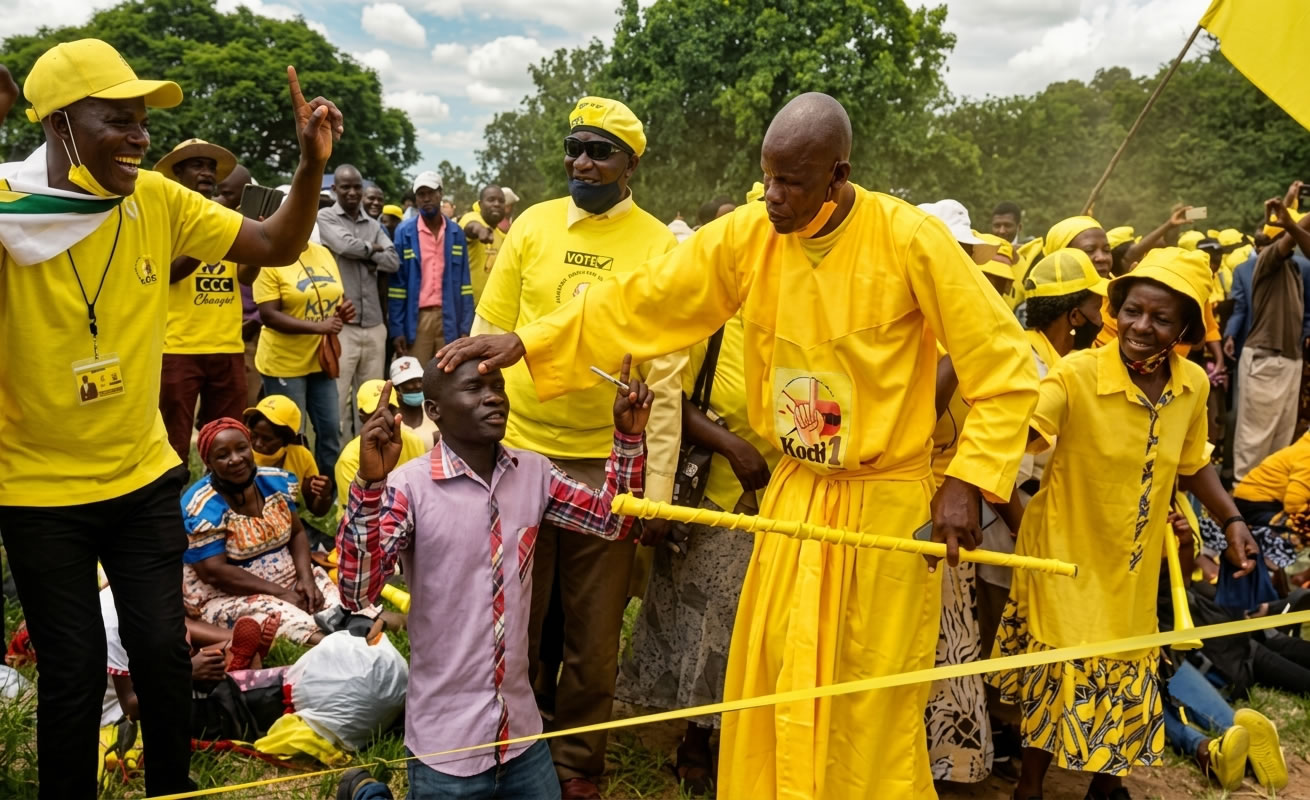
Harare – Godfrey Karembera, known to his fervent followers and the apprehensive state alike as Madzibaba Veshanduko, has once again found himself at the centre of a political maelstrom in Zimbabwe. Despite a recent acquittal that saw him walk free after eight months in pre-trial detention, the Zimbabwe Republic Police (ZRP) has issued a fresh public appeal for his arrest, alleging he has “undermined police authority”. This relentless pursuit of a man whose only apparent crime is his ability to mobilise the grassroots raises a critical question: why is the state so profoundly obsessed with a simple man in a yellow apostolic robe?
Sources reveal a deeper, more unsettling narrative: a calculated conspiracy to silence influential commoners before the anticipated 2030 term extension protests gain unstoppable momentum. Karembera’s defiance is not merely a singular act; it is his unique capacity to galvanise ordinary citizens in a manner that the formal opposition has struggled to achieve. This makes him an existential threat to the ruling elite.
The latest police appeal, issued on 22 July 2026, seeks information on Karembera’s whereabouts. Yet, conspicuously, it lacks specific details of a new crime. This omission strongly suggests a tactical manoeuvre designed to keep him in hiding and disconnected from his burgeoning base of support. The allegations of “undermining police authority” reportedly stem from instances where he allegedly told officers they were “used and manipulated by VP Chiwenga” and referred to them as “dogs”. Such charges, often vaguely defined, have historically been weaponised against dissenting voices in Zimbabwe, serving as a convenient legal pretext for political harassment.
To truly understand the state’s apprehension, one must delve into the heart of Zimbabwe’s apostolic sects. These religious communities have traditionally been a steadfast stronghold for the ruling ZANU PF party, forming the bedrock of its rural support. However, Madzibaba Veshanduko’s “yellow” brand, symbolising his allegiance to the opposition Citizens Coalition for Change (CCC), represents a significant crack in this foundation. The fear within the corridors of power is palpable: if a prominent Madzibaba can openly support the opposition and endure state harassment, the ruling party’s grip on millions of apostolic voters could irrevocably crumble. This is not merely a political challenge; it is perceived as a potential religious uprising, threatening to dismantle decades of carefully cultivated loyalty.
Karembera’s journey into the national spotlight began long before this latest warrant. On 17 March 2022, he was first arrested in central Harare while campaigning for by-elections. His offence then was wearing a yellow gown and engaging in what police deemed “unsanctioned political activity,” leading to a charge of disorderly conduct. During this detention, he was allegedly subjected to severe physical assault by police, sustaining injuries to his legs and back. Images circulated at the time depicted wounds said to be from these beatings, drawing condemnation from civil society and human rights organisations. Human Rights Watch later cited his case in a report detailing the treatment of opposition supporters ahead of the August 2023 elections.
His activism continued, leading to further confrontations with the state. In January 2023, Karembera faced threats of eviction from his ancestral home in Mutata Village, Guruve South, due to his unwavering support for the opposition. This move, widely seen as an attempt to economically disenfranchise and silence him, prompted calls for President Emmerson Mnangagwa to intervene. These incidents paint a consistent picture of a state determined to suppress any form of dissent, particularly when it emanates from influential community figures.
The most significant legal battle prior to his recent acquittal unfolded in October 2025. Following a police manhunt, Karembera was arrested after a high-speed chase, accused of distributing flyers in Harare’s high-density suburbs. He was jointly charged with other activists for incitement to commit public violence, linked to a planned “One Million Men March” against alleged corruption and poor governance under the Mnangagwa administration. He spent a gruelling eight months in remand prison, a period during which he spoke of feeling isolated and abandoned by some political colleagues, and his family faced considerable economic hardship.
However, on 3 June 2026, justice, albeit delayed, prevailed. Harare magistrate Lisa Mutendereki acquitted and discharged Madzibaba Veshanduko, along with his co-accused, Jim Kunaka and Malcolm Masarira. The court found that the prosecution had failed to establish a prima facie case, concluding there was no evidence connecting him to the alleged offence. His lawyer, Paida Saurombe of the Zimbabwe Lawyers for Human Rights (ZLHR), confirmed the magistrate’s ruling, highlighting the state’s inability to substantiate its claims.
This acquittal, however, proved to be a brief respite. Less than two months later, the ZRP’s renewed public appeal for his arrest underscores the state’s relentless determination. The timing is particularly telling, coinciding with a period of heightened political tension surrounding President Mnangagwa’s bid for a term extension. On 24 June 2026, the Senate approved a constitutional amendment that could see Mnangagwa remain in office until 2030. This move has ignited widespread concern and calls for protests, with the government already issuing stern warnings against demonstrations planned for 31 July 2026.
The political calculus behind Madzibaba Veshanduko’s latest legal ‘cat and mouse’ hunt is straightforward: why would the state expend significant resources – thousands of dollars in fuel and manpower – to hunt down one man? The answer lies in the upcoming 2030 and 2037 term extension plans. The ruling party desperately needs a compliant population to facilitate these constitutional changes without significant opposition. Madzibaba Veshanduko, with his loud and visible reminder that not everyone is accepting the official narrative, poses a direct threat to this agenda.
His influence extends beyond mere political activism; it touches upon the very fabric of religious freedom in Zimbabwe. By targeting a religious leader who mobilises his community for political change, the ruling elite risks alienating a significant portion of the population that traditionally respects spiritual authority.