


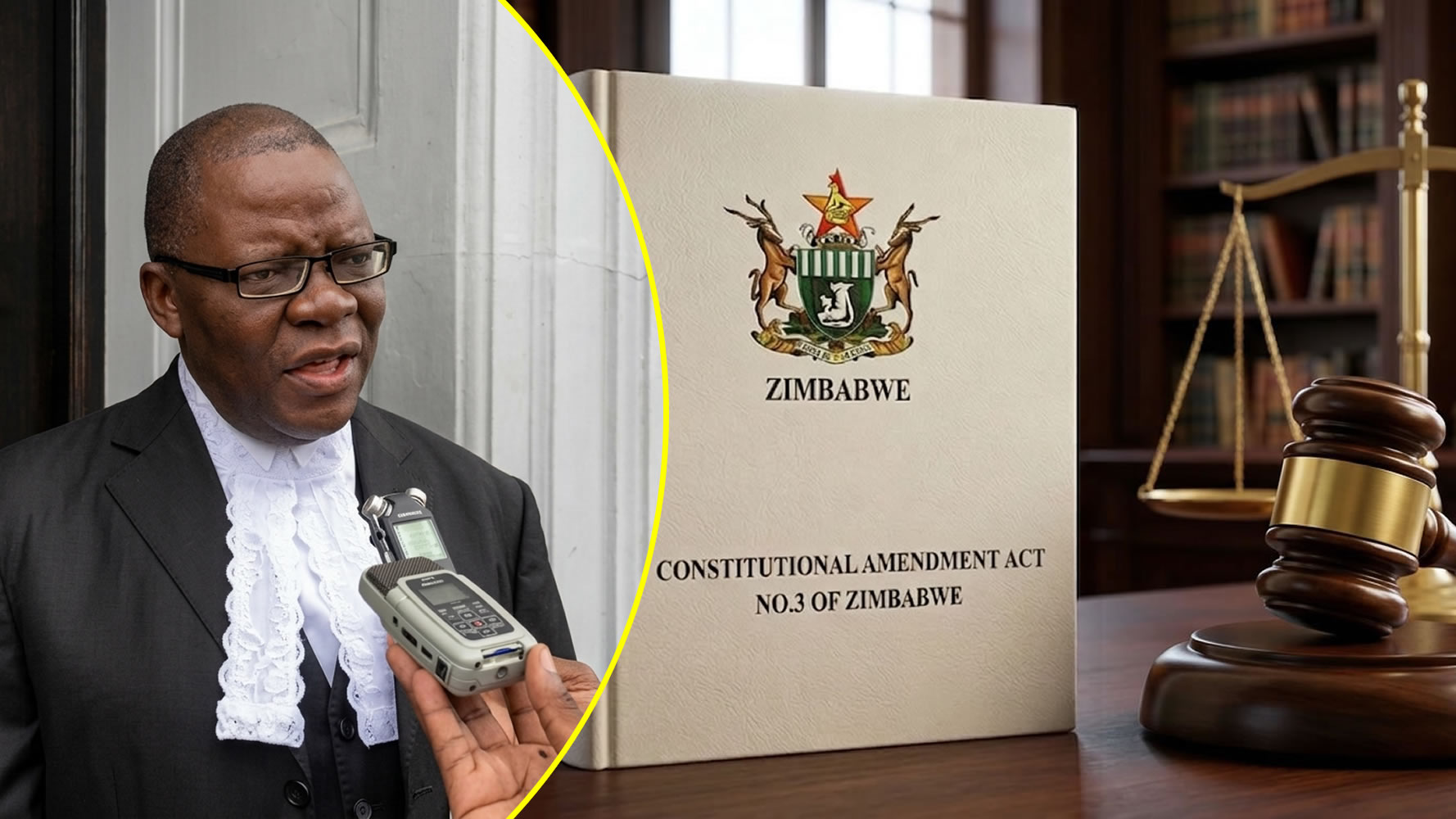
Former finance minister Tendai Biti has warned that Zimbabwe is being driven away from republican government and towards a monarchy, where the state will be governed by a king not a president, as liberation war veterans opposing Constitution Amendment Act No. 3 prepare to continue their challenge in the courts.
Biti said the changes introduced by the legislation were not simply an adjustment to the Constitution but part of a wider attempt to weaken the country’s democratic system. He said the campaign to keep President Emmerson Mnangagwa in power had now moved beyond extending his term and was threatening the character of the state itself.
“We will resist any attempt to destroy Zimbabwe and establish a monarchy — a dubious monarchy, for that matter — by people who are never and were never claimants of the original Munhumutapa kingdom,” Biti said on Monday.
His comments followed the enactment of Constitution of Zimbabwe Amendment No. 3, which was signed into law in July. The Act extends presidential and parliamentary terms from five years to seven, postpones elections that were due in 2028 to 2030 and replaces the direct election of the president with a process in which Parliament selects the head of state.
It also increases the size of the Senate from 80 members to 90. The changes affect the political timetable, the way the president is chosen and the balance of power inside the legislature, where the ruling Zanu PF holds a commanding majority.
“But we are concerned that the regime is already on autopilot to amend this constitution — not just to amend it, to destroy this constitution through the introduction of a monarchy and the destruction of a republic,” Biti said.
“Zimbabwe is a republic. People died to establish this republic. When they went to war, they went to war to vindicate the principle of ‘one man, one vote’, the principle of ‘one woman, one vote’. Representative democracy is at the epicentre of republicanism.”
The monarchy warning has been fuelled by the official declaration of Mnangagwa’s birthday as a public holiday called Munhumutapa Day, as well as by the president’s public association with the name Munhumutapa. The title refers to rulers of an ancient empire that extended across parts of present-day Zimbabwe and Mozambique.
Biti said the symbolism was part of a dangerous political direction. “Even the same charlatan regime that runs us masquerades under a moniker: ‘The Second Republic’ — that’s what they call themselves,” he said.
“So we will not accept that absolute nonsense — a nonsense that will cross the lines. Those who fought to establish this republic will not sit and watch. We, who were too young to participate in that war, will not sit and watch the decimation of the Zimbabwean state, the decimation of the Zimbabwean Republic.”
He said any move to create a monarchy would violate the basic structure of the Constitution. “And such a constitutional amendment is an unlawful constitutional amendment, because the basic structure of the Zimbabwean Constitution is republicanism,” Biti said. “So you are creating a monster that is not connected to that constitution. Don’t call it a constitutional amendment — it is a coup, a blatant coup against republicanism, and we will not accept that.”
The remarks came as a group of war veterans rejected attempts by senior Zanu PF figures to portray opposition to CAA3 as rebellion. The War Veterans Pressure Group said its members had a duty to defend the Constitution, even when their position differed from that of the ruling party.
“Going to court is not rebellion. Defending the Constitution is not betrayal,” the group said through its secretary, Godfrey Gurira.
“Holding a different political opinion does not make a liberation war veteran less of a liberation war veteran.”
Gurira heads the war veterans desk of the Defend the Constitution Platform, led by Jameson Timba. The pressure group is also part of Sungano yeVanhu, a coalition that has since reconstituted itself as the Constitutional Restoration Movement.
The group’s statement was directed at Zanu PF spokesperson Christopher Mutsvangwa, party secretary for war veterans Douglas Mahiya and businessman Wicknell Chivayo. Mutsvangwa has held senior positions in war-veterans’ structures and served as minister responsible for war veterans. Mahiya has previously warned that veterans who use the association to promote what he described as “divisive agendas” could be blacklisted and stopped from speaking on behalf of the wider war-veterans’ movement.
In March, Mahiya called on war veterans to support CAA3 and to follow the Zanu PF resolution backing Mnangagwa’s continued stay in office until 2030.
Gurira said the party’s authority did not extend to the country’s supreme law. “Zanu PF may exercise authority over its members, but it does not exercise supremacy over the Constitution of Zimbabwe,” he said.
“The War Veterans Pressure Group will not be intimidated. We will continue to stand with all Zimbabweans committed to defending the 2013 Constitution and the sovereignty of the people. We have chosen the Constitution. We have chosen the courts. We have chosen peaceful and lawful action. And on fundamental changes to the democratic settlement of our country, our position remains clear: Let the people decide.”
Six liberation war veterans, including Reuben Zulu, are asking the Constitutional Court to allow them direct access to challenge the amendment. The court heard the application last week and reserved judgment. The veterans are represented by constitutional law professor Lovemore Madhuku, Advocate Lewis Uriri and Advocate Tawanda Zhuwarara.
The applicants argue that changes of such importance required a national referendum under Section 328 of the Constitution. Their challenge began before the amendment was enacted and has now shifted to the legality of the law itself.
The dispute has also been drawn into a controversy involving Uriri and Chivayo. On 21 September, Chivayo offered the lawyer a package worth US$350,000, consisting of a 2026 Range Rover Sport Autobiography valued at US$250,000, US$50,000 for fuel and a further US$50,000 described as a “handbag allowance” for Uriri’s wife.
Uriri rejected the package. He said accepting gifts of that value could create a perception of financial obligation and damage public confidence in his professional independence. He also said the offer had been made without consultation and that he had not spoken to Chivayo or carried out professional work for him since June 2024.
“Yes, I openly admit that the timing was unfortunate. Had I known that Advocate Uriri was presently appearing for another party in proceedings involving interests associated with me, common sense dictates that I would never have offered him anything at that particular time.”
“I simply did not know.”
He said the offer had been made publicly and had not carried any condition. “There was no secret approach. No clandestine meeting. No hidden payment. No condition attached,” Chivayo said. “I publicly announced a gift, exactly as I have publicly announced countless gifts to different people. Advocate Uriri publicly declined it. End of story.”
He also called the veterans’ application “hopeless”, “frivolous and vexatious” and said he supported Mnangagwa remaining in office beyond 2030. He said the court case should be left to the judges.
The war veterans’ group rejected the suggestion that the proceedings could be shaped by political influence, wealth or public pressure. “Neither money, political proximity nor public bravado decides constitutional litigation. Judges do,” its statement said.
The confrontation has brought together war veterans, churches, labour unions, civic organisations, students and opposition politicians. The coalition includes Biti, Madhuku, Timba, Jacob Ngarivhume and Munyaradzi Gwisai, all of whom oppose the changes or have called for the public to be given a direct say.
The latest challenge now awaits the Constitutional Court’s decision, while the political fight continues outside the courtroom. For the veterans and their allies, the issue is no longer only whether Mnangagwa should remain in office until 2030. They say the future of Zimbabwe’s republican system, the 2013 Constitution and the public’s right to choose its president are all at stake.