


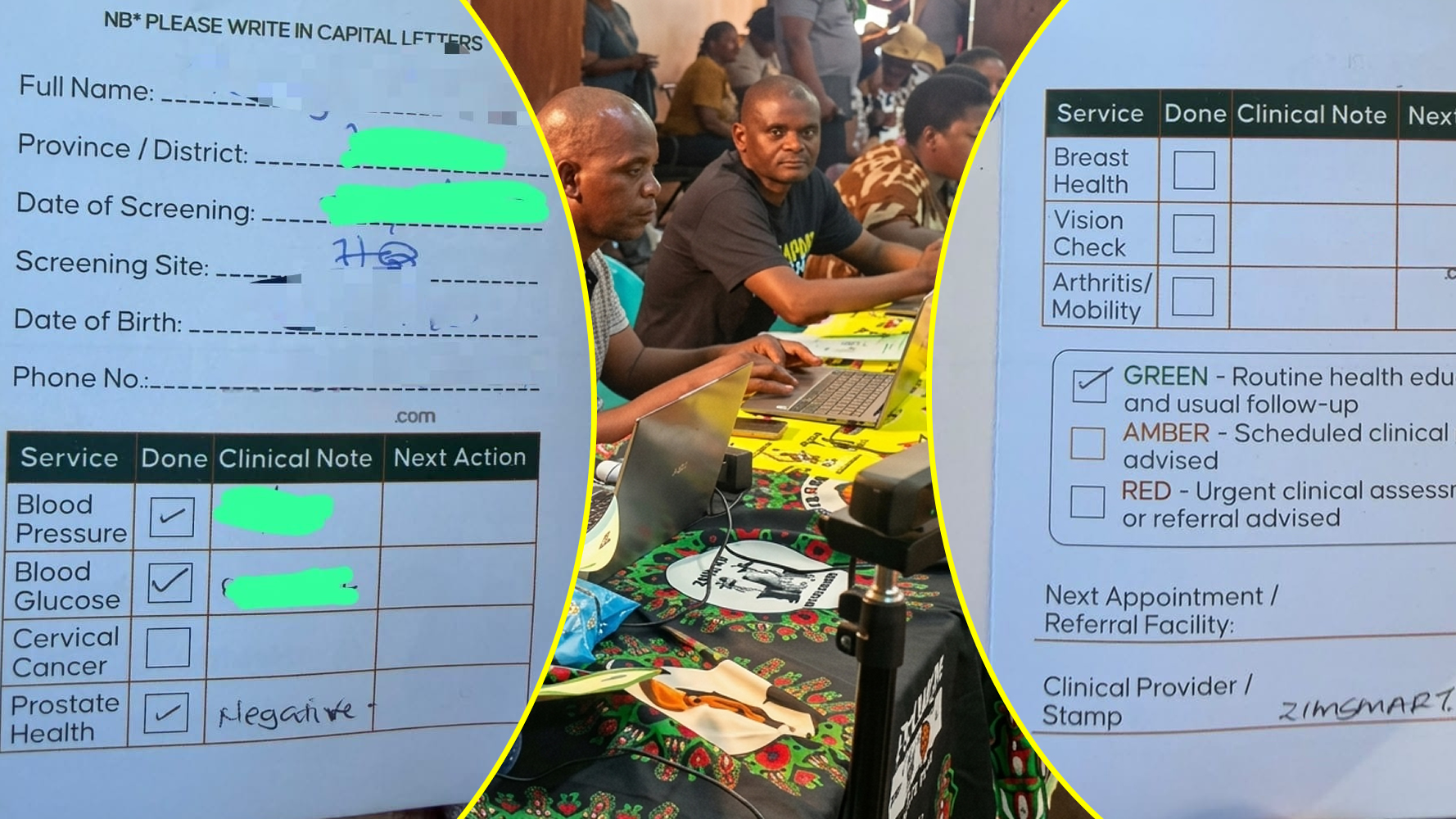
CHINHOYI — Zanu PF delegates attending the party’s 23rd annual conference have been required to undergo health checks before they can be accredited, with organisers issuing a “Your Health Passport – Proof of Screening” card that links each person’s identity to the screening process.
The tests include blood-pressure and blood-glucose checks, as well as prostate and breast cancer screening. The exercise is being conducted at Zanu PF headquarters in Harare by NetOne’s One Health in collaboration with ZimSmart Villages. Delegates must present proof of screening to receive accreditation.
The screening card requests a delegate’s name, district of origin, date of birth and phone number. Health workers record whether a potential concern was identified. A positive result does not bar a delegate from the conference, but the person is advised to arrange a clinical assessment.
The mandatory nature of the process has raised questions from delegates about why political organisers need identifying details alongside sensitive health information, who will control the records and how they may be used. One delegate from Bulawayo said: “This is highly unusual and leaves one feeling a sense of unease. For whom is this data being collected, and what do they intend to use it for? These are highly personal tests. It should have been voluntary, in case others don’t mind.”
A delegate from Mashonaland West said the screening itself was quick and used modern equipment, but questioned the collection of personal information. “Is someone collecting health information about their political rivals? What’s the purpose of this? Is it even legal?” the delegate asked.
While the question about political use is not evidence that a database has been created for targeting rivals, however, what is established is that the screening process collects identifying details, records results and makes proof a condition of conference accreditation. No public explanation has been given for the compulsory requirement, the purpose for retaining the records, who may access them or whether the information will be deleted after the conference.
Zimbabwe’s Data Protection Act classifies health information as sensitive data. Section 11 states that a data controller may not process sensitive data unless the person concerned has given consent in writing. The Act also says personal information must be processed fairly and lawfully and collected for specified, explicit and legitimate purposes. The written law is available in the Data Protection Act.
The distinction matters because a screening result is not just a medical reading when it is attached to a person’s name, birth date, telephone number and home district. The recorded information could reveal a suspected illness or a need for follow-up care. The materials made public so far do not explain what written consent was sought, what privacy notice delegates received or what safeguards are in place to prevent access beyond the health team.
The checks are taking place as the party prepares to move its conference programme from Harare to Chinhoyi, where the gathering is scheduled to conclude on Saturday, 17 October. The Politburo and Central Committee meetings are part of the programme. The conference comes amid internal arguments over proposed changes to Zanu PF’s constitution. An extraordinary Politburo meeting scheduled for 9 October was postponed after senior party figures had assembled. Party spokesperson Christopher Mutsvangwa said: “There was a clash or an overflow of programmes, and the meeting was postponed.” The party’s information director described it as a “clash of programmes” and said it was “nothing serious”.
The dispute over party rules and the health-screening exercise are separate events. No information has linked the medical checks to the constitutional debate or shown that results are being used in internal political contests. But the timing gives added force to delegates’ demand for clear answers about how the data will be handled, particularly when access to a major party conference depends on completing the tests.
The privacy questions also come against a wider dispute over who controls sensitive health information in Zimbabwe. In February, Harare halted negotiations over a proposed US$367 million, five-year health agreement with Washington. Zimbabwean officials objected to terms concerning access to health data and biological samples, among other concerns. Government spokesperson Nick Mangwana said the proposal was unfair, saying: “At its core, the arrangement was asymmetrical. Zimbabwe was being asked to share its biological resources and sensitive health data with no corresponding guarantee of access to medical innovations such as vaccines, diagnostics or treatments that might result from that data.”
“This is not a rejection of partnership, but an insistence that partnership be genuine,” he added.
She said the Zimbabwean government had “assured us it is prepared to sustain the fight against HIV/AIDS” and ended her statement with: “We wish them well.”
The withdrawal affects a health system that has relied on US support for HIV prevention and treatment, tuberculosis and malaria programmes, laboratory systems, medical supplies and community services. More than 1.2 million Zimbabweans were receiving HIV treatment, according to figures cited in a 2023 US government statement. The end of funding therefore puts pressure not only on medicine supply but also on testing, counselling, patient follow-up and the networks that help people stay connected to care.
There was an earlier warning of the disruption in January 2025, when a US foreign-aid freeze led to stop-work orders and the termination or suspension of grants. Clinics and civil-society programmes providing HIV testing, counselling, treatment refills and prevention services were affected. The newly announced end to bilateral health funding extends the uncertainty beyond that initial interruption and increases the burden on domestic services and other donors.
Zimbabwe’s government has said it intends to sustain health programmes and increase domestic financing. But the loss of a major donor has sharpened public attention on the handling of health records and on the resources available to provide care. The conference screening is much smaller than the national health-data dispute, but it raises a similar basic question: when sensitive information is collected, what purpose does it serve, who controls it and what protections apply?
For delegates, the immediate issue is practical. Screening may identify conditions that need timely medical attention, and people who receive a positive result are being advised to seek clinical assessment. At the same time, requiring the test for accreditation turns a health intervention into a gatekeeping step for participation in a political event. Until organisers explain the data arrangements, delegates are being asked to hand over personal details and undergo tests without a public account of what happens to the records afterwards.