


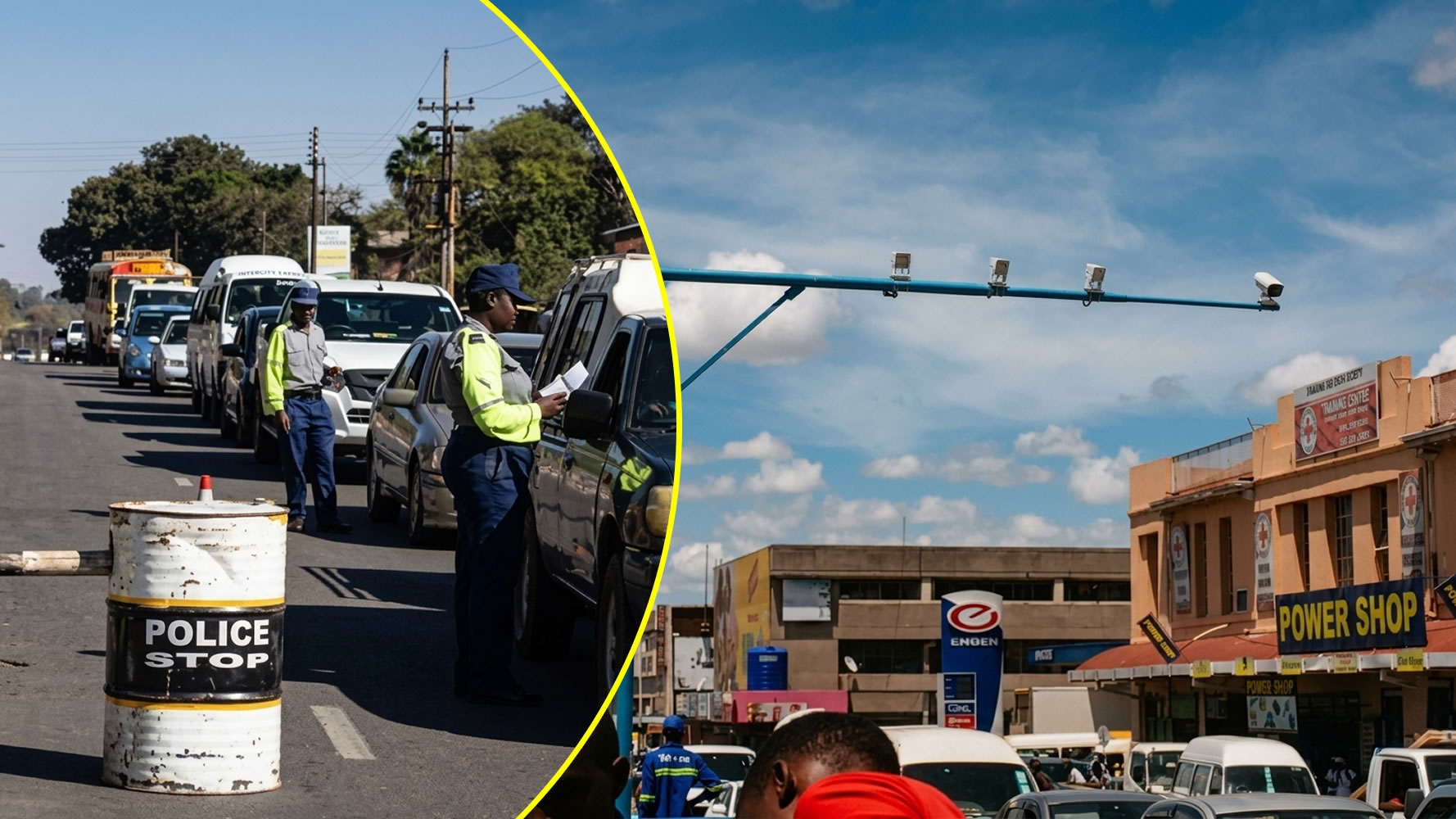
HARARE – For thousands of motorists navigating the bustling streets of Harare, a quiet technological revolution is unfolding above intersections and highway junctions. Since going live earlier this year, the Government’s newly installed network of artificial intelligence-driven surveillance cameras has flagged more than 1.1 million suspected traffic violations. For ordinary drivers, however, the headline figure of 1.1 million flags carries an unsettling uncertainty: when financial penalties eventually arrive, what will they actually be billed for, and how can a motorist defend themselves against an invisible digital accuser?
This investigation examines the reality behind Harare’s Electronic Traffic Management System (ETMS)—a high-tech rollout implemented by the Ministry of Home Affairs and Cultural Heritage in partnership with TelOne. While authorities position the camera network as a vital shield against carnage on the roads, motoring groups and municipal officials have raised pressing questions regarding transparency, data validation, and the specter of retrospective debt.
Inside the Surveillance Grid: How the Technology Works
Currently, Phase One of the national Smart Traffic Management and Surveillance Programme operates across 16 strategic camera sites in Harare, with ambitious government plans to scale the network to more than 300 high-tech cameras before expanding to other urban centres. These digital sentinels are programmed to automatically monitor and record a wide range of infractions, including speeding, failure to obey traffic lights (commonly known in Zimbabwe as robots), illegal turns, mobile-phone use behind the wheel, and missing seatbelts.
Unlike traditional policing, where traffic officers pull motorists over on the spot, the ETMS captures high-resolution imagery and video footage of passing vehicles, logging time, date, and registration details. Yet, government officials have been quick to draw a crucial distinction between a flagged violation and a confirmed fine. Permanent Secretary in the Ministry of Home Affairs and Cultural Heritage Ambassador Raphael Faranisi candidly admitted that not every digital capture is a valid offense.
“As of last week, we had recorded about 1,1 million vehicles that had violated traffic laws, and these were recorded on the various traffic cameras installed across the city,” Ambassador Faranisi told The Sunday Mail. “However, we are still validating these offences. Probably at the time the violation was committed, the intersection was being controlled by a police officer. Then, in some instances, maybe the markings on the road were not clear enough, so those are some of the verifications that we are working on.”
This administrative bottleneck explains why, despite the staggering 1.1 million tally, zero penalties have been issued to date while rigorous manual validation takes place. However, Home Affairs Minister Kazembe Kazembe has indicated that once Treasury, the police, and TelOne finalize payment and revenue-sharing frameworks, recorded offences will be backdated and billed. This prospect leaves motorists wondering how they will be notified and whether they will receive due process before enforcement begins.
Three Journeys Through the System
To understand how the ETMS impacts daily life in the capital, one must follow three distinct motorists whose livelihoods depend on Harare’s congested tarmac: a private commuter driving to work, a minibus (kombi) operator shuttling passengers between suburbs, and a commercial delivery driver navigating tight delivery windows.
For the private commuter, the main anxiety centers on vehicle ownership records and notification channels. If a registered vehicle owner has changed their residential address or phone number without immediate central registry updates, will they discover accumulated fines only when attempting vehicle licensing or annual vehicle inspection (VID)?
For the kombi operator, margins are razor-thin, and a backlog of unnotified digital fines could cripple a small transport business overnight. How does a commercial driver prove that a traffic officer manually directed them through a red-light signal during a gridlock?
For the delivery driver, navigating faded road markings or poorly positioned signage at newly reconfigured junctions creates a minefield of potential infractions. If an AI camera records an illegal turn caused by obscured road paint, the driver bears the burden of proof.
Industry observers note that while automated systems offer impartiality, they lack contextual nuance. Without an accessible, transparent appeals platform where drivers can view the photographic evidence, challenge misread number plates, or present mitigating circumstances, public trust in the system could erode rapidly.
|
Feature / Aspect
|
Current Status & Implementation Details
|
|
Operational Scale
|
16 active camera sites in Harare; planned expansion to over 300 cameras nationwide.
|
|
Infractions Detected
|
Speeding, red-robot violations, illegal turns, mobile-phone use, missing seatbelts.
|
|
Total Violations Flagged
|
Over 1.1 million recorded incidents since rollout.
|
|
Fines Issued to Date
|
Zero penalties issued; all flags undergo mandatory administrative validation.
|
|
Technical Partner
|
TelOne, working alongside the Ministry of Home Affairs and Cultural Heritage.
|
The Clash Between Enforcement and Entrapment
The tension between automated deterrence and motorist protection has not gone unnoticed within municipal circles. Chief traffic officer Martin Chimombe recently sounded a cautionary note during a traffic enforcement master parade in Harare, urging authorities to prioritize transparent public communication. Chimombe warned that rolling out sophisticated surveillance without adequate advance warning risks creating widespread perceptions of entrapment.
“Harare’s roll-out of AI-powered traffic cameras in the CBD responds to persistent road safety and traffic enforcement challenges such as speeding, red-light running, illegal turns and congestion, which traditional methods of enforcement have struggled to contain,” Chimombe stated.
He emphasized that while the technology is designed to supplement human policing with reliable evidence capture and electronic ticketing, legitimacy requires proactive outreach.
“The system aims to supplement human policing with automated detection, reliable evidence capture and e-ticketing to deter dangerous behaviour and inform infrastructure decisions, thereby promoting consistent enforcement across busy junctions,” he said.
Furthermore, Chimombe advocated for a structured, non-penal transition period to allow motorists to adjust.
“Legitimacy requires that motorists be informed well before laws are gazetted and certainly before enforcement commences,” he noted. “Advance notice allows drivers to change behaviour, reduces perceptions of entrapment, and provides a window for stakeholders to raise operational concerns. Authorities should run the system in a non-penal trial phase to identify and fix technical bugs, refine signage, and test appeals pathways before financial penalties are applied.”
Legal analysts and traffic lawyers consulted for this report suggest that motorists facing retrospective billing should demand clarity on the legal instruments governing backdated enforcement, published fine schedules, data-retention policies, and privacy safeguards. While government bodies possess the statutory authority to regulate traffic, legal experts emphasize that administrative fairness requires clear notice before financial liabilities can be legally enforced.
The Road Safety Imperative
Beneath the controversy of digital ticketing lies a stark national emergency. Government statistics paint a sobering picture of Zimbabwean roads: a traffic crash occurs roughly every 15 minutes, claiming an average of five lives daily, while approximately 38 people sustain injuries every single day.
Officially launching the Heroes and Defence Forces Holidays Road Safety Enforcement and Educational Awareness Campaign in Mazowe, Mashonaland Central province, Transport and Infrastructural Development Minister Felix Mhona highlighted the human cost of negligence. Running under the poignant theme “Be patient or you could end up a patient in hospital”, the campaign addresses the root causes of highway carnage.
“Our theme this time around was informed by the disturbing fact that up to 94 percent of road crashes on our roads in Zimbabwe are a direct result of inappropriate human decisions,” Minister Mhona declared. “We, therefore, realised that the time has come for us to speak directly to our road users through this message, which I believe will resonate with many and positively influence the manner in which we ply our roads this holiday… It is that time of the year again when we anticipate that thousands of Zimbabweans will be travelling across the country to pay respects to our national heroes, visit family and friends, attend church services, join in community events and spend time with loved ones. Indeed, this is a season where our drivers should exhibit all aspects of reducing human error to reduce road crashes.”
Minister Mhona also underscored the staggering economic toll of transport accidents, which costs the national economy an estimated US$400 million annually through medical expenses, lost productivity, supply chain delays, and property damage.
Echoing these sentiments, Home Affairs and Cultural Heritage Minister Kazembe Kazembe reminded the public that state intervention is fundamentally protective rather than punitive.
“So, many (police) officers will spend these holidays away from their families so that millions of Zimbabweans can travel safely,” Minister Kazembe said. “They will be deployed nationwide to fulfil one of Government’s most important constitutional obligations: the protection of human life. This entails enforcing speed limits, inspecting vehicle roadworthiness or ensuring compliance with traffic regulations, regulating traffic and assisting the travelling public. Hence, my appeal is for us all not to view traffic enforcement as punishment.”
Supporting this view, Traffic Safety Council of Zimbabwe (TSCZ) board chairperson Kura Sibanda stressed that compliance relies on basic disciplines—such as fastening seatbelts, respecting speed limits, maintaining safe following distances, and exercising courtesy on the road.
Conclusion: Balancing Trust and Technology
As Harare prepares to expand its digital enforcement network, the ultimate success of the Electronic Traffic Management System will hinge on striking a delicate balance. A technology designed to save lives and curb reckless driving can only maintain public legitimacy if drivers believe the process is fair, transparent, and free from administrative traps.
Whether the government can successfully transition from recording 1.1 million raw violations to enforcing valid, undisputed penalties without alienating the motoring public remains the defining test of Zimbabwe’s smart-city ambitions.