


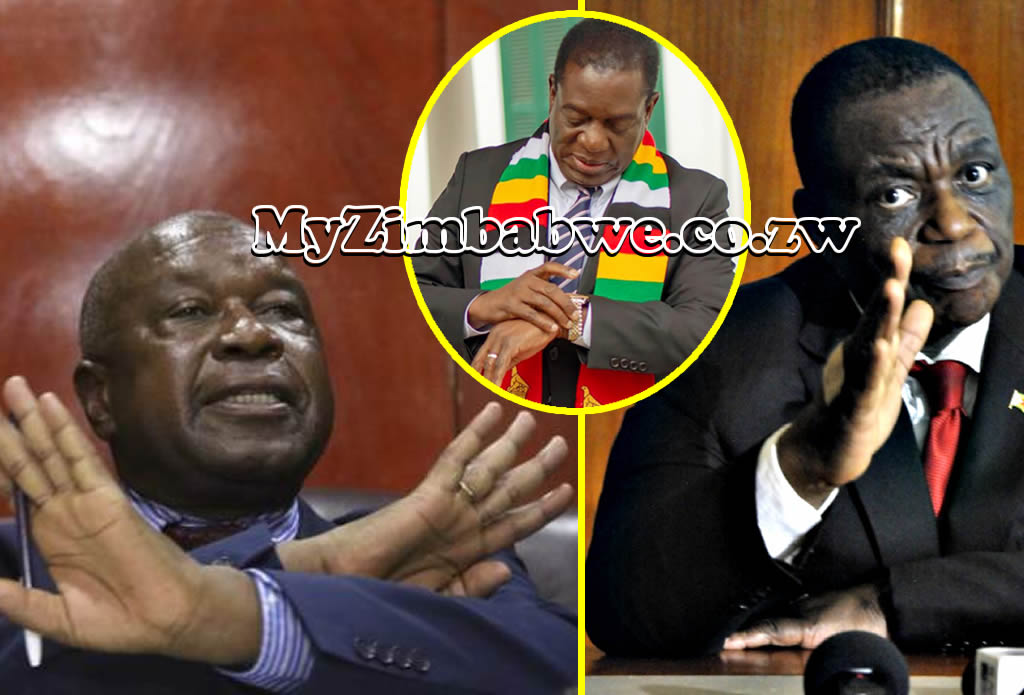
HARARE – Zimbabwe’s ruling Zanu-PF party has publicly refuted claims that the ongoing push to extend President Emmerson Mnangagwa’s term beyond 2028 is a veiled attempt to sideline Vice President Constantino Chiwenga or signifies a lack of confidence in his leadership.
Christopher Hatikure Mutsvangwa, Zanu-PF’s national spokesperson and former ambassador to China, firmly stated that Chiwenga is not automatically entitled to succeed Mnangagwa and that any suggestion of an anointment is misguided.
“It is not that we do not want him (Chiwenga). He can declare his candidacy. There is no provision in the Zimbabwean constitution that the vice president is the automatic leader of the country afterwards. We go to elections, and people vote in Zimbabwe for the leadership. So he needs to be voted,” Mutsvangwa told SABC News.
Mutsvangwa emphasised that Zimbabwe is a democratic country, not a papacy where succession is decided behind closed doors. “This is not a papacy. This is not cardinals in Rome, sitting in a cabal, deciding that this is going to be the person succeeding the pope. This is a democratic country, and people go to elections. If he wants, he can declare his candidacy for elections in the party or outside the party and do the test of the vote. This effort of someone being anointed for whatever reason, it is totally against the tenets of democratic governance,” he insisted.
He further questioned the preoccupation with Chiwenga, suggesting that some individuals believe he should be anointed as the next leader. “Why this particular preoccupation with this particular person, except that there are some people who feel that he should be anointed as the leader of Zimbabwe. This is not a papacy. This is a democratic, constitutionally-run country,” Mutsvangwa added.
President Mnangagwa has previously stated his commitment to upholding the constitution and stepping down in 2028.
The Zanu-PF’s recent adoption of a resolution at its annual conference, backing the extension of Mnangagwa’s term to align with the government’s “Vision 2030” development agenda, has ignited political tensions and drawn mixed reactions both at home and abroad.
Opposition activists and civil society figures have expressed concerns that the move could entrench authoritarian tendencies. Some analysts suggest that while the extension may be framed domestically as necessary for continuity, it could raise concerns among donors and regional partners about democratic backsliding.
Zimbabweans in the diaspora, including those residing in South Africa, have also voiced unease. Speaking to IOL, some critics argued that the extension reveals Zanu-PF’s reluctance to allow a generational leadership change, while supporters maintained that stability and economic recovery require continuity at the top.
Last week, former Zanu-PF bigwig and cabinet minister Saviour Kasukuwere condemned the plans to extend Mnangagwa’s term, warning that the move will end badly for both the president and Zimbabwe. “He (Mnangagwa) is dreaming and he has set himself up for a gigantic failure. Greediness knows no boundaries, and this will lead to a huge disaster for the country,” Kasukuwere told IOL.
The political debate in South Africa is further complicated by rising anti-immigrant sentiment and calls by some local groups for Zimbabwean migrants to return home. Observers warn that prolonged political uncertainty in Harare could exacerbate tensions in host communities across the region.
Adding to the political drama, law enforcement officers recently foiled the launch of a campaign against the extension of President Mnangagwa’s term. Zimbabwe Republic Police officers stormed the SAPES Trust on Tuesday morning, disrupting a scheduled address by opposition figures Tendai Biti, Job Sikhala, Munyaradzi Gwisai, and Jacob Ngarivhume.
The opposition figures have initiated a resistance against Zanu-PF’s plot to extend President Mnangagwa’s tenure to 2030, beyond its expiry in 2028. Sikhala stated that the police action would not deter the opposition from fighting the extension of President Mnangagwa’s hold on office. “It shows the state of national panic as we are speaking here, you can see the riot police officers are now approaching here, demonstrating that the dictatorship is in panic. Zimbabweans do not panic, we are going to announce the next course of action after this,” said Sikhala.
The launch suffered a major setback when a conference room at the SAPES Trust was petrolbombed by suspected state agents.
Within Zanu-PF, a clique backing Vice President Constantino Chiwenga is reportedly opposing the move to amend the constitution, favouring the former army general to succeed Mnangagwa.
Kenneth Mtata, programmes director for the World Council of Churches (WCC), warned that the move to extend Mnangagwa’s term will have ripple effects on the country’s position in the global community. “The proposal to extend the presidential term will hurt Zimbabwe at many levels. Here are five main reasons,” Mtata said.
He argued that the extension would undermine international re-engagement efforts, jeopardise debt restructuring, discourage investment, shatter fragile social trust, and ultimately damage President Mnangagwa’s legacy. “First, it will undermine all the hard work of international re-engagement pursued since 2017. It will signal to global partners that Zimbabwe cannot be trusted to honour its own constitutional and democratic commitments,” Mtata explained.
“Second, it will jeopardise the ongoing debt restructuring efforts. Third, this extension will discourage investment. Recently, Forbes magazine is said to have identified Zimbabwe as one of the most attractive tourist destinations. Investors would be wary of systems that change rules to suit political convenience. Policy inconsistency and instability will scare away the very capital needed for national economic recovery,” he added.
Mtata further warned that the term extension would likely lead to a return of political violence and intimidation, reopening old wounds and further dividing communities. “Fourth, the term extension will shatter the fragile social trust that had begun to form after years of political violence. Coercive force and intimidation would likely return to our national life in order to enforce such an unpopular measure. This will reopen old wounds and further divide communities once again,” he said.
Finally, Mtata argued that the decision would tarnish President Mnangagwa’s legacy, associating him with leaders known for clinging to power rather than serving with integrity and stepping aside with dignity. “Fifth, this decision will remove any chances of the President leaving a positive legacy. He will be classified with all those leaders remembered for clinging to power, rather than those honoured for serving with integrity and stepping aside with dignity,” Mtata concluded.
If Zanu-PF proceeds with the resolution, it would be referred to parliament, where the party’s two-thirds majority could initiate the constitutional amendment process. This would likely trigger legal and political challenges from opposition parties and civil society, and could prompt increased scrutiny from regional bodies such as SADC and the AU.
The central political question for the months ahead remains whether Mnangagwa’s extension will be presented as a caretaker continuity measure or a hard political move to shape succession.