


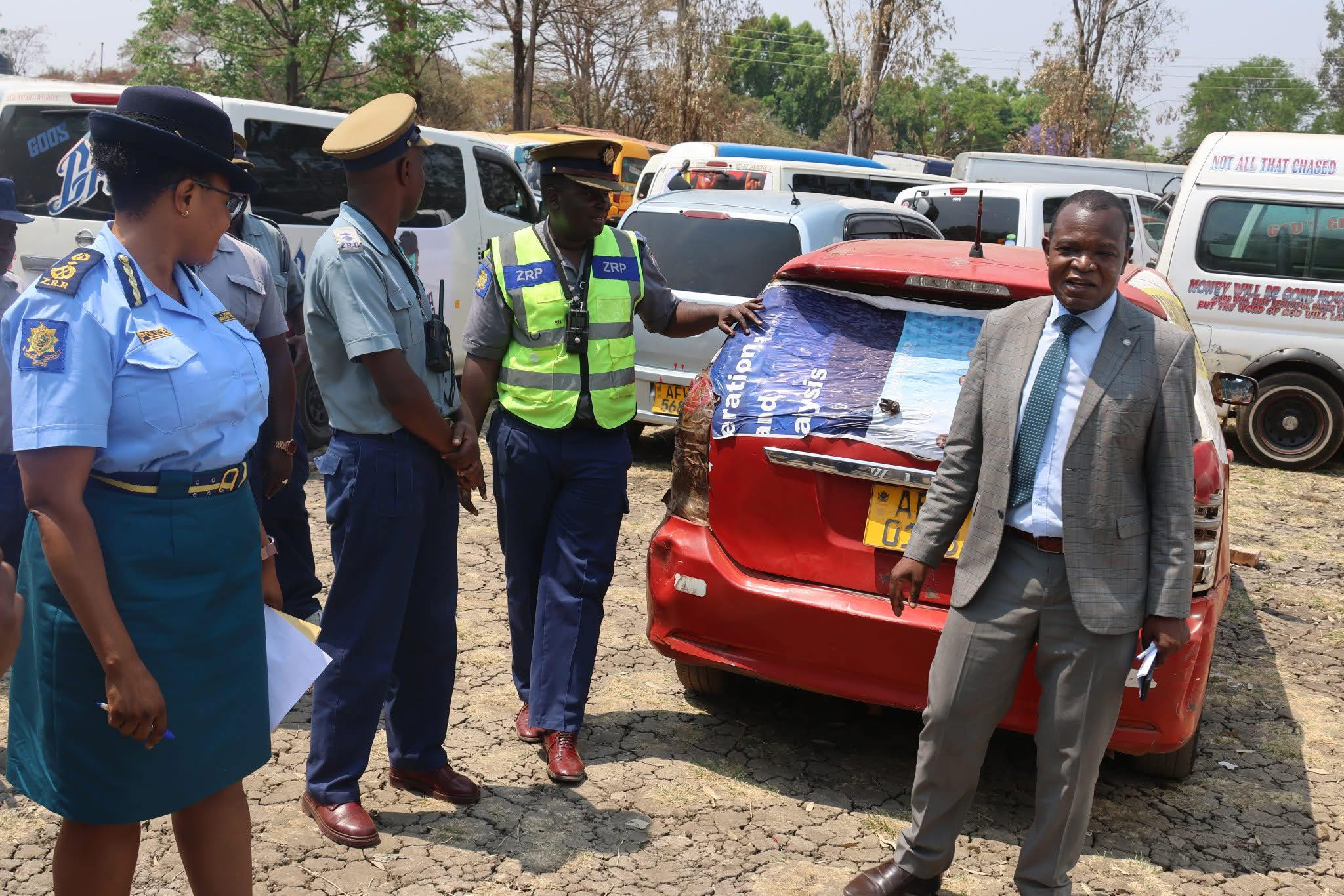
HARARE — The Zimbabwean roads, long a theatre of both necessity and lawlessness, are currently witnessing one of the most significant enforcement operations in recent memory. In a decisive move that has redefined the daily commute for thousands, the Zimbabwe Republic Police (ZRP) has impounded more than 3,400 vehicles in a fortnight. This nationwide crackdown, aimed at restoring sanity to the country’s thoroughfares, targets a specific breed of offender: the plateless, the unregistered, and those illegally adorned with the trappings of emergency services.
As of mid-March 2026, the official tally stands at 3,478 vehicles. These are not merely statistics on a ledger; they represent a diverse cross-section of Zimbabwean society. From high-end luxury SUVs to the battered “mshikashika” pirate taxis that navigate the urban sprawl, no vehicle has been deemed exempt. The operation, which commenced in earnest on Monday, 9 March 2026, has seen police checkpoints transformed into temporary holding pens for cars that have, for too long, operated in the shadows of the law.
National police spokesperson Commissioner Paul Nyathi has been the public face of this offensive. In a series of briefings, he has articulated the rationale behind such a sweeping exercise.
“The ZRP operation targeting vehicles without registration number plates and those illegally fitted with sirens, blue lights, bar lights, beacons and other unauthorised gadgets has netted 3,478 vehicles,” Commissioner Nyathi confirmed. “These vehicles are all classes of vehicles, from the cheapest to the most expensive cars. The ZRP operation is targeting all vehicles classified to be breaking the law.”
The motivation for this “blitz,” as it is colloquially known, extends far beyond simple administrative compliance. For the investigative eye, the removal of number plates is rarely an act of forgetfulness; it is frequently a calculated tactic used by those who wish to remain invisible. The police have noted a direct correlation between the rise in plateless vehicles and a surge in violent crime across the country.
The Shadow of the Plateless Vehicle
In the world of investigative journalism, we often look for the “why” behind the “what.” The “what” is 3,400 impounded cars. The “why” is a growing list of victims. Unregistered vehicles have become the preferred tool for armed robbers, kidnappers, and those involved in hit-and-run accidents. By operating without a unique identifier, these motorists effectively grant themselves a license to commit crimes with a reduced fear of being traced.
Recent incidents provide a chilling context to this necessity. On 6 March 2026, just days before the official launch of the crackdown, two young men, Conrad Moyo (22) and Milford Sidhakwa (24), were apprehended in Beatrice. They are currently being linked to at least seven armed robbery cases. Among their alleged exploits was a midnight raid at a Beatrice motel and a separate early morning robbery. In many such cases, witnesses describe getaway vehicles that lack registration plates, making the task of law enforcement nearly impossible without immediate intervention.
Commissioner Nyathi pointed out that some motorists are deliberately removing their plates to evade identification after committing offences. This includes not just major crimes, but also chronic traffic violations.
“Some vehicles are being fitted with illegal sirens, blue lights and bar lights which are reserved for authorised emergency vehicles,” Nyathi explained. “This causes chaos on the roads and above all, the use of bar lights has also been noted to disturb the vision of other motorists at night, thereby endangering road users.”
The use of these unauthorised gadgets is more than just a nuisance. It creates a false sense of authority, allowing private citizens to bully their way through traffic, often causing accidents in the process. The ZRP has made it clear that these fittings will be removed on the spot, and the vehicles will only be released once they are properly registered and fitted with lawful plates.
The Urban Jungle: Mshikashika and Masked Identities
In cities like Bulawayo and Harare, the crackdown has met with a mixture of praise from law-abiding citizens and desperate evasion from those whose livelihoods depend on the “mshikashika” trade. At the illegal taxi rank along 6th Avenue in Bulawayo, a new form of cat-and-mouse game has emerged. Investigative observations have revealed kombi operators using cardboard material to partially mask their number plates, attempting to obscure just enough of the registration to prevent a clear reading by police or traffic cameras.
This culture of evasion is what the ZRP is now fighting with technology as much as manpower. The police recently released a list of 1,241 vehicles caught on camera violating red traffic lights in Harare’s Central Business District (CBD). This follows a similar move in Bulawayo late last year, where over 1,900 vehicles were named for the same offence. The message is clear: the era of anonymous lawbreaking is coming to an end.
The table below provides a summary of the categories and issues being addressed in this ongoing operation:
|
Category of Target
|
Description of Violation
|
Enforcement Action
|
|
Plateless Vehicles
|
Operating without any registration plates.
|
Immediate impoundment; 7 days to report.
|
|
Illegal Fittings
|
Unauthorised sirens, blue lights, beacons.
|
On-the-spot removal and seizure.
|
|
Masked Plates
|
Using materials to hide registration numbers.
|
Impoundment and potential criminal charges.
|
|
Traffic Violators
|
Caught on camera running red lights or lane indiscipline.
|
Public listing of registration and summons.
|
|
Government/Fleet
|
Official or company cars lacking proper ID.
|
Subject to the same impoundment rules as private cars.
|
A Promise of Professionalism: The Service Charter
Coinciding with this massive enforcement effort is a renewed push for police accountability. The ZRP recently relaunched its Service Charter, a document intended to bridge the gap between the police and the public. In Bulawayo, Commissioner Jasper Chizemo stood before a gathering of government officials, business leaders, and transport operators to reaffirm the force’s commitment to professionalism.
“The service charter relaunch embodies our commitment to meeting the service delivery expectations of our clients,” Commissioner Chizemo stated. “Today, we reiterate that pledge and promise to serve the people of Bulawayo diligently. It sets minimum service standards that the public is entitled to expect from the police.”
The standards set by this charter are ambitious. The ZRP now commits to attending to members of the public within one minute of their arrival at a police station. Telephone calls are to be answered within three rings, and written correspondence must receive a response within seven days. For a public that has often felt neglected or intimidated by the bureaucracy of law enforcement, these are significant promises.
“No report is too small to be recorded and no complaint will be turned away,” Chizemo added. “Where evidence is established, cases will be presented before the courts without delay so that justice is served. Our goal is a city where people feel safe in their homes, workplaces and public spaces.”
The Public Verdict and Political Pressures
While the impoundment of 3,400 cars is a logistical feat, it has not been without its critics. Investigative enquiries have highlighted a recurring theme among the Zimbabwean public: the demand for impartiality. There have been vocal calls on social media and in community forums for the ZRP to ensure that the crackdown includes vehicles belonging to high-ranking officials and political organisations, specifically ZANU-PF.
The perception that certain “big fish” are above the law is a hurdle the ZRP must overcome if it wishes to maintain the “public reassurance” mentioned in its new charter. Commissioner Nyathi’s insistence that the operation targets “all classes of vehicles” is a step toward addressing these concerns, but the true test will be in the visibility of the enforcement across all sectors of society.
The sheer scale of the operation—averaging nearly 250 cars impounded every single day—suggests a level of intensity that is difficult to sustain without significant resources. However, the police have indicated that they will increasingly rely on modern technologies, such as CCTV, road cameras, and even drones, to maintain road safety and identify offenders.
Conclusion: A Long Road Ahead
As the sun sets over the impound yards of Harare and Bulawayo, filled to capacity with vehicles of every description, the impact of the last two weeks is undeniable. The roads feel different. There is a palpable sense of caution among motorists who previously viewed traffic lights as mere suggestions and number plates as optional accessories.
For the investigative journalist, the story does not end with the impoundment. The true measure of success will be whether this operation leads to a sustained decrease in armed robberies and hit-and-run incidents. It will be whether the promises made in the Service Charter translate into a more responsive and trusted police force.
The ZRP has thrown down the gauntlet. By taking over 3,400 vehicles off the road in just 14 days, they have sent a message that the culture of impunity is under siege. Whether this leads to a permanent shift in Zimbabwean road culture or remains a temporary “blitz” remains to be seen. For now, the message to every motorist is simple: register your vehicle, remove your illegal lights, and follow the law—or prepare to walk.
Key Statistics of the Crackdown
- Total Vehicles Impounded: 3,478.
- Duration of Current Blitz: 14 Days.
- Launch Date: 9 March 2026.
- Red Light Violators Named (Harare): 1,241.
- Red Light Violators Named (Bulawayo): 1,890 (May-Aug 2025).
- Service Charter Response Time Goal: 1 Minute.
- Service Charter Telephone Goal: 3 Rings.