


From Glenview to the Grave: Betrayal and Bullets—How a Police Informant Led to the Downfall of Harare’s Most Ruthless Armed Robbery Syndicate!
HARARE – The afternoon sun was still high over the Warren Park 1 Shopping Centre on a Wednesday that began like any other in the bustling Harare suburb. For the patrons of the local shops and the vendors lining the dusty pavements, the sudden crack of gunfire was a terrifying intrusion into their daily routines. Within minutes, a silver Toyota Passo sat riddled with bullet holes, its occupants slumped inside, as the smoke cleared from one of the most violent confrontations between the Zimbabwe Republic Police and the criminal underworld in recent months.
Four men — Mike Manyima, 37, Office Chanakira, 38, and two others known to their associates only as ‘Atenzi’ and ‘Chris’ — met their end in a hail of bullets. They were the core of a gang that had, according to police records, spent the previous two months terrorising businesses across the capital. Their deaths marked the climax of a meticulous operation by detectives from the Criminal Investigations Department (CID) Homicide section, a unit that has found itself increasingly on the front lines of a surging wave of armed crime.
The crackdown began not in the streets of Warren Park, but in the quiet residential extension of Glenview 7. On March 30, 2024, acting on a tip-off that would prove to be the undoing of the entire syndicate, detectives moved in on 28-year-old Nelson Chitima. Cornered at his residence, Chitima chose cooperation over resistance, providing the names and locations of his accomplices that set a lethal chain of events in motion.
Chitima’s first betrayal led police to the Mhishi Shopping Centre, where they sought 38-year-old Edson Guvira. The encounter was brief and chaotic. When Guvira spotted the plainclothes officers approaching, he turned and fled, ignored the shouts to halt, and continued running even as warning shots tore through the air. The chase ended only when a police bullet found his leg, bringing him to the ground and into custody.
As Guvira was being treated, a search of the gang’s operational assets revealed the tools of their violent trade. In a Nissan NV350 getaway vehicle, police recovered a white balaclava, two pairs of gloves, and a stash of liquor—the spoils of a recent raid. But the investigation was far from over. The most dangerous members of the crew were still at large, and they were already planning their next move.
The trail led the CID Homicide team to Warren Park 1, where they observed a purple Toyota Passo pulling into the shopping centre. Inside were Manyima, Chanakira, Atenzi, and Chris. They were reportedly preparing to strike another business, unaware that the net had already closed around them. When the detectives identified themselves and ordered the men to surrender, the response was immediate and defiant. The suspects allegedly opened fire, sparking a fierce shootout in the middle of the shopping area.
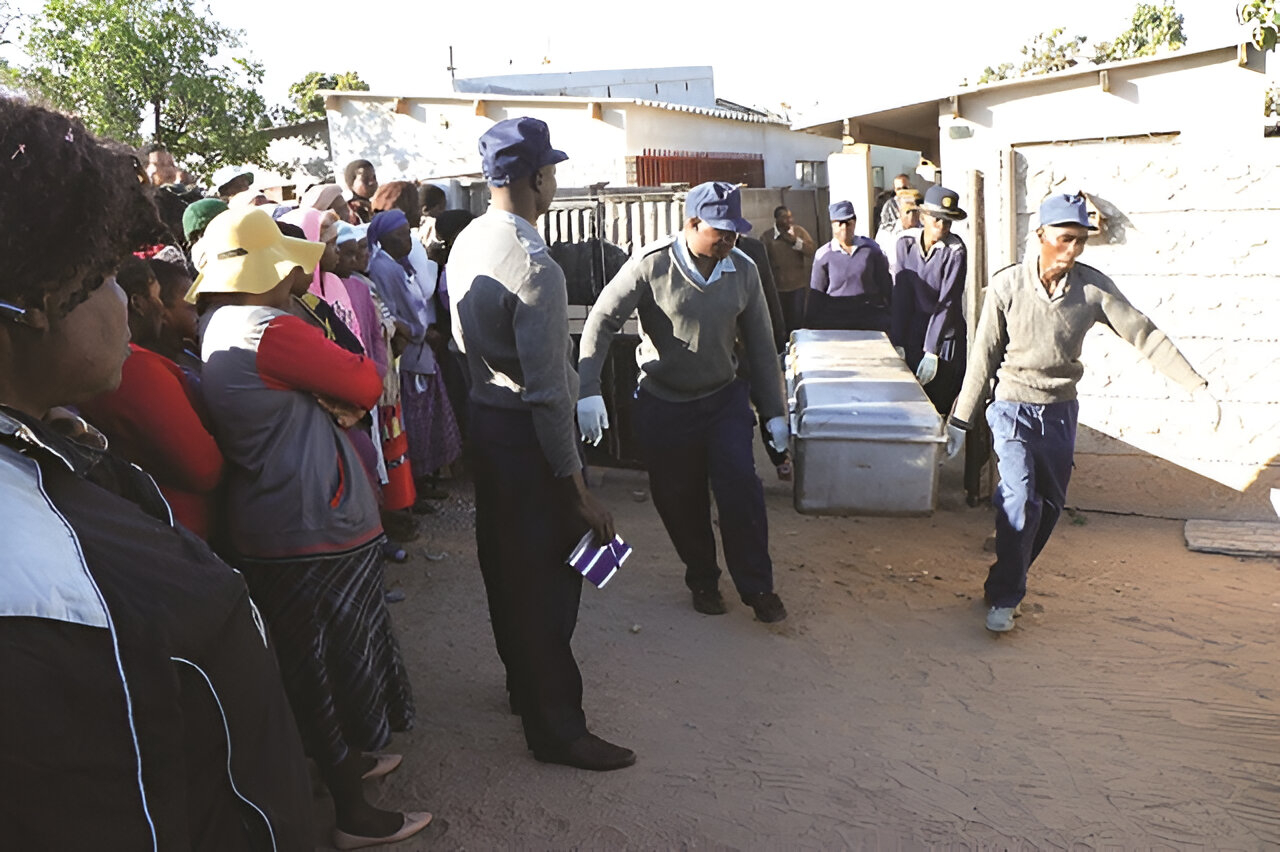
When the firing stopped, all four suspects were fatally wounded. They were rushed to Parirenyatwa Group of Hospitals, but were pronounced dead upon admission. The aftermath of the gunfight revealed a small arsenal within the Passo: a .70 Vozol pistol with a three-round magazine, a .38 Rossi revolver, a Supercat 1911 pellet gun, and 35 live rounds of 9mm ammunition. Perhaps most chilling were the eight detonators and four fuses found among their belongings, suggesting the gang was prepared for more than just simple store robberies.
National police spokesperson Commissioner Paul Nyathi was firm in his assessment of the incident. He stated:
“There is no going back in the fight against armed robbery cases in the country. The police will decisively respond appropriately to any form of violent confrontation by armed robbery gangs.”
The gang’s criminal footprint was extensive. Investigations have linked them to a string of daring raids, including a break-in at Kuwadzana 2 Shopping Centre on February 25, where they made off with goods worth US$500. Just a day later, they attacked security guards at Aspindale, stealing the very .38 Rossi revolver that would later be used against the police in Warren Park. Their most recent known heist occurred on March 25, when they raided a Glen Norah liquor store, stealing lager beers and whisky valued at US$1,989.
This incident is not an isolated eruption of violence. It comes at a time when Zimbabwe is grappling with a significant rise in armed robberies, a trend that has seen criminals becoming increasingly bold and well-armed. In 2024 alone, the country recorded over 1,340 cases of armed robbery, a statistic that has kept the public on edge and the police on high alert.
The Warren Park shootout echoes other high-profile confrontations that have defined the past year. Only weeks earlier, in mid-March, two other suspected robbers were gunned down in Gweru following a similar exchange of fire with the ZRP. The shadow of the infamous Ecobank heist in Bulawayo also looms large over the national consciousness. In October 2024, a gang pulled off the biggest cash robbery in the country’s history, seizing over US$4 million from an Ecobank branch in broad daylight. While two suspects in that case, Abraham and Elias Dube, were eventually tracked down and arrested in South Africa in July 2025, the sheer audacity of the crime highlighted the evolving nature of the threat.
The involvement of sophisticated weaponry and the use of detonators in the Warren Park case suggest a level of organisation that mirrors these larger syndicates. In several recent cases, police have even uncovered the involvement of serving or former members of the security forces, adding a layer of complexity to the challenge of policing. Just months ago, nine suspects, including three serving members of the Zimbabwe National Army, were arrested for their roles in a series of robberies in Harare.
For the residents of Warren Park, the reality of the shootout is a grim reminder of the dangers that now lurk in the shadows of everyday life. “You see these things in movies, you don’t expect them at your local shops,” said one witness who asked not to be named. “One minute people are buying bread, the next there is lead flying everywhere. It’s frightening to think what could have happened if a bystander had been caught in the crossfire.”
The police have recovered a total of four vehicles from the gang: the Nissan NV350, a black Toyota Hiace, the purple Toyota Passo, and a red Honda Fit. These vehicles, often fitted with stolen or fraudulent plates, are the lifeblood of robbery crews, allowing them to strike quickly and vanish into the labyrinthine streets of Harare’s high-density suburbs.
Commissioner Nyathi’s warning to the criminal element serves as a manifesto for the ZRP’s current strategy. The policy of “decisive response” has seen an increase in fatal encounters, a tactic that some see as necessary to stem the tide of violence, while others worry about the potential for collateral damage in crowded public spaces.
As the bodies of Manyima, Chanakira, and their two unidentified partners lie in the mortuary at Parirenyatwa, and as Nelson Chitima and Edson Guvira await their day in court, the investigation continues. Detectives are working to determine if the detonators found in the Passo were intended for use in ATM bombings or safe-cracking operations, and whether this crew had links to the larger syndicates operating across the border in South Africa.
The battle for the streets of Harare is far from over. While the Warren Park crew has been dismantled, the conditions that gave rise to them—economic hardship, the proliferation of illegal firearms, and the lure of ‘easy’ US dollar hauls—remain. For now, the message from the authorities is clear: those who live by the gun in Zimbabwe can expect to meet their end by the same means. The silence that has returned to Warren Park 1 Shopping Centre is a heavy one, bought at the price of blood and brass.