


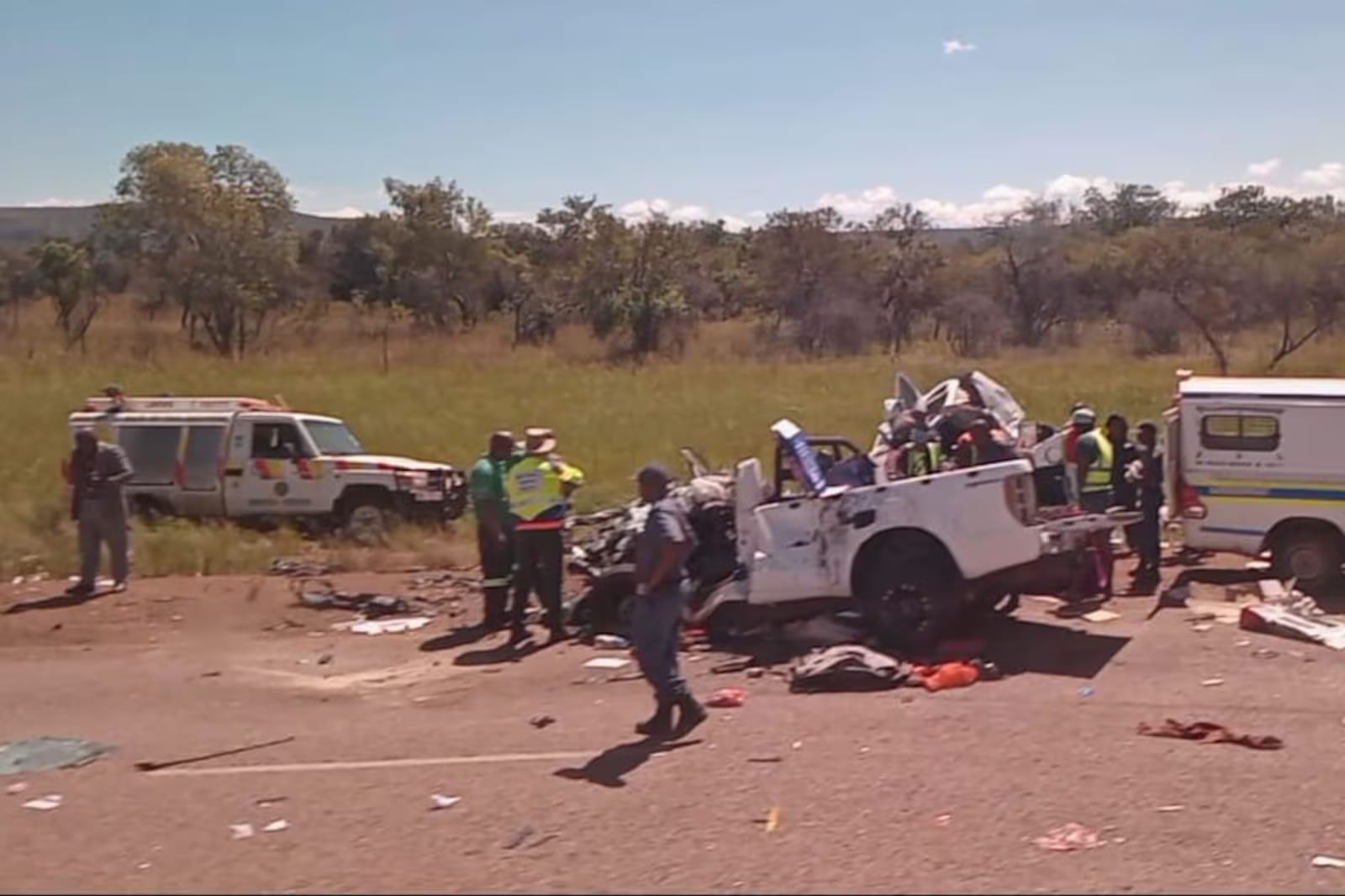
LIMPOPO — The stretch of the N1 freeway between Modimolle and Mookgophong is a notorious artery for South African transport, particularly as the nation braces for the annual Easter pilgrimage. However, on Wednesday, 1 April 2026, this vital road became a scene of absolute carnage. In a moment of inexplicable recklessness, a Zimbabwean truck driver allegedly attempted an illegal U-turn in the middle of the freeway, a decision that resulted in a head-on collision that claimed five lives, including that of a small child.
The sheer scale of the devastation was visible for kilometres. Emergency responders arriving at the scene found the mangled remains of several vehicles, including a bakkie that had been crushed by the force of the impact. Debris was scattered across the asphalt, and the silence of the Limpopo bushveld was broken only by the sirens of ambulances and the desperate shouts of rescue workers. While five people were pronounced dead at the scene, two others were rushed to a nearby hospital in a critical condition, their lives hanging by a thread.
Preliminary investigations by the Limpopo Department of Transport have painted a chilling picture of the moments leading up to the crash. It is alleged that the truck driver, who had recently passed a fuel station, decided to perform a U-turn on the high-speed freeway to return to the pumps. This manoeuvre, illegal on any major South African road, proved fatal as oncoming traffic had no time to react to the massive obstacle suddenly blocking both lanes.
| Incident Details |
Information
|
|
Date
|
Wednesday, 1 April 2026
|
|
Location
|
N1 Freeway, between Modimolle and Mookgophong, Limpopo
|
|
Primary Cause
|
Illegal U-turn by a heavy-duty truck
|
|
Fatalities
|
Five (including one child)
|
|
Injuries
|
Two (critical condition)
|
|
Arrest
|
Zimbabwean driver taken into custody
|
The driver’s state at the time of the incident has further fuelled public outrage. Tshifhiwa Dali, a spokesperson for the Department of Transport, confirmed the findings of initial sobriety tests.
“The driver was under the influence of alcohol and other unknown substances,” Dali stated.
The revelation that a heavy-duty vehicle was being operated by someone significantly impaired has reignited the national debate regarding the regulation of foreign truck drivers and the enforcement of road safety laws.
For the families of the victims, the loss is immeasurable. The inclusion of a baby among the deceased has struck a particularly somber chord across the country. As South Africans prepare for a long weekend meant for spiritual reflection and family gatherings, five households are now planning funerals instead of festivities. The identities of the deceased have not yet been officially released, as police continue the grim task of notifying next of kin.
This tragedy did not occur in isolation. Only twenty-four hours later, a strikingly similar incident unfolded on the N3 highway near the Tugela Plaza. Another Zimbabwean truck driver was arrested after allegedly making an illegal U-turn that triggered a horrific multi-vehicle pile-up. While no fatalities were reported in that instance, twenty-five passengers sustained various injuries, and the N3—the country’s busiest freight corridor—was brought to a standstill for hours.
These recurring incidents have placed the spotlight firmly on the Department of Transport and the Road Traffic Management Corporation (RTMC). Investigative findings suggest a deepening crisis within the South African trucking industry. According to data from the RTMC, South Africa’s roads claim nearly 12,000 lives annually, a rate of 25 deaths per 100,000 people. This is significantly higher than neighbouring Botswana, which records approximately 18 per 100,000, and dwarfs the United Kingdom’s rate of 3 per 100,000.
|
Road Safety Statistics (2025/2026)
|
South Africa
|
Botswana
|
United Kingdom
|
|
Annual Road Deaths
|
~12,000
|
~450
|
~1,700
|
|
Fatality Rate (per 100k)
|
25
|
18
|
3
|
|
Economic Impact (% of GDP)
|
3%
|
Unknown
|
<1%
|
The economic toll of these accidents is staggering, draining an estimated 3% of South Africa’s Gross Domestic Product (GDP) every year. This is not merely a statistic; it represents billions of rands that could have been invested in infrastructure, education, or healthcare. Instead, these funds are swallowed by emergency services, hospitalisations, and the loss of economically active citizens.
Limpopo Premier Phophi Ramuthuba has been vocal in her condemnation of reckless driving, particularly during the Easter period when millions of pilgrims travel to the province for the Zion Christian Church (ZCC) and St Engenas Zion Christian Church gatherings. Ramuthuba described road safety as a “shared responsibility that requires vigilance, discipline, and mutual respect.” Her spokesperson, Thilivhali Muavha, added that while the premier encouraged visitors to explore Limpopo’s hospitality, safety must remain the absolute priority.
However, many industry experts argue that “shared responsibility” is not enough when systemic failures are at play. Investigations into the freight sector have uncovered a thriving black market for fraudulent vehicle roadworthiness certificates and driving licences. In many cases, “driver error” is a convenient label for mechanical failures caused by worn brakes, bald tyres, and broken steering systems that should have been identified during mandatory inspections.
The issue of foreign truck drivers, particularly those who are undocumented or operating with fraudulent permits, has also become a flashpoint for social tension. KZN Transport MEC Siboniso Duma recently mandated the Road Traffic Inspectorate to intensify operations against undocumented drivers. Duma reported witnessing trucks with dangerously worn-out tyres being operated by individuals without valid legal standing in the country.
As the Zimbabwean driver involved in the N1 crash awaits his first court appearance, the South African public is left demanding more than just arrests. There are growing calls for stricter border controls for commercial drivers, mandatory real-time GPS monitoring for heavy vehicles, and a complete overhaul of the national licensing system to eliminate corruption.
The N1 freeway has since been reopened, and the flow of traffic has returned to its usual frantic pace. Yet, for those who passed the scene on Wednesday morning, the memory of the twisted metal and the knowledge of the lives lost will not easily fade. The five South Africans who died on that stretch of road were not victims of a mere accident; they were the casualties of a profound failure in road discipline and systemic oversight.
As the sun sets over the Limpopo plains this Easter, the empty chairs at five dinner tables serve as a haunting reminder of the cost of a single, reckless U-turn. The question remains whether the government will finally steer policy in a direction that ensures “arriving alive” is a reality for all road users, or if the N1 will continue to be a highway of heartbreak.