


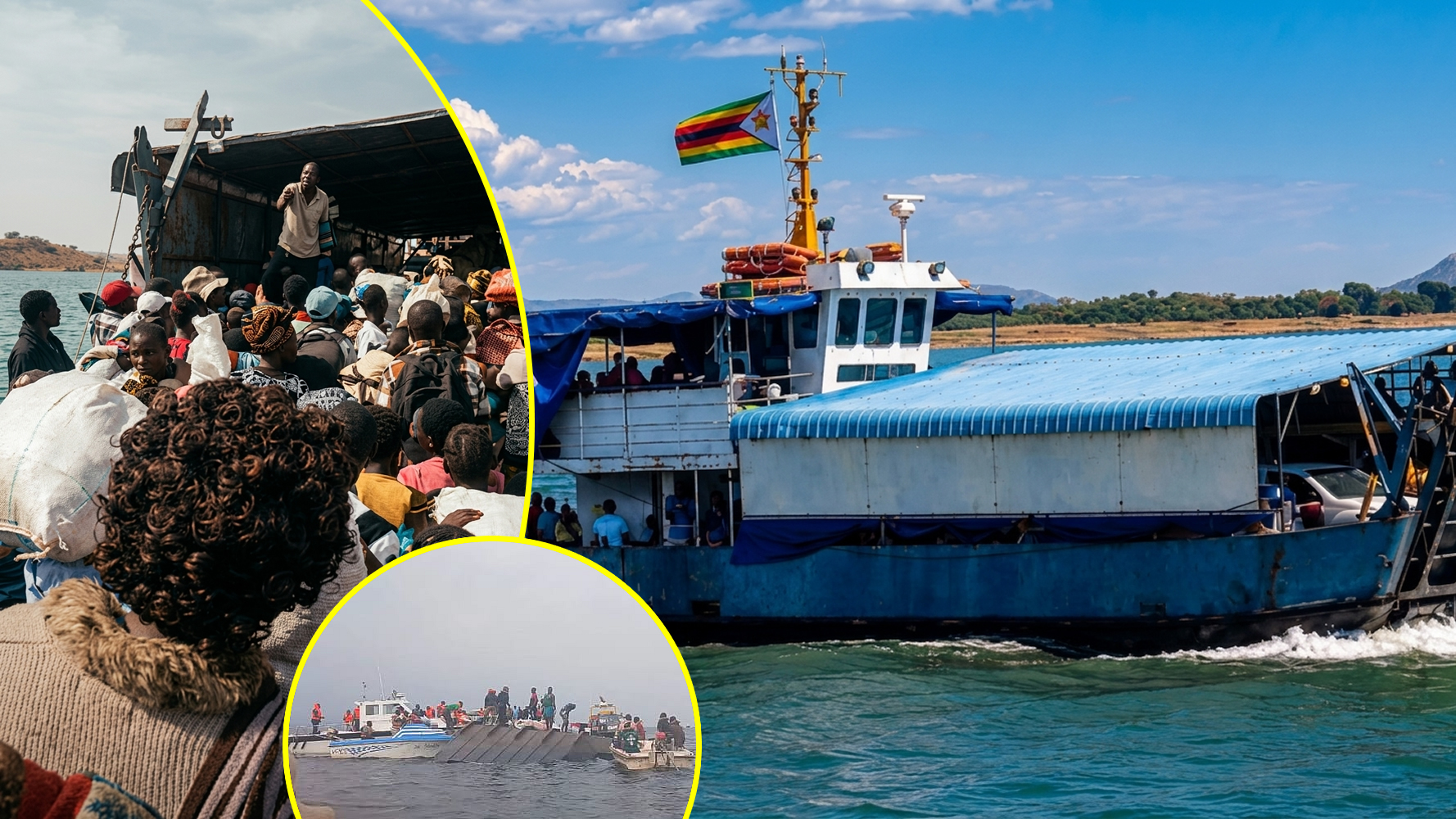
The death toll from the Lake Kariba ferry disaster has risen to 84, but a second figure is now troubling families and investigators: the number of people known to have been aboard the vessel appears to be higher than the ferry’s approved capacity and much higher than the first passenger total released by authorities.
Four more bodies were recovered near Long Island on Sunday afternoon, pushing the confirmed number of dead to 84. Police said search and recovery teams were still working to locate victims believed to be missing as the operation entered another day on the vast reservoir shared by Zimbabwe and Zambia.
“The ZRP reports that the death toll is now 84 after the recovery of four bodies from the lake this afternoon. The Police confirm that search efforts are still under way in a bid to recover victims identified as missing,” said Commissioner Paul Nyathi, the national police spokesperson.
The latest figures mean that 84 people have been recovered dead and 77 survivors have been recorded. Together, those figures account for 161 people. That total is eight more than the 153 passengers previously indicated by the Rural Infrastructure Development Agency, or RIDA, and 71 more than the vessel’s official passenger capacity of 90.
The discrepancy has left authorities trying to establish how many people boarded the Mbuya Nehanda before it left Kariba town for Chalala Fishing Camp. The final passenger list has not been confirmed, and the number of people still missing remains unclear. For families waiting for news, the uncertainty has added another painful layer to a disaster in which bodies continue to be recovered from the lake days after the vessel disappeared beneath the water.
The ferry capsized on Tuesday, 11 August, while carrying people and goods towards communities along the western reaches of Lake Kariba. The route serves fishing settlements where damaged roads and limited public transport make water travel an important link to Kariba town. Passengers were understood to include adults, children, fishermen and people travelling with basic goods and catches from the lake. The Mbuya Nehanda was an ageing government passenger ferry that had reportedly been operating on Lake Kariba since 1985, making it about 41 years old when it sank.
Available reports describe it as a former Department of District Development Fund (DDF) vessel that later came under the Rural Infrastructure Development Agency (RIDA). Public accounts differ on whether it was commissioned in 1983 or entered service in 1985, and My Zimbabwe News News could not verify a reliable official record naming the person, organisation or country that donated it to the Zimbabwean Government. However, it was reportedly handed over to the state in the mid-1980s, after which it became part of the government ferry fleet serving Lake Kariba.
The ferry was not primarily a tourist service. It provided an essential transport link for people living in remote fishing camps, islands and lakeshore settlements in Nyaminyami and surrounding areas, connecting them with Kariba town for food, medicines, schooling, trade and access to government services. Many of those communities have limited public transport and poor or damaged road links, leaving the lake as their most practical route.
That dependence helps explain why demand could exceed the vessel’s approved capacity of 90 passengers: when the ferry arrived, residents, fishermen, children, traders and cargo could be waiting for the same crossing, with few realistic alternatives. It does not make the overcrowding safe or lawful, but it shows why the Mbuya Nehanda had become such a vital lifeline for communities around Lake Kariba.
View this post on Instagram
Among those confirmed dead are 18 children. Sixteen of the children were aged 10 or younger, while the youngest victim was reported to have been 1 year old. The details have deepened the grief in communities along the lake, where relatives have gathered to search for names, identify bodies and learn whether loved ones survived.
The search has involved the Zimbabwe Republic Police Sub-Aqua Unit, the Zimbabwe National Army, officials from the Zimbabwe Parks and Wildlife Management Authority, the Ministry of Transport and Infrastructural Development, local boat operators, fishermen and community volunteers. They have been working in difficult water and weather conditions, recovering bodies from different parts of the lake and checking areas where currents may have carried victims.
The operation has also raised the question of access to Zambian waters. Lake Kariba lies between Zimbabwe and Zambia, with the international boundary running through the reservoir. Some missing people are believed to have been swept towards Starvation Island, which falls under Zambian jurisdiction. Search teams therefore need close co-ordination across the border if the recovery effort is to cover the areas where bodies or wreckage may have drifted.
Inland Waters Control director Lameck Chitenga called for urgent engagement with Zambia so that the search could be extended. “We are appealing to the government and all stakeholders to engage our Zambian counterparts so that the current search efforts can include Zambian waters,” Chitenga said.
Mashonaland West Minister of State and Devolution Affairs Marian Chombo said an existing agreement allows emergency co-operation between the two countries. “We have a Memorandum of Understanding with Zambia and we are free to search even across the Zambian borders. We have also talked with our Zambian counterparts to assist us with information should they discover a body across the borders,” she said.
The authorities have not yet provided a single final account of how many people were on board, or whether the search has formally covered every relevant part of the Zambian side of the lake. Officials have continued to verify the figures as recovery teams bring more bodies ashore and as survivors and relatives provide information about those who boarded.
The changing totals have been visible throughout the operation. Early recovery efforts produced a steady rise in the death toll, with bodies found on several successive days. By the weekend, police had confirmed a sharp increase in fatalities as teams reached parts of the lake that had not been fully searched. The figure first stood at 80 before four additional bodies were recovered on Sunday afternoon.
The number of survivors has also differed between official updates. One account recorded 67 people surviving the accident, while the disaster response operation later placed the number rescued at 77. Those differences may reflect separate stages of verification, but they have made it more difficult to establish a reliable passenger manifest. Until the records are reconciled, the total number of people who travelled on the Mbuya Nehanda cannot be stated with certainty.
The government has intensified its investigation into the cause of the sinking. Transport and Infrastructural Development Minister Felix Mhona met boat and ferry operators in Kariba on Sunday and visited the scene with Chombo and senior officials. A technical report on the accident was expected to be presented to Cabinet during the week.
Preliminary indications have pointed to several possible contributing factors. These include a navigational error, overloading and the failure to heed warnings about worsening weather. The ferry was travelling across exposed sections of the lake as afternoon winds strengthened. Local mariners refer to the sudden rough conditions in the area as the “Binga Wave”.
Officials have not concluded that the vessel’s physical condition caused the accident. Chitenga said an assessment found that the hull remained intact. That finding has shifted attention towards what happened on the water, including the weather, the route taken, the number of people on board and the distribution of passengers, luggage, fishing equipment and goods inside the ferry.
The investigation is also expected to examine the ferry’s operating records, passenger registers, crew information, safety procedures and weather warnings issued before departure. It will need to establish whether the vessel left with more passengers than permitted, whether all those passengers were recorded, and how the crew responded when the ferry began to take on water.
The approved capacity of 90 passengers is central to those questions. Even the first estimate of 153 people represented a substantial excess over the authorised limit. The latest known total of 161, calculated from the 84 deaths and 77 rescues, is higher still. It does not necessarily represent the final number aboard, because it does not include anyone who may remain missing or any person whose status has not yet been verified.