


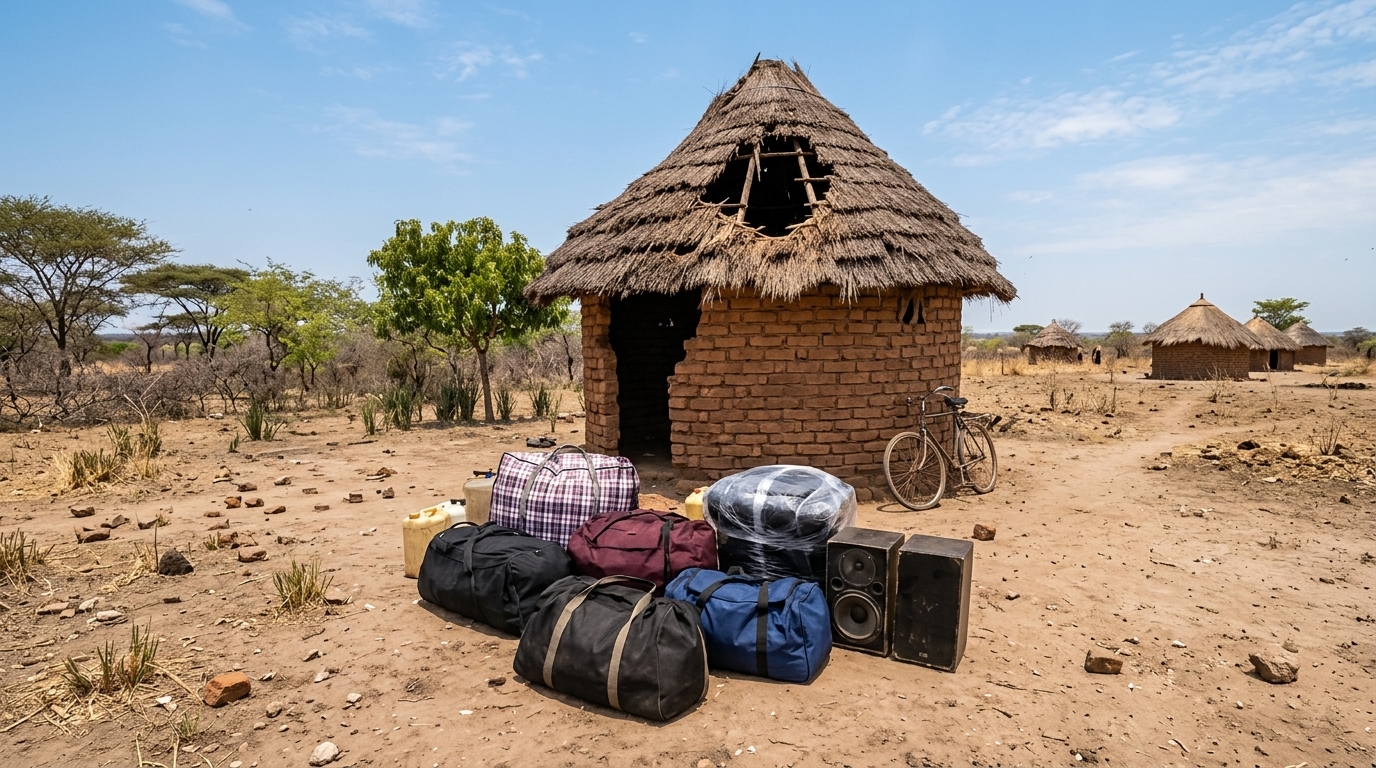
A 38-year-old Zimbabwean man who was deported from South Africa in May has been found hanging at his family homestead in Chipinge, days after another young returnee in Bulawayo took his own life.
Luke Sithole, of Watershed Village under Chief Mapungwana, was found hanging from a tree branch outside his family yard on 12 September. His death came after he repeatedly spoke about property he had left behind in South Africa and his efforts to recover it.
The case has brought fresh attention to the severe pressure facing Zimbabweans who have been forced or persuaded to leave South Africa, only to return to a country where jobs are scarce, money is limited and support for newly arrived families is stretched.
Assistant Inspector Wiseman Chinyoka, the acting Manicaland provincial police spokesperson, confirmed Sithole’s death. His father, 72-year-old Mike Sithole, told police that his son had been deeply troubled since his deportation.
“Luke’s father reported that after being deported from South Africa sometime in May, his son repeatedly complained about belongings he had left behind. He said Luke was constantly worried about recovering the property and often spoke about it,” Assistant Inspector Chinyoka said.
Police said Sithole went to bed as usual on the evening of 11 September. The next morning, his father went to check on him and discovered that he was not in his bedroom. A search of the homestead led to the discovery of his body outside the family yard.
“The matter is being treated as a suspected suicide. Investigations are continuing,” Assistant Inspector Chinyoka said.
Sithole’s death followed the death of a 21-year-old man from Gwabalanda in Bulawayo, who had returned from South Africa a few months earlier. Relatives said the young man repeatedly complained that life had become difficult after coming home. He spent much of his time drinking at Masilela Beer Garden in Luveve and was also said to have taken drugs with friends.
A relative said he often returned home in the early hours of the morning heavily intoxicated. She said he had spoken to family members about suicide before he was found dead.
“His untimely death is absolutely heartbreaking and one of the worst things I have seen in my life,” she said.
“Before he hanged himself, he told some of us that since coming back home from South Africa, life was getting very difficult for him and the only way out was to commit suicide.
“Of course, some of us thought he was joking. However, a few days later, it was with a heavy heart and deep sadness that we found out that he had hanged himself.”
The two deaths came after one of the largest movements of Zimbabweans across the border in recent years. Nearly 100,000 Zimbabweans had returned from South Africa by the middle of July, according to figures released by the Zimbabwean government. More than 70 per cent of those returnees were women and children.
The movement gathered pace in the weeks before and after 30 June, a deadline set by the anti-immigrant March and March movement, led by Jacinta Ngobese-Zuma, for undocumented foreign nationals to leave South Africa. Operation Dudula and other groups also campaigned against migrants, while threats of house-to-house action increased fear in several communities.
Ngobese-Zuma defended the campaign in June, saying: “If you come into South Africa with a passport that allows you to stay for 30 days. When it’s 50 days, when it’s two years, when it’s five years, you know you’re breaking the law.”
She also said: “We can’t have South Africa being turned into a refugee site for all failed African states… every country prioritises its citizens and we want the South African government to do the same.”
The threats did not affect only people without papers. Migrants with documents also described being targeted, losing their homes or abandoning work, property and medical treatment as they tried to reach safety.
Shingirai Kurebwaseka, a 35-year-old Zimbabwean, arrived at Beitbridge with stitches on his head, a plastered arm and a splint on his foot after being attacked during the protests. He said: “They beat me all over, smashed my foot with a hammer, burned me with some plastic papers which they had lit and were going to put a tyre around me but I somehow still managed to escape.”
After spending seven days in hospital, Kurebwaseka travelled back on a bus arranged for foreign nationals. He remained at a crowded shelter in Beitbridge while waiting for treatment and a way home.
Tichaona Magomazi, 35, returned after 11 years in Johannesburg with a single suitcase. He stood beside a road outside Beitbridge, looking for transport to Harare because he could not afford the fare.
“I left at the earliest opportunity,” he said. “I have no words for this situation that we are finding ourselves in.”
Amos Ferenando, 41, said he had spent seven years working in South Africa’s construction sector before fleeing when vigilantes began searching houses for foreigners. He was stranded at a roadside kiosk while trying to contact relatives in Zvishavane. He said his money had run out after he paid fines at the border.
An assessment of returnees found that 69 per cent described their journeys as sudden or forced. Many needed food, transport and psychological support after arriving with little more than the clothes they were wearing. By early July, more than 73,000 Zimbabweans had returned, including people who travelled by themselves and others assisted by government programmes.
At Beitbridge, humanitarian organisations had to expand water, sanitation, shelter and medical services. More than 20,000 Zimbabweans were still waiting for transport assistance at diplomatic missions and assembly points in South Africa in mid-July. Reception facilities faced pressure from the number of families arriving at once.
Doctors Without Borders treated people for burns, trauma, chronic pain, high blood pressure, HIV and tuberculosis at clinics in Musina and Beitbridge. Malvern Pedzisai, a 25-year-old Zimbabwean gardener from Mamelodi, suffered severe burns after protesters set fire to a bush where he and 10 other foreign nationals were hiding. He ran through the flames to escape and later returned to Zimbabwe for continued treatment.
Other returnees arrived after losing access to essential medication. Freedom Matemavi, a 46-year-old electrician and plumber, said anti-migrant groups had prevented him from reaching treatment and that he went without antiretroviral medicine for three months. His health deteriorated, he lost weight and became too weak to work. He returned to Zimbabwe despite holding a valid passport and work permit.
A Zimbabwean chef known as Nobuhle returned to her home in Soweto to find it had been burnt down. Her passport, permit, furniture, clothing and her children’s records were gone.
“I found my house burnt. I lost my passport and permit, all my clothes and furniture, my children’s birth records and birth certificates. I have nothing with me. All I have is this small handbag. I do not even have a change of clothes. I thought having a passport and permit would save me, but no, I was wrong. I wanted to kill myself. I have lost hope, and I do not know what I will do,” she said.
The return programme has included transport, food, shelter, medical care and education support, with Zimbabwean ministries working alongside civil society and United Nations agencies. But the needs have continued beyond the border. Many returnees still have to travel long distances to rural homes, find places to stay and rebuild livelihoods that were abandoned in South Africa.
For families such as the Sitholes, the consequences have also included the loss of property, income and contact with the lives left behind. The belongings Luke kept asking about represented years of work in South Africa and a possible route back to stability. Once he was deported, recovering them became a source of continuing distress.
The African Commission on Human and Peoples’ Rights warned in June that intimidation, attacks and threats of expulsion by vigilante groups placed migrants’ safety and dignity at risk. It called for protection, safe spaces and action against groups attempting to enforce immigration rules themselves.
The deaths in Bulawayo and Chipinge have now added a human cost to the mass return. They show how quickly the promise of safety at home can become another struggle for people who have lost work, property, health and hope across the border.