


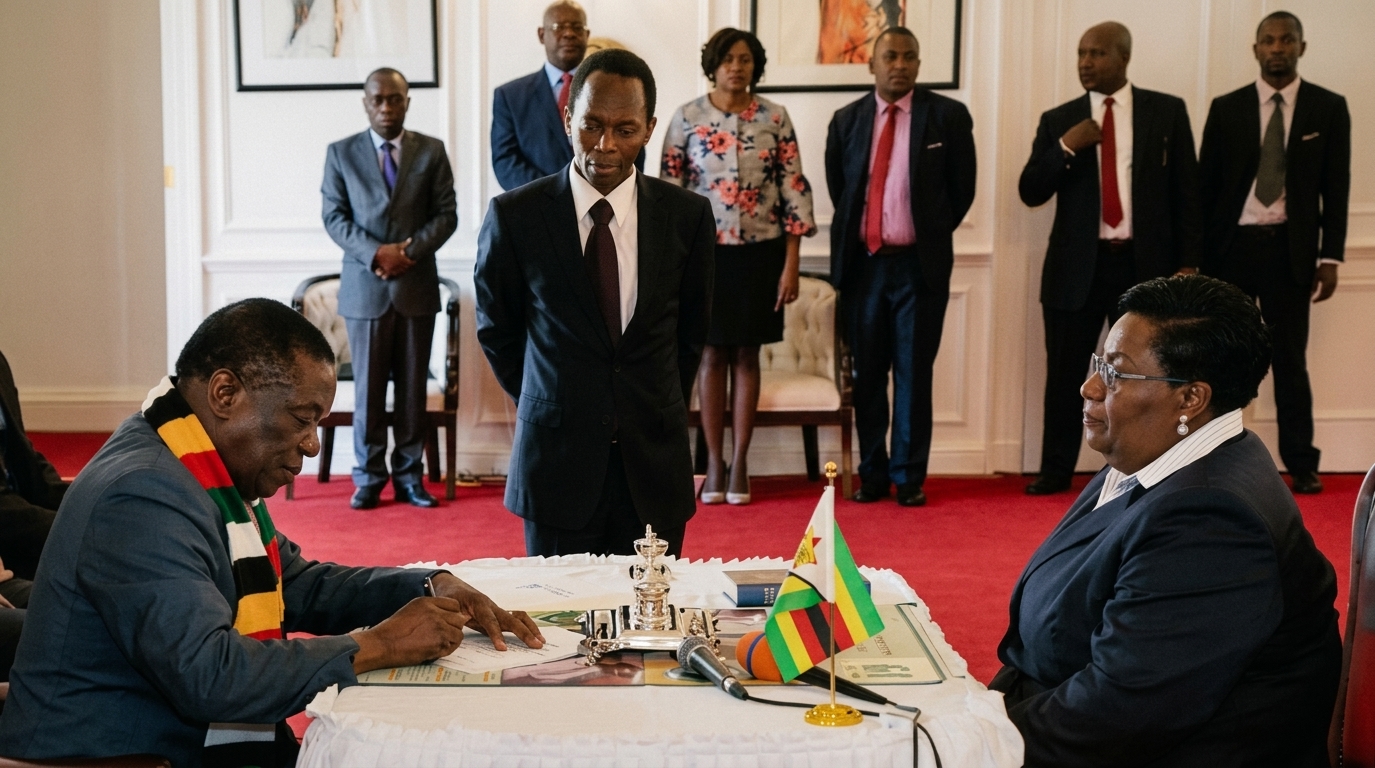
Zimbabwe could reopen the debate on capital punishment if tougher prison sentences fail to stop the country’s expanding drug trade, Prosecutor-General Loice Matanda-Moyo has warned.
Matanda-Moyo told the Daily News that the spread of drug peddling had become so serious that the Government might eventually have to consider the death penalty for major traffickers, despite President Emmerson Mnangagwa’s long-standing opposition to executions.
Her warning comes less than two years after Mnangagwa signed the Death Penalty Abolition Act into law, ending capital punishment for ordinary crimes. The Act, signed on 31 December 2024, stopped courts from imposing death sentences in normal circumstances. It also ordered the re-sentencing of people who had been on death row.
However, the legislation contains an exception that has kept the door open to capital punishment during a declared state of public emergency. The provision allows the death penalty to be reinstated for the duration of such an emergency under the Defence Act. That clause has already drawn criticism from Amnesty International, which welcomed abolition but called for the emergency provision to be removed.
Matanda-Moyo’s intervention has now placed drug traffickers at the centre of the unresolved question. She said the country could be forced to revisit the issue if life imprisonment and other severe penalties failed to deter the people directing the supply of dangerous substances.
“When we look at drug peddling, the trend is clear. Drug abuse is surging and drug peddlers are increasing by the day. This is a serious threat to our society because the consequences of drug abuse are not confined to the individuals who consume these substances.
“They affect families, communities, the economy and the moral fabric of the nation,” Matanda-Moyo said.
The warning follows a sustained national police campaign against drug and substance abuse. The National Prosecuting Authority’s 2023 annual report recorded 16,000 drug-related cases handled by prosecutors, with a clearance rate of 51.88 per cent. The report also recorded 505 murder cases received during the year, of which 359 were completed, giving a clearance rate of 71.8 per cent.
“In 2023, the National Prosecuting Authority of Zimbabwe (NPAZ) received 505 murder cases and successfully prosecuted 359, achieving a clearance rate of 71.8%. The rising number of murder cases is alarming, and we join the chorus advocating for an expansion of High Courts nationwide to effectively address this issue”, Matanda-Moyo said back in 2024.
The figures were published as the prosecution service faced staffing shortages and a heavy court workload. A review of the annual report noted that Midlands Province alone had about 400 murder dockets ready for trial and needed its own High Court. The report also showed the pressure on prosecutors handling serious crimes, sexual offences, gender-based violence and economic offences at the same time as drug cases.
National police spokesperson Commissioner Paul Nyathi said a search of the vehicle led to the recovery of sachets of dagga and Gorilla Glue, as well as Bronclear and Astra Pain syrups. Officers carrying AK-47 rifles were seen during the pursuit, while gunshots were heard along George Silundika Street between 8th and 9th Avenue, according to the report.
“A search of the vehicle, a blue Honda Fit GE6, registration number AHR 7991, allegedly resulted in the recovery of several sachets of dagga and Gorilla Glue, as well as Bronclear and Astra Pain syrups,” Nyathi said.
The case followed a series of operations in Bulawayo neighbourhoods. In Makokoba, detectives arrested 36-year-old Monalisa Sindisiwe Cheche after finding five sachets of suspected crystal methamphetamine in the pocket of the jacket she was wearing. Police said the two grams of crystal meth had an estimated street value of ZWG750.
The same operation led to the arrest of 11 people, including former Highlanders, FC Platinum and CAPS United midfielder Joel Ngodzo. The group was found smoking dagga in a barber shop on 7th Street, according to police. All 11 pleaded guilty and were fined between US$200 and US$300, with prison terms hanging over them if they failed to pay.
One of the accused, Aaron Phiri, gave the court an explanation for his drug use.
“Mbanje makes me run, I feel better and can have a peaceful sleep at night,” he said.
Bulawayo Magistrate Themba Chimiso responded with a warning that Zimbabwe was in a “war against drugs”.
In August, detectives also arrested Annet Sebele, 38, in Tshabalala after receiving information that she was allegedly operating a drug supply business from her home. Police said they recovered four cobs of dagga weighing 1.8 kilogrammes and valued at ZIG28,000, together with empty sachets believed to have been prepared for packaging.
A second suspect, Fortune Tshabalala, 42, was later arrested at a nearby property that investigators believed had been used as a storage facility. At another house in Newton West, detectives found 36 cobs of dagga weighing about 30 kilogrammes, 58 boxes of Broncleer cough syrup containing 50 bottles each and another 447 loose 100-millilitre bottles. Police estimated the value of the drugs at US$26,429.
“It is well recognised that drugs are inherently addictive, and individuals found in possession are often victims of socio-economic hardships rather than mere criminals,” Magistrate Moyo said.
He also said: “The real culprits behind drug trafficking are often well-connected politically and financially, enabling them to evade arrest and prosecution.”
“The court finds that the typical harsh sentences imposed for such offences may be unnecessarily punitive. Instead, a focus on reform and rehabilitation is warranted,” he said.
The magistrate’s remarks came as police reported a nationwide operation launched in July 2026 that had resulted in more than 2,000 arrests. Commissioner Nyathi said the operation was targeting crimes of concern, drug and substance abuse, and traffic offences.
Zimbabwe’s economic difficulties have added to the pressure on families and communities. High unemployment among young people, mental-health problems and economic hardship have been identified in recent reporting as factors linked to the spread of substances such as crystal methamphetamine, known locally as “guka” or “mutoriro”.
The political conflict over capital punishment is therefore unfolding alongside a far-reaching security and social crisis. Zimbabwe had not carried out an execution since 2005, even though courts continued to impose death sentences for aggravated murder. About 60 people were on death row at the end of 2023, according to Amnesty International.
Mnangagwa has repeatedly said that no executions would take place under his watch. During his time as Justice Minister and later as Vice-President, he said: “I would rather resign from my ministerial post than sign execution certificates for the people currently on death row.”
He has also described his own experience of being sentenced to death by the Rhodesian government in 1965 as “mental torture” and called capital punishment an “affront to human dignity”. He refused to sign death warrants after becoming Justice Minister in 2013 and later abolished the punishment after becoming President in 2017.