


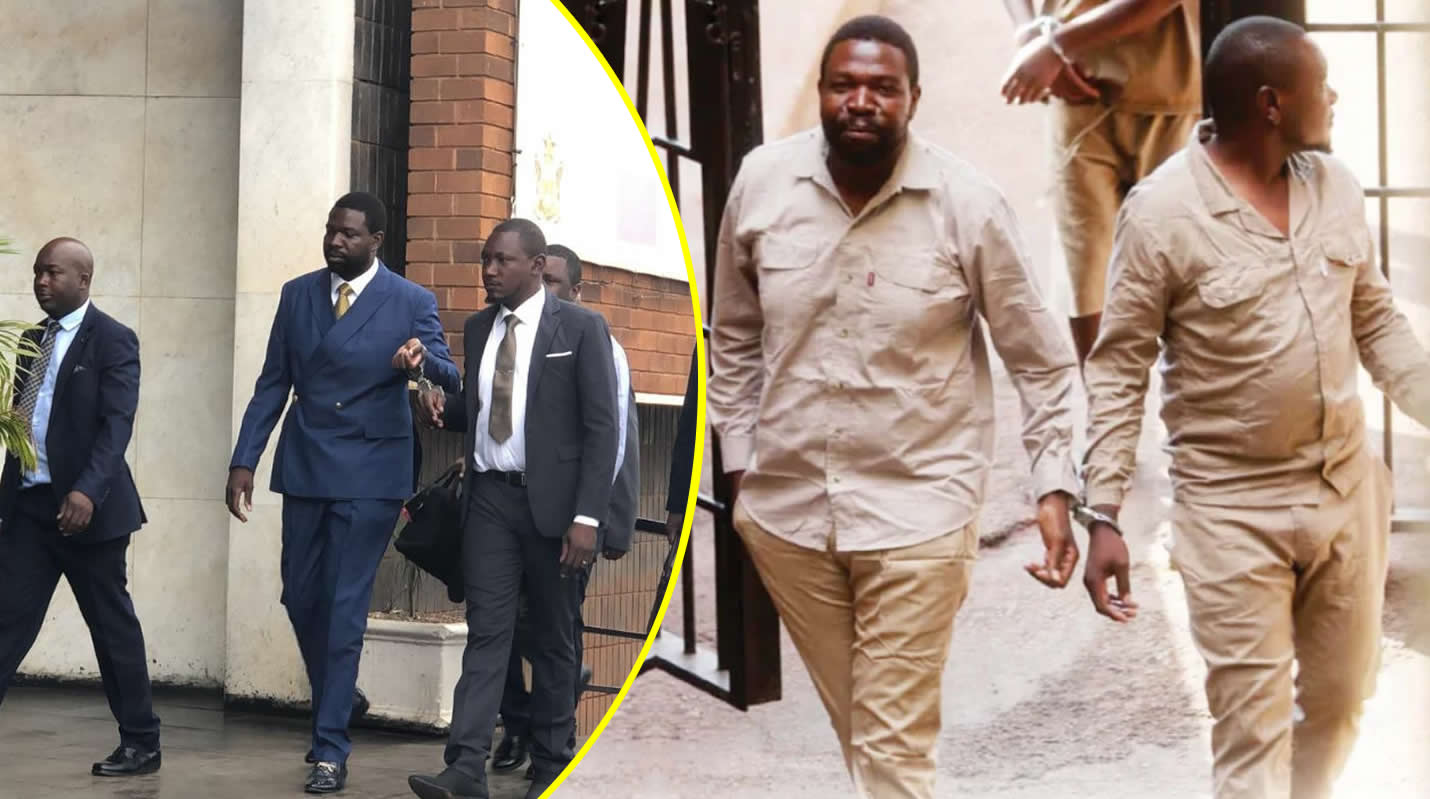
HARARE – The dramatic legal saga of Prophetic Healing and Deliverance (PHD) Ministries founder, Walter Magaya, took a sharp and chaotic turn this Monday as the prominent clergyman was re-arrested by detectives in the parking lot of the Harare Magistrates’ Court. The arrest, which occurred just moments after Magaya had appeared in court for ongoing rape and fraud trials, marks a significant escalation in the mounting legal challenges facing the 41-year-old preacher.
As Magaya and his legal team stepped out of the courthouse, they were intercepted by officers from the Criminal Investigations Department (CID). While the specific reasons for this latest arrest were not immediately made public, the atmosphere was one of high tension, following a morning of legal maneuvering that saw his high-profile rape trial grind to a sudden halt.
A Trial in Turmoil
The day was supposed to mark the commencement of Magaya’s trial on multiple counts of rape, an indictment that has hung over him since 2022. However, the proceedings before Magistrate Francis Mapfumo were quickly derailed. The State, represented by prosecutor Tendai Shonhai, was forced to apply for a postponement, citing a “communication breakdown” with key witnesses currently residing in Ireland.
According to the prosecution, the witnesses—including one of the primary complainants—had failed to travel to Zimbabwe because of a misunderstanding regarding airfare. “The State only learned last week that the witnesses believed the State would fund their airfare, while the State had assumed the witnesses would cover their own costs,” Shonhai told the court. “As a result, the witnesses did not travel to Zimbabwe.”
The State requested a two-week delay to resolve these logistical failures, but the defence was quick to pounce on the disorganisation. Magaya’s lead counsel, Admire Rubaya, launched a scathing attack on the prosecution, accusing them of “instalment justice” and “jelly legs.”
“We are disheartened that the State superintended the arrest of the accused first,” Rubaya argued, referring to a previous high-drama arrest at Magaya’s Prayer Mountain involving more than 40 armed officers. “All that drama. We thought that the State’s house was in order. These are offences allegedly committed in 2022. They told the whole nation that they were ready to try the accused. Suddenly they have developed jelly legs and are now unable to proceed.”
The Shadow of the Fake Diploma
While the rape trial stalled, a newer and perhaps more politically sensitive scandal continued to loom over the proceedings: the allegation that Magaya submitted a fraudulent diploma from the University of South Africa (UNISA) in a bid to contest the presidency of the Zimbabwe Football Association (ZIFA).
The investigation, spearheaded by the Zimbabwe Anti-Corruption Commission (ZACC), followed a public disavowal by UNISA. In a formal statement, the institution clarified that Magaya was neither a student nor a graduate. “Unisa does not have Mr Magaya either as a student or a graduate. Any certificate/s he produces which he claims to be from Unisa is/are therefore fraudulent,” the university stated.
The fake qualification—a National Diploma in Marketing—was allegedly used to satisfy the eligibility criteria for the ZIFA leadership race. Critics and investigators suggest that the document was also submitted to the High Court in separate proceedings, potentially opening Magaya up to further charges of perjury and fraud.
Rubaya, however, maintained that the legal onslaught was a coordinated effort to prevent his client from seeking justice or participating in public life. “They want to be seen as if they are doing work. They are not looking for justice,” he asserted in court.
78 Counts of Fraud
Adding to the complexity of the day’s events was a separate hearing involving Magaya and his wife, Tendai Magaya. The couple is facing a staggering 78 counts of fraud, a case that has been remanded to 27 March 2026 for possible indictment to the High Court.
The fraud allegations are reportedly linked to financial dealings within PHD Ministries and associated business ventures. The State has indicated its intention to begin the High Court trial in the second quarter of 2026. Unlike the rape trial, where the defence is pushing for removal from remand, the fraud case appears to be moving steadily toward a full-scale trial.
During the morning session, the court heard that the State is still finalising the necessary paperwork. “We hope that by then we will have finalised everything for his trial to commence at the High Court,” Shonhai said. Rubaya consented to the March remand date but expressed hope that the State would actually be ready to proceed by then, rather than seeking further delays.
A Complainant Withdraws
In a significant twist in the rape case, Rubaya informed the court that one of the complainants had formally withdrawn her allegations. He claimed that a sworn affidavit had been sent to the Prosecutor-General’s office as early as November 2025.
“Effectively, the person who was saying ‘I was raped’ is saying ‘I have nothing against the accused’,” Rubaya told the court. “It means that our client is here for nothing. Effectively, the reason why the accused is on remand has collapsed.”
Despite this claim, the State appears determined to proceed with the remaining counts, which involve a second complainant. The legal battle has become a war of attrition, with the defence accusing the State of violating Magaya’s constitutional right to a trial within a reasonable time.
The ‘Prayer Mountain’ Arrest and Beyond
The drama in the court parking lot is just the latest chapter in a series of high-stakes confrontations between Magaya and the Zimbabwean authorities. The defence frequently cites the “theatrical” nature of his arrests—most notably the raid on his Prayer Mountain—as evidence of a vendetta.
For years, Magaya has been one of Zimbabwe’s most influential and controversial figures, commanding a massive following through his PHD Ministries. His “healing” sessions and business interests have made him a multi-millionaire, but they have also made him a frequent target of both state scrutiny and public scandal. From the 2018 “Aguma” herbal cure controversy—where he claimed to have found a cure for HIV/AIDS—to the current rape and fraud charges, Magaya has remained a permanent fixture in the nation’s headlines.
As he was led away by detectives on Monday, the future of his ministry and his personal freedom seemed more uncertain than ever. With the ZIFA presidency bid now in tatters due to the diploma scandal and his High Court trials looming, the “Prophet” finds himself in a legal labyrinth from which there may be no easy escape.
The court has set 2 March 2026 as a tentative date for the rape trial to resume, provided the State can secure its witnesses from Ireland. In the meantime, the nation waits to see what new charges will emerge from his latest arrest, and whether the mounting legal troubles will finally bring down one of Zimbabwe’s most resilient public figures.
For the thousands of followers who still flock to his services, the arrest is seen as a test of faith and a case of religious persecution. For his detractors and the victims seeking justice, it is a long-overdue reckoning. Regardless of the perspective, one thing is clear: the trial of Prophet Walter Magaya is no longer just a legal proceeding—it is a national spectacle that continues to expose the deep fractures in Zimbabwe’s judicial and social fabric.