


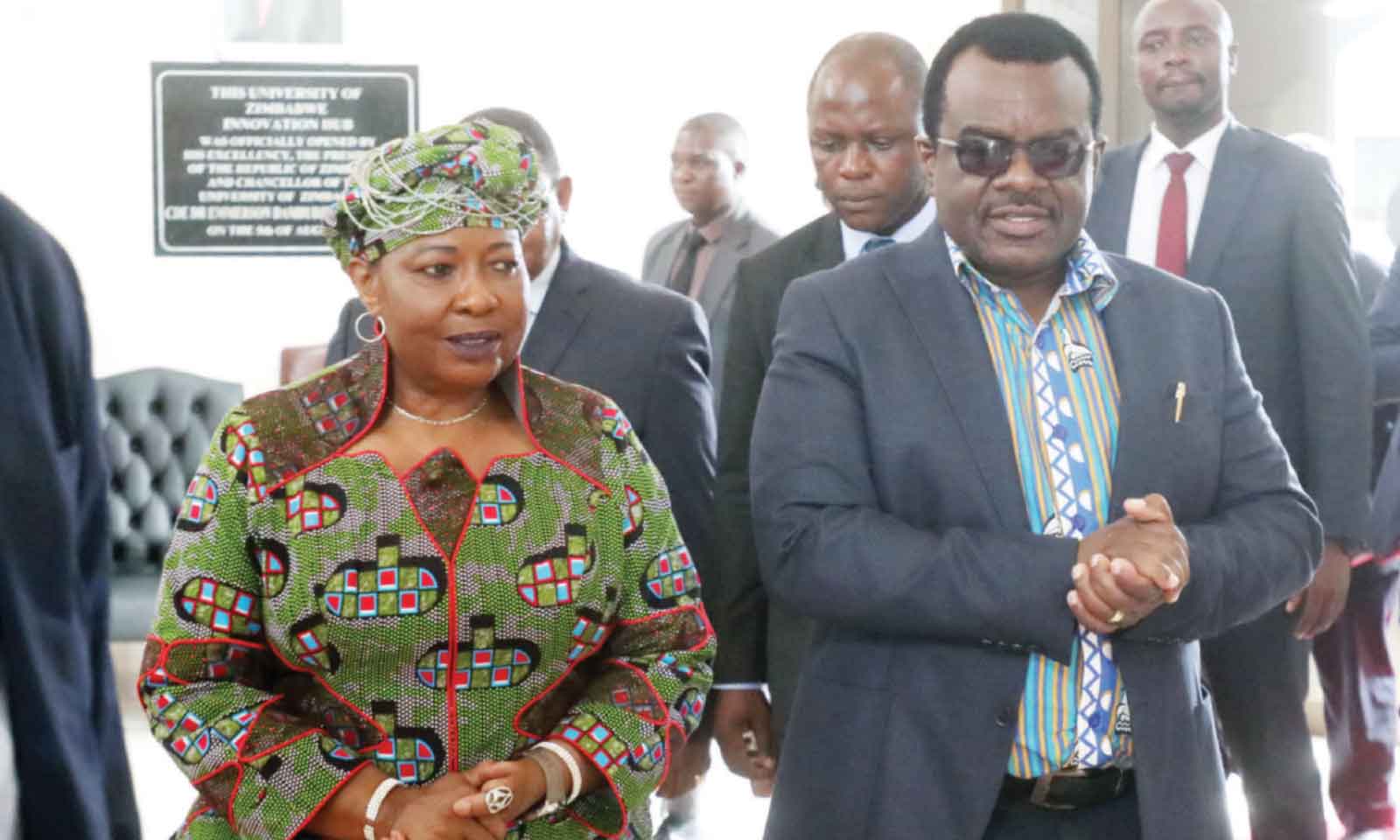
BINDURA – When First Lady Dr Auxillia Mnangagwa stood before a crowd of students at the University of Zimbabwe last week to launch the “Youth Vanguard Movement,” the atmosphere was thick with the official rhetoric of “empowerment,” “patriotism,” and “heritage-based education.” Dressed in her signature modest attire, the First Lady spoke of a “pioneering national initiative” designed to produce a “new calibre of young leaders” equipped to drive the nation’s development agenda. To the casual observer, it seemed like another standard government programme aimed at addressing the chronic unemployment that has left many graduates “sitting at home without opportunities,” as one student from Beitbridge, Florence Ndou, put it during the event.
However, for those who lived through the early 2000s, the imagery and language used during the launch were chillingly familiar. Our investigative team has tracked the initial recruitment drives in Mashonaland Central—specifically in the Mount Darwin area, a traditional stronghold for such movements—and found that the training modules include far more than just “national orientation.” There are growing reports of “discipline drills” and “community monitoring” tasks that look suspiciously like a paramilitary structure designed to suppress local-level dissent. The “Green Bombers,” the notorious graduates of the Border Gezi National Youth Service (NYS), once haunted these same hills, and the ghosts of that era appear to be returning under a new, more polished veneer.
The Youth Vanguard Movement is officially described as a three-month intensive programme that blends leadership simulations with community engagement. Dr Mnangagwa emphasised that the movement’s success would be judged not by numbers, but by the “tangible impact participants create and the influence they spread.” She told the gathered youths:
“This programme is a national platform that recognises that leadership is not an accident. Leadership must be nurtured, mentored, tested and guided by norms and values rooted in our culture and tradition. The launch of the Youth Vanguard Movement is a call to action for our young people to rise above limitation, fear and insecurity, and to embrace responsibility in shaping the future of our nation.”
While the First Lady’s words focus on “responsibility” and “integrity,” the reality on the ground in Mashonaland Central suggests a different kind of training. Local sources, speaking on condition of anonymity for fear of retribution, describe recruits being put through rigorous physical exercises that mirror military basic training. These “discipline drills” are reportedly followed by lectures on “defending the gains of the revolution,” a phrase that has historically served as a euphemism for partisan political enforcement. The “community monitoring” aspect of the programme is particularly concerning, as it encourages these “empowered youth” to keep a close eye on their neighbours, ostensibly to “identify development needs,” but in practice, it creates a network of grassroots informants.
The funding of the Vanguard Movement remains one of its most guarded secrets. While many essential government programmes are currently cash-strapped, with the 2026 National Budget struggling to meet basic infrastructure needs, this initiative appears to have a direct line to “special interest” funds. Investigative leads suggest that the movement is not entirely dependent on the ZiG 1.7 billion allocated to the Ministry of Youth Empowerment, Development and Vocational Training. Instead, a significant portion of its operational budget is believed to flow through the First Lady’s own Angel of Hope Foundation and other “private-public partnerships” that operate with little to no parliamentary oversight.
This financial autonomy has fuelled a growing conspiracy that the Vanguard is being built as a private political force, loyal not to the state or the traditional security apparatus, but to the “First Family” interests. As the 2030 agenda—President Emmerson Mnangagwa’s vision for a middle-income society—gains momentum, the need for a grassroots enforcement wing becomes clear. The 2030 agenda is often framed as a purely economic goal, but critics argue it is also a political timeline. In this context, the Youth Vanguard Movement serves as a “shadow army,” operating outside the traditional chain of command of the Zimbabwe Defence Forces (ZDF) or the Republic Police (ZRP).
The organisational chart of this new movement is deceptively simple, yet it overlaps strategically with existing security structures. While it is officially housed under the Ministry of Youth, headed by Minister Tino Machakaire, the actual “mentorship” and “leadership simulations” are often conducted by retired military personnel and “war veterans” who have remained loyal to the current administration. Minister Machakaire himself noted during the launch:
“Your address has not only launched the Youth Vanguard Movement, but has stirred a sense of responsibility, renewed patriotism and a powerful call for us to step forward and do more. To the young people, the future is yours and today you have been entrusted with the responsibility to help shape it. Step forward with courage and the ability to make a difference.”
What happens when “empowered youth” are given the authority to “protect the revolution” in your neighbourhood? History provides a grim answer. The original Green Bombers were infamous for their role in election-related violence, using their “national service” status to justify the intimidation of opposition supporters. By rebranding this force as the “Youth Vanguard,” the administration is attempting to sanitise its image while retaining its core function. The focus on “heritage-based education” is particularly clever, as it allows the state to frame any criticism of the movement as an attack on Zimbabwean culture and sovereignty.
|
Feature
|
Youth Vanguard Movement (2026)
|
Green Bombers / NYS (2000s)
|
|
Official Stated Goal
|
Leadership, Heritage, Empowerment
|
Patriotism, Skills, National Service
|
|
Primary Patron
|
First Lady Dr Auxillia Mnangagwa
|
Late Border Gezi / ZANU-PF
|
|
Training Duration
|
3 Months
|
Variable (often 6 months)
|
|
Key Locations
|
University of Zimbabwe, Mashonaland Central
|
Mount Darwin, Border Gezi Centres
|
|
Core Modules
|
Leadership simulations, Community monitoring
|
Military drills, Political orientation
|
|
Funding Source
|
Special interest funds, Angel of Hope
|
National Budget, ZANU-PF coffers
|
The involvement of the University of Zimbabwe’s Vice Chancellor, Professor Paul Mapfumo, adds a layer of academic legitimacy to the movement. During the launch, Professor Mapfumo described the programme as “exceptional innovation and visionary leadership.” He stated:
“The programme you are launching today demonstrates exceptional innovation and visionary leadership. It speaks to a deep commitment to our culture, our traditions and the empowerment of our people. As a university, we are ready to support this life-changing initiative and to contribute meaningfully towards shaping a generation of leaders who will drive Zimbabwe’s future.”
However, students at the university are divided. While some, like Simbarashe Munyanyiwa from Shurugwi, see it as a way to “say no to drug abuse and unemployment,” others fear it is a trap. “We are told it’s about leadership,” said one final-year political science student, “but when you look at the people running the workshops, they aren’t academics. They are the same faces we see at party rallies, the ones who talk about ‘crushing’ anyone who stands in the way of the 2030 vision.”
The “2030 Agenda” is more than just a slogan; it is the framework within which the Youth Vanguard operates. As the administration seeks to consolidate power and ensure a smooth transition or extension of the current leadership, having a disciplined, loyal youth wing becomes a strategic necessity. These youths are being trained to be “solution-providers” and “development champions,” but in a political environment where “development” is synonymous with “loyalty,” the line between community service and political policing becomes dangerously thin.
Dr Mnangagwa was explicit about the expectations for these graduates:
“We do not want young people who only speak, but those who act and deliver results. Not those who simply attend meetings, but initiators of development who carry responsibility and the will to serve others. Through structured mentorship and leadership exposure, participants will gain not only knowledge, but also the wisdom and guidance necessary to lead with integrity and purpose.”
The “wisdom and guidance” mentioned by the First Lady often comes from a very specific ideological perspective. By embedding these “vanguards” into the fabric of local communities, the state is creating a permanent presence that can be activated at any time. Unlike the police, who are bound by at least some semblance of legal procedure, the Youth Vanguard operates in a grey area of “community engagement.” They are the “eyes and ears” of the First Family, tasked with ensuring that the “ripple effect” of their training is one of total compliance.
As the first batch of recruits completes their three-month stint, the true nature of the Youth Vanguard Movement will become even clearer. If the reports from Mashonaland Central are any indication, the “transformation of our nation’s governance” that the First Lady spoke of is not towards a more open and democratic society, but towards a more tightly controlled one. The “shadow army” is being assembled, and its soldiers are the very youth who were promised a better future. In the end, the “Vanguard Mystery” may not be a mystery at all, but a well-rehearsed strategy to ensure that the 2030 agenda is protected by any means necessary.
The tragedy of the Youth Vanguard is that it exploits the genuine desperation of Zimbabwe’s young people. When you have a degree but no job, and someone offers you “full sponsorship for training” and a “clear pathway for empowerment,” it is hard to say no. But as history has shown, the price of such empowerment is often one’s conscience and the safety of one’s community. The First Lady may call it a “trailblazing move,” but for those who value freedom, it looks like a path we have walked before, and it leads to a very dark place.