


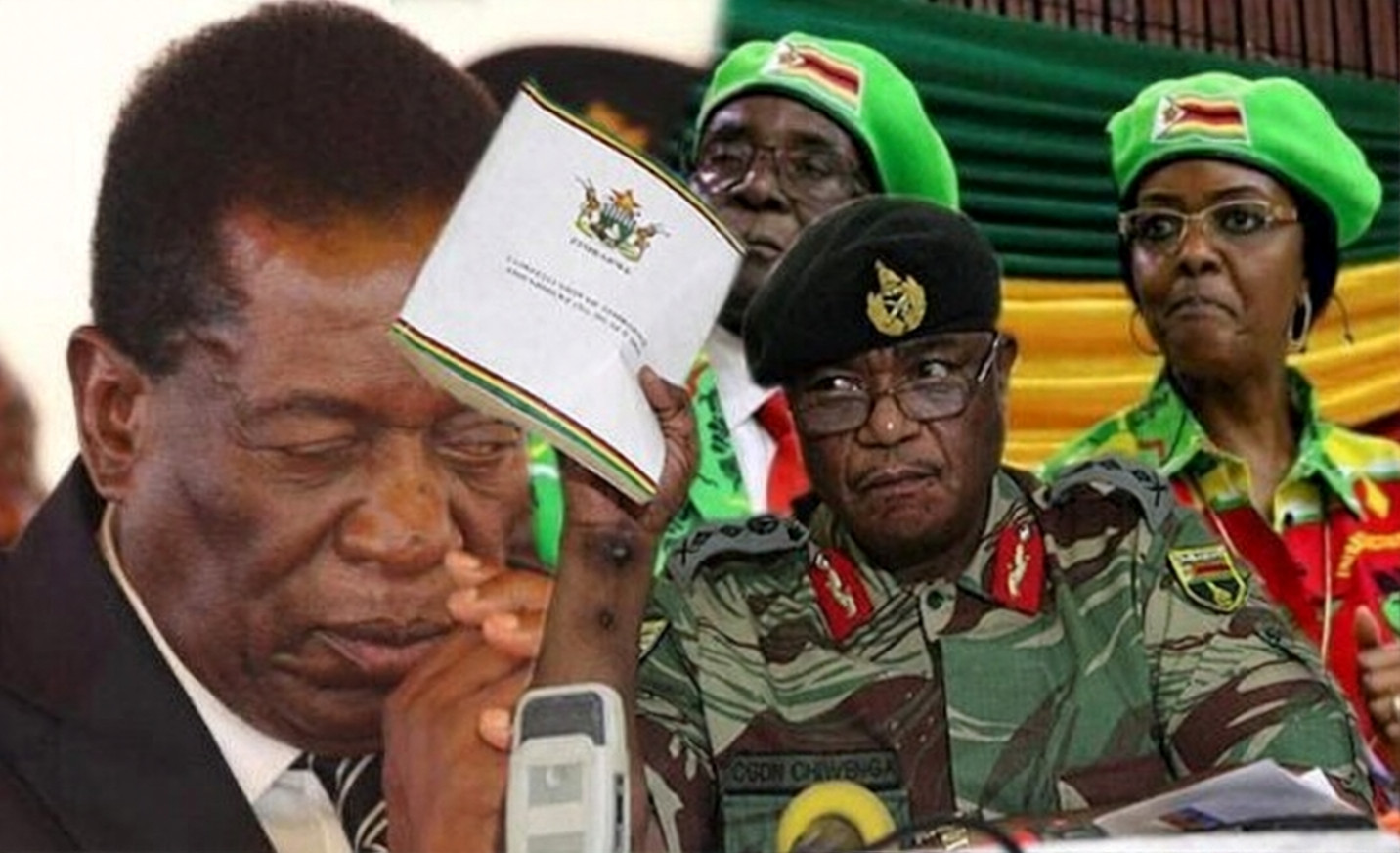
The Chiwenga-Muchinguri Swap: Is the ‘General’ Being Pushed Out in a Cold-Blooded Palace Coup?
Zimbabwe’s political landscape is once again gripped by an intense power struggle, with whispers of a cold-blooded palace coup reverberating through the corridors of power. At the heart of this unfolding drama lies the question: “Has VP Chiwenga Been Replaced By Oppah Muchinguri?” This query, initially a headline on ZimEye, has quickly become a focal point, reflecting a deep-seated contest for influence within the presidium. Our investigation delves into the intricate web of alliances and rivalries, examining the clashes between Vice President Constantino Chiwenga and loyalists of President Emmerson Mnangagwa, the systematic erosion of military influence, and the strategic positioning of Defence Minister Oppah Muchinguri.
The political temperature in Harare has been steadily rising, marked by significant internal strife within the ruling ZANU-PF party. Recent reports indicate a dramatic politburo confrontation on 31 March 2026, where Vice President Chiwenga reportedly clashed head-on with President Mnangagwa’s loyalists. Insiders revealed that Chiwenga vehemently challenged the controversial “2030 agenda” and issued a stark warning against pushing Constitutional Amendment No. 3 without a national referendum. This amendment, designed to extend presidential term limits, has become a flashpoint, exposing deepening fractures within ZANU-PF.
At the epicentre of this explosive confrontation was a heated exchange between Chiwenga and State Security Minister Lovemore Matuke. Sources indicate that Chiwenga demanded that any extension of presidential term limits be subjected to a referendum, a position directly at odds with the party’s current trajectory. Matuke allegedly retaliated, accusing dissenting voices of undermining party unity. The clash quickly escalated, drawing in Defence Minister Oppah Muchinguri-Kashiri and ZANU-PF commissar Munyaradzi Machacha, both of whom reportedly backed Matuke, thereby setting the stage for a full-blown factional standoff.
This internal “Cold War” is particularly evident within the Munhumutapa Building, where the military’s once-unquestionable influence appears to be systematically eroding. The military, which played a pivotal role in bringing Mnangagwa to power in 2017, now finds its authority challenged by the “civilian” wing of ZANU-PF. The push for Constitutional Amendment No. 3, which seeks to extend Mnangagwa’s rule until 2030, is widely seen as a move to manipulate the central committee of ZANU-PF and consolidate civilian power, thereby sidelining military figures like Chiwenga.
This statement was widely interpreted as a thinly veiled swipe at rivals within the party hierarchy, underscoring the deep divisions and historical grievances that continue to shape Zimbabwe’s political landscape. The unfolding drama carries haunting echoes of the 2017 military intervention that ousted Robert Mugabe, where discontent brewed within military and war veteran networks before erupting into decisive political action. Mnangagwa’s rise was built on that very military backing, but now, the same pillars appear to be wobbling.
The sudden positioning of Oppah Muchinguri-Kashiri as a “loyalist” alternative to Chiwenga is a critical element in this power play. Muchinguri, a seasoned politician and the current Minister of Defence and War Veterans Affairs, is known for her staunch loyalty to President Mnangagwa. Her background includes military training in Mozambique during the liberation struggle, making her a unique figure capable of bridging the gap between the party and the barracks. As Defence Minister, she is strategically placed to influence the military, potentially serving as a counterweight to Chiwenga’s enduring influence within the armed forces. Her reported backing of Matuke in the recent politburo clash further solidifies her role as a key player in Mnangagwa’s camp.
Chiwenga’s health has frequently been a subject of public discussion and, controversially, a pretext for his political sidelining. While health issues are a private matter, in the cutthroat world of Zimbabwean politics, they often become tools in the larger game of succession. The “2030 project,” which aims to extend Mnangagwa’s tenure, necessitates a Vice President who will not challenge the “Crocodile’s” grip on power. This project, driven by ZANU-PF, seeks to amend the constitution to allow Mnangagwa to remain in office until 2030, bypassing the need for a direct presidential election. This move is perceived by many as an attempt to secure Mnangagwa’s position and prevent any potential challenge from within, particularly from Chiwenga, who is widely seen as a presidential hopeful.
The cracks in the military-state alliance, which once seemed unshakeable, are becoming increasingly visible. A significant public crack emerged recently with the outspoken comments of Retired Lieutenant General Winston Sigauke Mapuranga. On 4 April 2026, Mapuranga launched a renewed attack on President Mnangagwa’s attempts to amend the Zimbabwean Constitution to secure an extra two years of his second and final term. Mapuranga, one of the few senior government officials, past or present, to openly oppose the extension of Mnangagwa’s stay against constitutional dictates, questioned the rationale behind the proposed amendment.
In a powerful statement, Mapuranga asked, “Two years President Mnangagwa, what exactly is the plan?” He continued, “I have spent decades in uniform defending a Zimbabwe I believed in. I have watched governments rise and I have watched them rot. I have held my tongue when discretion demanded it. I am holding it no longer.” He further elaborated on his concerns, stating, “We are being asked to amend a constitutional framework – the supreme law of this republic – not because the constitution is broken, but because a political timetable is inconvenient. That is not governance. That is the behaviour of a man who does not trust the people to freely choose him. And if a leader cannot trust the people, why should the people trust the leader?”.
Mapuranga’s comments underscore a growing disillusionment within certain segments of the military and war veteran community, traditionally a bedrock of ZANU-PF’s power. His critique extended to the state of Zimbabwe’s infrastructure, highlighting collapsed power grids, dry taps, and how ministers were forcing people to celebrate mediocrity. “In Zimbabwe, we have lowered the bar so far that survival is mistaken for success,” he lamented, adding, “We have normalised brokenness. We have built a political culture so accommodating of failure that the citizenry has been socially conditioned to celebrate the absence of catastrophe as though it were prosperity”.
The unfolding events paint a picture of a slow-motion “Palace Coup,” meticulously orchestrated to reshape Zimbabwe’s leadership before the next election. The constitutional amendments, the strategic deployment of loyalists like Muchinguri, and the sidelining of influential figures like Chiwenga, all point towards a calculated effort to consolidate power. The demand for a referendum on the constitutional changes, now echoed by a faction of the Zimbabwe National Liberation War Veterans Association in Mashonaland West, has thrown a spanner into Mnangagwa’s 2030 ambitions. Their bold letter, dated 30 March 2026, warned that any constitutional amendment pushed without public approval lacks legitimacy, invoking the liberation struggle’s core principle of “one man, one vote”.
This dual posture—loyal yet resistant—signals a dangerous shift within the party. What was once unthinkable dissent within liberation structures is now emerging in plain sight. The conspiracies, the “broken pacts” between the military and the civilian leadership, and the high-stakes gamble being played out could redefine Zimbabwe’s political landscape. The threat to Mnangagwa is no longer solely from the opposition; it is rising from within his own ranks, as history suggests that when such cracks appear, seismic shifts often follow. The question remains whether this internal struggle will culminate in a decisive victory for one faction or plunge the nation into further political uncertainty.