


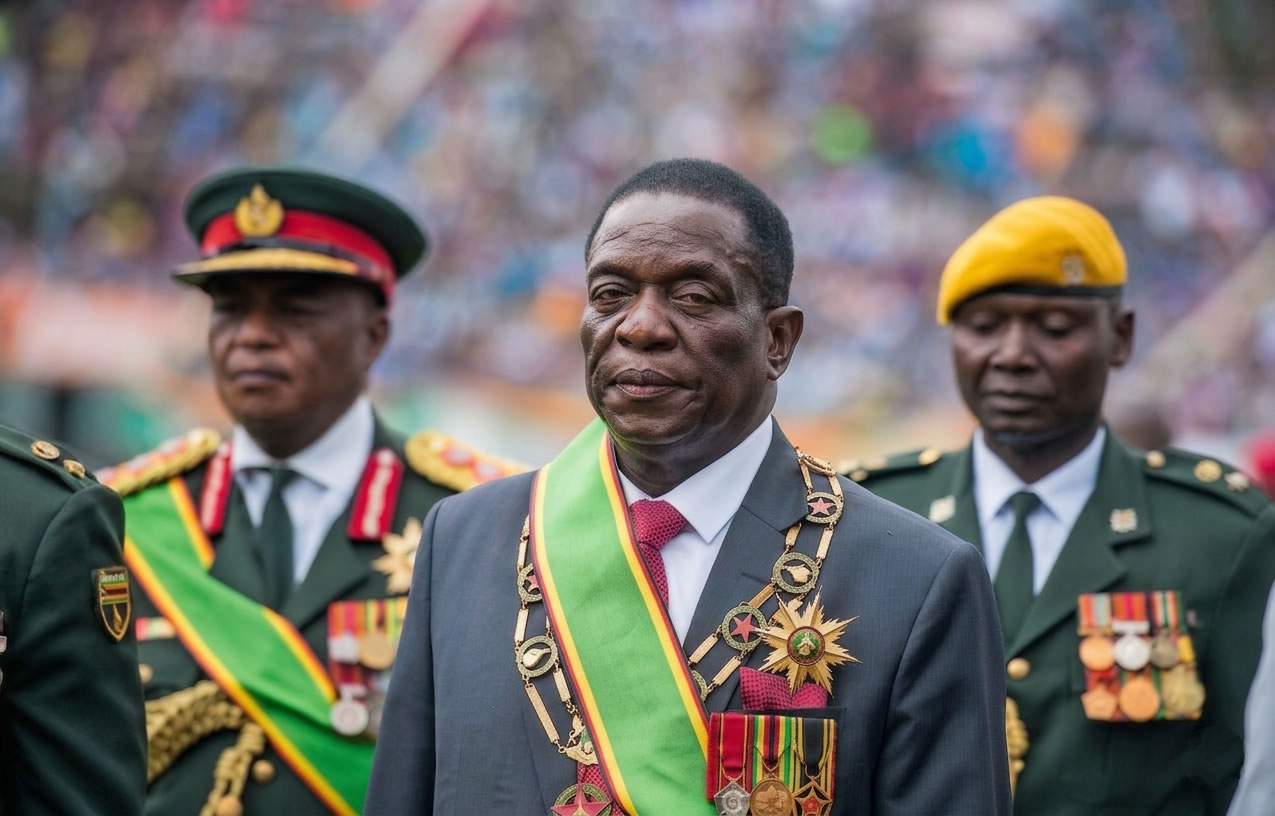
Harare – A profound political crisis is brewing at the heart of Zimbabwe’s ruling Zanu PF party, as a formidable group of retired military commanders openly challenges President Emmerson Mnangagwa’s bid for an extended term and the controversial Constitution Amendment Act No. 3. This unprecedented resistance, spearheaded by former Air Vice-Marshal Henry Muchena, signals a significant fracture within the nation’s historically powerful military elite, threatening to reshape the country’s political landscape ahead of crucial electoral events.
The simmering tensions have escalated into a full-blown succession battle, forcing these influential generals to rally their forces against Mnangagwa’s leadership. Insiders suggest that Muchena’s public defiance represents a critical rupture within Zanu PF’s traditional bedrock – the military, which has historically served as the party’s political vanguard. The outspoken opposition from this group underscores deep internal divisions, particularly concerning the President’s consolidation of power and the future direction of the nation.
The Genesis of Conflict: Constitution Amendment Act No. 3
At the core of this political maelstrom is the Constitution Amendment Act No. 3, a legislative manoeuvre that critics argue heavily centralises executive authority and disenfranchises voters. The group of retired commanders, including Muchena, formally submitted written objections to Parliament in March, warning that altering key constitutional provisions without a public referendum subverts the fundamental ideals of the liberation struggle. They contend that the principle of
“one man one vote” and the direct power of the masses to elect their President are being undermined by these amendments.
Specifically, the ex-commanders argue that by bypassing a public referendum and transferring the power to elect a head of state to Parliament, the changes create a situation where a sitting president is significantly insulated from direct popular accountability. This move, they assert, deviates sharply from the democratic principles fought for during the liberation war.
The Shadowy Operators: A Coordinated Resistance
The group of former army commanders is not a loose collection of disgruntled individuals but a real, coordinated entity. Its membership has been closely guarded, a deliberate operational security measure to protect participants while Muchena acts as the public face. The NewsHawks, after conducting checks and verification, confirmed the involvement of several retired generals whose names had been previously speculated but unconfirmed.
An investigation report, titled “A Report on the Figures Named in Zimbabwe’s 2026 Constitutional Amendment (No.3) Resistance,” seen by The NewsHawks, names nine retired commanders as the core team battling Mnangagwa’s leadership.
This cohort includes:
|
Name
|
Former Position
|
|
Air Vice-Marshal Henry Muchena (Rtd)
|
Deputy Air Force of Zimbabwe Commander; former Principal Director, Zanu PF Commissariat
|
|
Lieutenant-General Martin Chedondo (Rtd)
|
Chief-of-Staff, Zimbabwe National Army; former Ambassador to China
|
|
Major-General Mike Nicholas Sango (Rtd)
|
Head of Military Intelligence; former Ambassador to Russia
|
|
Major-General Paul Chima (Rtd)
|
Commander, Mechanised Brigade at Inkomo Barracks
|
|
Chris Mupande (Rtd)
|
Director-General of Policy, Public Relations, and International Affairs, Ministry of Defence
|
|
Etherton Shungu (Rtd)
|
Commander, Artillery Brigade
|
|
Livingstone Chineka (Rtd)
|
Former Army Commander; Zanu PF MP for Zaka East
|
|
Richard Ncube (Rtd)
|
Top Zipra Commander (Chief of Operations during liberation struggle)
|
|
Frederick Mutanda (War Veteran)
|
Close aide to late Zapu leader Joshua Nkomo
|
These individuals, with their deep roots in the liberation struggle and extensive military careers, represent a significant segment of the old-guard military establishment. Their collective opposition to Mnangagwa’s constitutional amendments underscores a profound ideological and power struggle within the ruling party.
Mnangagwa’s Power Consolidation and Military Reshuffles
President Mnangagwa, since assuming power, has systematically worked to consolidate his authority and “coup-proof” his administration. This has involved a gradual but deliberate purging, reshuffling, and realignment of the security services command element, including the police, intelligence, and army chiefs. This strategy aims to neutralise potential threats and ensure loyalty within the armed forces.
A notable example of this consolidation was the sidelining of the army during the 2023 elections. Instead, a shadowy intelligence-run structure known as Forever Associates Zimbabwe (FAZ), led by former army and Central Intelligence Organisation senior officer Walter Tapfumaneyi, took centre stage. This move was reportedly driven by Mnangagwa’s fear that the army, historically a decisive electoral weapon for Zanu PF, might be used to rig him out of power.
Following the elections, Tapfumaneyi was promoted back into the military, rapidly ascending to the rank of Lieutenant-General and appointed Commander of the Zimbabwe National Army (ZNA). This promotion was seen as a strategic move to prevent Vice-President Constantino Chiwenga and his faction from leveraging the army, as they had reportedly attempted in the run-up to a planned mass action on 31 March 2025. Lieutenant-General Sanyatwe, a known Chiwenga ally, was abruptly removed as ZNA commander and redeployed as Sports Minister, replacing Olympian Kirsty Coventry.
Sources suggest that had it not been for the advice of former Zimbabwe Defence Forces (ZDF) commander Philip Valerio Sibanda, Mnangagwa’s position might have been jeopardised. Sibanda is credited with previously saving Mnangagwa from a foiled coup attempt in January 2019 while the President was on a foreign trip. In a clear sign of reward and continued influence, Mnangagwa has since appointed Sibanda to the Zanu PF politburo, indicating his consideration in the broader succession matrix.
The Shifting Role of the Military
Further solidifying his control, Constitution of Zimbabwe Amendment (No. 3) Act also officially alters the constitutional role of the defence forces. The amendment changes Section 212 of the constitution, shifting the military’s mandate from being “upholders” of the constitution to simply having to “act in accordance with” it. This seemingly subtle change has ignited considerable debate, with opposition leaders and civic groups labelling it a “coup-proofing” measure designed to restrict the army from political interference and forestall future coup possibilities.
Muchena and his allies are acutely aware of this new reality. Consequently, they have emphasised that their mobilisation and resistance efforts will remain legal and peaceful, despite Chiwenga having previously invoked the spectre of the 2017 coup. This strategic declaration highlights the delicate balance of power and the generals’ understanding of the legal and political ramifications of their actions.
Chiwenga’s Ambitions and the 2030 Project
The succession battle within Zanu PF is inextricably linked to Vice-President Chiwenga’s presidential ambitions. In September last year, Chiwenga presented a 25-page anti-corruption dossier to Mnangagwa and the Zanu PF politburo, implicating the President’s close business allies in widespread corruption and “industrial scale looting”. This explosive report was widely interpreted as a direct challenge to Mnangagwa’s authority and an attempt to undermine his support base.
Chiwenga reportedly blamed Mnangagwa for the “2030 project,” describing him as the “real architect” of what they term a “constitutional coup” – a sentiment echoed by Muchena and his group. In retaliation, Mnangagwa’s allies, led by Justice Minister and Zanu PF legal affairs secretary Ziyambi Ziyambi, who spearheaded the constitutional amendments, swiftly branded Chiwenga’s report as “treasonous” and dismissed his claims as an “immature, emotional outburst”.
Insiders suggest that following the Constitution Amendment Act No. 3, Chiwenga’s presidential aspirations have encountered further political headwinds from Mnangagwa’s camp. Muchena’s movement, therefore, serves a dual purpose: acting as a protective shield for Chiwenga’s power calculations and applying centrifugal pressure on Mnangagwa’s extended rule, thereby keeping the succession battle fiercely alive.
A Pivotal Moment in Zanu PF’s Turbulent History
The public stand taken by Muchena and his cohort marks a pivotal moment in Zanu PF’s turbulent succession matrix. It symbolises a direct clash between Mnangagwa’s political ambitions and the entrenched interests of the old-guard military establishment. The history of Zanu PF’s leadership succession, from its founding leader Ndabaningi Sithole to Robert Mugabe and now Mnangagwa, has consistently been characterised by intense contestation, turbulence, and, at times, deadly power struggles.
Historically, the military has often acted as the ultimate power broker in these transitions. However, Mnangagwa has, for the moment, effectively neutralised this influence by securing the army’s backing for defensive purposes, thereby depriving Chiwenga of his preferred “offensive weapon of choice”.
By openly opposing the constitutional changes and demanding a public referendum, the generals have unequivocally challenged the status quo and thrown down the gauntlet to Mnangagwa. This ensures that the transition of power from Mnangagwa to his successor – whether it be Chiwenga, Sibanda, or even purported billionaire Kudakwashe Tagwirei – will be far from smooth or seamless. Instead, it sets the stage for a cutthroat, protracted, and high-stakes political showdown ahead of the ruling party’s crucial elective congress next year and the watershed 2030 elections, which remain highly uncertain given the current political climate.