


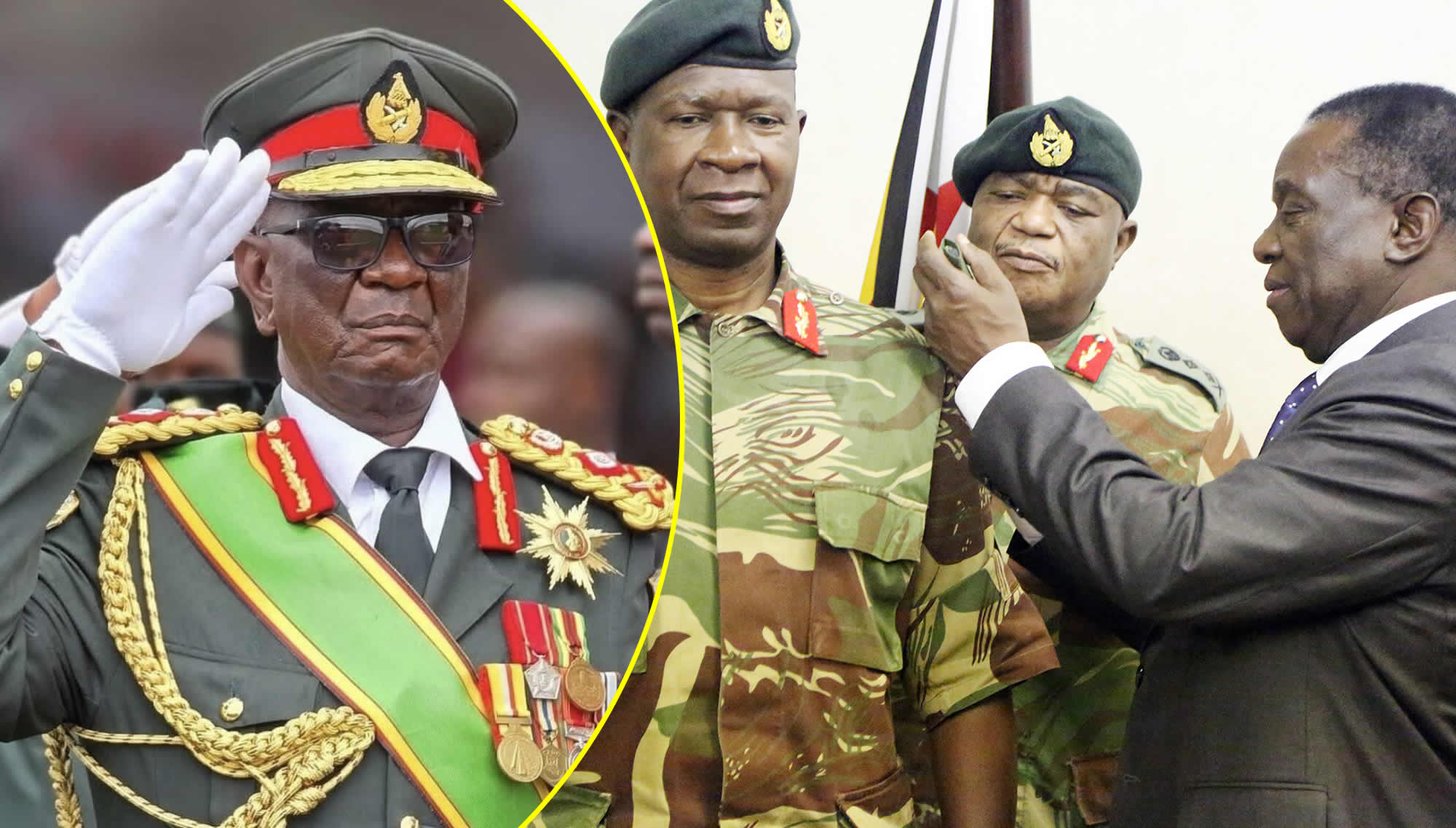
President Emmerson Mnangagwa’s recent military appointments, specifically the elevation of Lieutenant-General Emmanuel Matatu to full General and Commander of the Zimbabwe Defence Forces (ZDF), and Major-General Asher Walter Tapfumaneyi to Lieutenant-General and Commander of the Zimbabwe National Army (ZNA), have ignited a flurry of speculation and analysis regarding the President’s long-term political strategy. These moves, following the retirement of General Philip Valerio Sibanda, are widely seen as calculated manoeuvres to consolidate power, manage the volatile Zanu-PF succession landscape, and potentially coup-proof his presidency.
Adding fuel to the fire, observers point to the fact that General Matatu, at 72 years old, is already past the official retirement age. This seemingly paradoxical appointment leads to the conclusion that his tenure as ZDF Commander may be relatively short-lived – perhaps a year or two at most. By placing a general nearing retirement at the helm, Mnangagwa appears to be limiting the potential for any long-term power plays or challenges from within the military leadership.
Similarly, the elevation of General Tapfumaneyi, who turned 66 two days ago, suggests a similar strategy. If Matatu were to hold the ZDF position for approximately two years, Tapfumaneyi would likely become the next ZDF Commander, but only for a brief period before reaching his own mandatory retirement age of 70.
This approach contrasts sharply with the strategy employed by the late former President Robert Mugabe, who appointed General Constantino Chiwenga as ZDF Commander on 1 January 2004 when Chiwenga was only 47. This decision would prove to be a significant miscalculation, as Chiwenga’s extended tenure ultimately culminated in the 2017 military intervention that ousted Mugabe from power. Reports indicate that since December 2013 when Chiwenga was supposed to be retired as the ZDF commander, he reportedly would refuse to relinquish power, and Mugabe had no option but to “wait and see”, since Chiwenga seemed to be too powerful for Mugabe to manage him.
The law stipulates that service chiefs should retire after a maximum of 10 years in office. By December 31, 2013, Chiwenga, then 57, should have been retired, but he reportedly refused and remained in command until the November 2017 coup. Mnangagwa’s current strategy appears to be an attempt to close this security loophole by appointing military leaders who are nearing or have already surpassed the mandatory retirement age, thus limiting their ability to amass power and influence over an extended period.
In essence, Mnangagwa seems to be prioritising short-term stability and loyalty over long-term leadership potential within the military.
The retirement of General Sibanda has also sparked speculation about his future political role. Prominent journalist Hopewell Chin’ono believes Sibanda is now likely to enter Zanu-PF politics. He argued that Sibanda could be appointed to replace Vice President Kembo Mohadi, whose retirement he said appears “imminent.”
According to Chin’ono, Sibanda did not previously join the Zanu-PF politburo because the Constitution barred serving security chiefs from holding political office, and because his United Nations pension restricted political participation.
With his retirement effective November 23, Chin’ono says Sibanda now has “a clean exit” and is well-positioned to assume a political role.
He further suggested that Sibanda could become the next Vice President representing the former ZAPU side of the 1987 Unity Accord, noting his ZIPRA background during the liberation struggle.
“I now see him going directly into politics, and being appointed as the replacement for Vice President Kembo Mohadi whose retirement is now imminent,” Chin’ono stated.
“I see General Sibanda becoming the new Vice President representing ZAPU, which is consistent with the 1987 Unity Accord signed by Robert Mugabe and Joshua Nkomo to end the genocide in Matabeleland and the Midlands. He was a ZIPRA military commander during the war of liberation.”
Former cabinet minister Jonathan Moyo described Sibanda as “an officer and a gentleman,” praising his more than five decades of service, from the liberation struggle, through United Nations missions, to his leadership of the ZNA and ZDF.
“An Officer and a Gentleman, retiring after more than five decades of unwavering dedication, valour, and distinguished service to Zimbabwe,” Moyo stated.
“From his heroic contributions during the National Liberation Struggle—rising with distinction through the ranks post-independence—to leading United Nations peacekeeping missions, commanding the Zimbabwe National Army from 2003 to 2017, and serving as Commander of the Zimbabwe Defence Forces since 2017, he has exemplified level-headed leadership and remained scandal-free throughout.
“A true pillar of professionalism, integrity, and honour in the ZDF, his career was not merely served but masterfully led, inspiring generations. Well done, General—may your legacy endure!” Moyo wrote.
The new ZDF Commander, General Emmanuel Matatu, is a figure who embodies a gradual and consistent rise through the military ranks. He is not known for being outspoken, overtly political, or seeking the limelight. Instead, he is seen as a dedicated and reliable officer who has steadily gained experience and earned the trust of his superiors.
Born in the early 1960s, Matatu hails from the Midlands province and completed his secondary education at Thekwane High School in Plumtree. Like many of his generation, his life was shaped by the liberation struggle. In the late 1970s, he joined ZIPRA, undergoing training in Zambia and entering the post-independence era with a strong sense of military discipline and political awareness.
Following independence, Matatu remained in the military, steadily climbing the ranks. In 2001, he entered the circle of generals, and two decades later, he was promoted to Major-General. His career path has been characterised by administrative roles, overseeing the logistical and operational aspects of the defence forces. He served at the National Defence University and later became Chief of Staff for Administration at Army Headquarters.
The year 2025 marked a turning point in Matatu’s career. He was first promoted to Lieutenant-General and appointed Commander of the Zimbabwe National Army, a testament to his reliability and institutional loyalty. He is known for emphasising discipline, cautioning against the spread of misinformation on social media, and stressing the importance of adhering to formal communication channels – a reflection of his calm, procedural, and understated leadership style.
His subsequent promotion to full General and Commander of the Zimbabwe Defence Forces solidified his position at the apex of Zimbabwe’s military structure.
Analysts often describe him as a “bridge figure” between different generations of military leadership. While his age may limit his long-term tenure, his temperament makes him an ideal choice for stabilising the military during a period of transition. He is not seen as a divisive figure or driven by personal ambition. Instead, he is viewed as a steady hand, a product of the liberation struggle who has evolved into a dependable and predictable leader.
In the often-turbulent landscape of Zimbabwean security politics, Matatu represents a more traditional approach: loyalty, adherence to procedure, and a commitment to duty above all else. This is precisely the type of leader that presidents often seek when they desire stability and calm at the highest levels of the military.
In contrast to Matatu’s low-key profile, General Asher Walter Tapfumaneyi is a more prominent and well-known figure, often associated with discussions about the state, intelligence, and power. His background is a complex mix of military service, political involvement, and a degree of mystery.
Tapfumaneyi’s career began in the military, but his influence was primarily shaped during his time in the Central Intelligence Organisation, where he eventually became a Deputy Director General. He has long been regarded as one of the most politically astute security figures in the post-2000 era. Even after his retirement as a Brigadier General, he remained connected to the system, with his involvement evident in political mobilisation efforts, national intelligence matters, and behind-the-scenes strategic planning.
The year 2025 marked Tapfumaneyi’s return to a position of overt power. He was re-appointed to the army as a Major-General, a move that surprised many who believed he had long departed from military service. Months later, he was promoted to Lieutenant-General and appointed Commander of the Zimbabwe National Army. This swift comeback is seen as an indication of the deep trust that the President places in him.
Tapfumaneyi’s career has spanned both military service and political engineering. In addition to his intelligence background, he has served as Permanent Secretary for War Veterans and in the Ministry of Presidential Affairs. This combination of roles has given him significant influence, leading many to describe him as a strategist rather than simply a career military officer.
However, his rise has not been without controversy. His name has been linked to political mobilisation structures, clandestine election strategies, and aggressive campaigns that critics allege have unfairly influenced the political playing field. Regardless of the validity of these claims, Tapfumaneyi has never been a neutral figure. He is a powerful player, a loyalist, and someone who understands the intricate connections between the political and security establishments.
His rapid promotions in 2025 are viewed as more than just routine reshuffling. Many analysts believe that he is part of a broader strategy to place trusted individuals in key positions throughout the government. Tapfumaneyi fits this profile perfectly: experienced, loyal, politically savvy, and willing to operate in the more opaque areas of power.
In a political environment where loyalty often outweighs other considerations, Tapfumaneyi is the kind of figure who thrives. He is now back at the centre of power, commanding the army, shaping internal dynamics, and reaffirming the notion that in Zimbabwe’s power structure, some individuals never truly leave the stage.
Chin’ono also argued that Mnangagwa is tightening control of the military. He pointed to the promotion of Major General Tapfumaneyi, described as a key figure in Mnangagwa’s 2023 campaign, to Lieutenant General and commander of the Zimbabwe National Army (ZNA).
Chin’ono said he views this as a temporary placement, predicting that Tapfumaneyi will eventually take over the entire defence forces once the newly appointed Commander of the ZDF, General Emmanuel Matatu, reaches retirement age in about six months.
He added that the restructuring of military leadership reduces the likelihood of any internal challenge to Mnangagwa, saying the top ranks are being reorganised in a way that makes a coup attempt “increasingly unlikely.”
These recent appointments have significant implications for the ongoing succession battle within Zanu-PF. In March, Mnangagwa removed ZDF commander Lieutenant-General Anseleem Sanyatwe, who was perceived to be supporting Vice-President Constantino Chiwenga’s presidential ambitions ahead of the planned anti-government protests on March 31, organised by disgruntled war veterans leader Blessed Geza, an ally of Chiwenga.
These changes further solidify Mnangagwa’s control over the army, making it more difficult for Chiwenga to leverage his military influence in pursuit of the presidency. The military remains a crucial factor in Zimbabwean politics and a key determinant in succession outcomes.
The army has historically played a kingmaker role in power transitions and has acted as a guarantor of Zanu-PF’s political dominance, as demonstrated by the 2017 military intervention that brought Mnangagwa to power. Its influence extends to Zanu-PF succession battles, where military leaders wield considerable influence and have previously intervened to ensure outcomes that align with their interests. The deep integration of the military into the state, with numerous retired officers holding key government positions, reinforces its control over political security and the perpetuation of the ruling party’s dominance.
In conclusion, President Mnangagwa’s recent military appointments represent a complex and calculated strategy aimed at consolidating his power, managing the Zanu-PF succession dynamics, and preventing any potential challenges from within the military. By appointing seasoned but aging officers to key positions, he appears to be prioritising short-term stability and loyalty over long-term leadership potential, while simultaneously attempting to avoid the pitfalls of extended military tenures that plagued his predecessor, Cde Robert Mugabe (Baba Chatunga).