


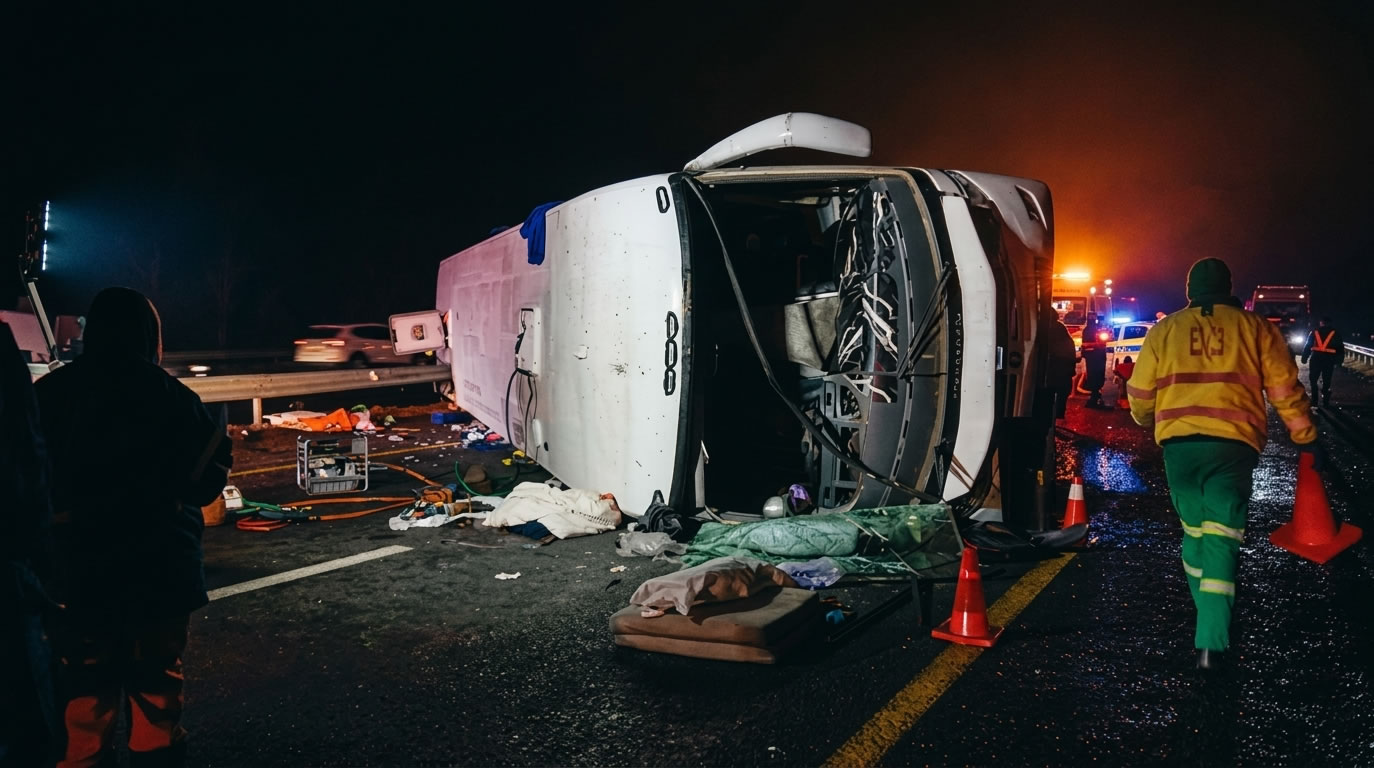
TROMPSBURG – The N1 highway, a vital artery connecting the industrial heart of South Africa to the rest of the continent, became a scene of harrowing devastation on Wednesday evening. Twelve Zimbabwean nationals, among them five young children whose lives were only just beginning, were killed when their Cape Town-to-Zimbabwe bus overturned in the Free State Province. The tragedy has cast a long shadow over the cross-border community, highlighting not only the perils of the road but the increasingly desperate circumstances forcing many to make the journey.
The accident occurred approximately 24 kilometres north of Trompsburg as the vehicle was travelling towards Edenburg. In the dark of the night, the bus, carrying 78 passengers, lost control and overturned, leaving a trail of wreckage and broken lives across the tarmac. While 66 passengers managed to survive the initial impact, many remain in hospital, battling injuries that range from minor lacerations to life-threatening trauma.
Free State Department of Health spokesperson, Mr Mondli Mvambi, confirmed the grim toll but noted that the process of formal identification remains ongoing. “The identities and genders of the deceased had not yet been formally confirmed,” he stated, as forensic teams worked through the night to process the scene. The scale of the incident necessitated the total closure of the N1 in both directions, a move that brought one of Southern Africa’s busiest transport corridors to a standstill for hours.
For those who survived, the memory of the crash is a blur of shattered glass and screams. Passengers who sustained minor injuries were treated at Albert Nzula Hospital in Trompsburg, a facility quickly overwhelmed by the sudden influx of trauma cases. Five individuals suffered serious injuries, while four others, whose conditions were deemed critical, were rushed to Pelonomi Trauma Hospital in Bloemfontein for emergency specialist treatment.
Speaking from the scene, the Free State MEC for Community Safety, Mr Jabu Mbalula, offered his condolences to those whose lives have been irrevocably changed. “On behalf of the Free State Provincial Government, I extend my heartfelt condolences to the families who have lost their loved ones in this tragic accident. To those injured, we wish you a speedy and full recovery. This is a devastating loss, and our thoughts are with all those affected,” he said.
A Pattern of Tragedy on the N1
While the cause of Wednesday’s accident is still under investigation, the tragedy is far from an isolated incident. The N1 highway is the primary link between South Africa and its northern neighbours, including Zimbabwe, Zambia, the Democratic Republic of Congo, Malawi, Angola, and Tanzania. It is a road that carries the weight of a region’s commerce and the dreams of thousands of migrants. Yet, it has also become a graveyard.
Only last year, in October 2025, the region was gripped by similar grief when 42 Zimbabwean and Malawian nationals were killed in a horrific bus crash near Musina, in the Limpopo Province. That accident, which also claimed the lives of seven children, remains one of the deadliest in recent memory. The recurring nature of these fatalities has raised urgent questions about the safety of cross-border transport, the fatigue of drivers working long-haul routes, and the mechanical integrity of the buses that serve as the only affordable link home for many.
The N1’s reputation as a high-accident zone is well-earned. The sheer volume of commercial trucks and cross-border passenger traffic creates a high-pressure environment where a single moment of inattention or a mechanical failure can lead to catastrophe. For the families of the 12 victims in the Trompsburg crash, the statistics are cold comfort; they are now faced with the daunting task of repatriating remains across a border that is becoming increasingly difficult to navigate.
The Climate of Fear: The Shadow of Xenophobia
However, to view this accident solely through the lens of road safety would be to ignore the broader, more troubling context currently defining the lives of Zimbabweans in South Africa. The bus was not merely a vehicle of transport; for many on board, it was a vessel of retreat. In recent months, a surge in xenophobic sentiment and the rise of vigilante groups have made life for foreign nationals increasingly untenable.
Chief among these groups is a movement known as “March and March,” a citizen-led organisation that has vowed to mete out “instant justice” to those they deem to be in the country illegally. Their rhetoric, often centring on the scapegoating of foreigners for South Africa’s economic woes and high crime rates, has translated into a wave of violence that has swept through major urban centres. From Pretoria to Johannesburg and Durban, the presence of “March and March” has become synonymous with intimidation.
Reports from Human Rights Watch and other monitoring bodies paint a chilling picture of the group’s methods. In Durban, a Cameroonian shop owner who had lived in the country for two decades described being attacked by men he believed were affiliated with the movement. They used golf sticks, sjamboks, and stun guns, showing no regard for his legal status or his contributions to the local economy. “They whipped me and my three colleagues… no one came to assist us,” he recounted.
This atmosphere of hostility has reached a breaking point. Vigilante groups have issued ultimatums, warning foreigners to “go back to their respective countries” or face the consequences. For many Zimbabweans, these are not empty threats. The memory of previous waves of xenophobic violence, where shops were looted and individuals were targeted in their homes, remains fresh. The current “March and March” campaign has only served to reignite those fears, forcing thousands to abandon the lives they have built over years, sometimes decades.
An Unwilling Exodus
The sudden returning of Zimbabweans from South Africa is a movement born of necessity rather than choice. In the suburbs of Johannesburg and the townships of the Western Cape, families are packing what little they can carry into buses and trailers. They are leaving behind businesses, jobs, and homes, driven out by a climate where their very presence is treated as a provocation.
The impact on livelihoods is immeasurable. Zimbabweans have long been a cornerstone of the South African labour market, particularly in sectors such as hospitality, construction, and domestic work. Many had built stable lives, sending remittances back home to support extended families in a Zimbabwean economy that continues to struggle. Now, that lifeline is being severed.
“We are going back to nothing,” said one passenger who survived the Trompsburg crash. “In South Africa, we were told we are not wanted. They say we are taking their jobs, but we were just trying to survive. Now, we are losing everything—our furniture, our savings, and now, our brothers and sisters on this road.”
The economic ripple effects of this exodus will be felt on both sides of the Limpopo. In Zimbabwe, the sudden influx of thousands of returnees, many of whom have no immediate means of support, threatens to strain already limited social services. In South Africa, the departure of a skilled and industrious workforce may leave gaps in the economy that are not easily filled, despite the rhetoric of the vigilante groups.
A Journey Fraught with Peril
The Trompsburg crash serves as a grim reminder that for many Zimbabweans, the road home is just as dangerous as the streets they are fleeing. The desperation to leave, often coupled with the need to transport all their worldly possessions, leads to overloaded vehicles and hurried departures. Cross-border buses, already under pressure to maintain schedules, become the only option for those who cannot afford air travel or private transport.
As the investigation into the cause of the Wednesday evening crash continues, the focus remains on the human cost. Twelve families are now mourning, their grief compounded by the fact that their loved ones were killed while trying to reach the perceived safety of their homeland. The five children who perished in the wreckage will never see the country their parents were so desperate to return to.
The N1 highway will eventually reopen, and the flow of traffic will resume. But the underlying issues—the lack of road safety, the rise of xenophobic vigilantism, and the economic desperation of a region—remain unresolved. For the survivors of the Trompsburg crash, the physical wounds may heal, but the trauma of a journey that ended in tragedy will endure. They are the faces of a modern-day exodus, caught between a country that no longer wants them and a homeland that is ill-prepared for their return.