


The Highway of Broken Promises: Death and Despair on the Karoi-Binga Road
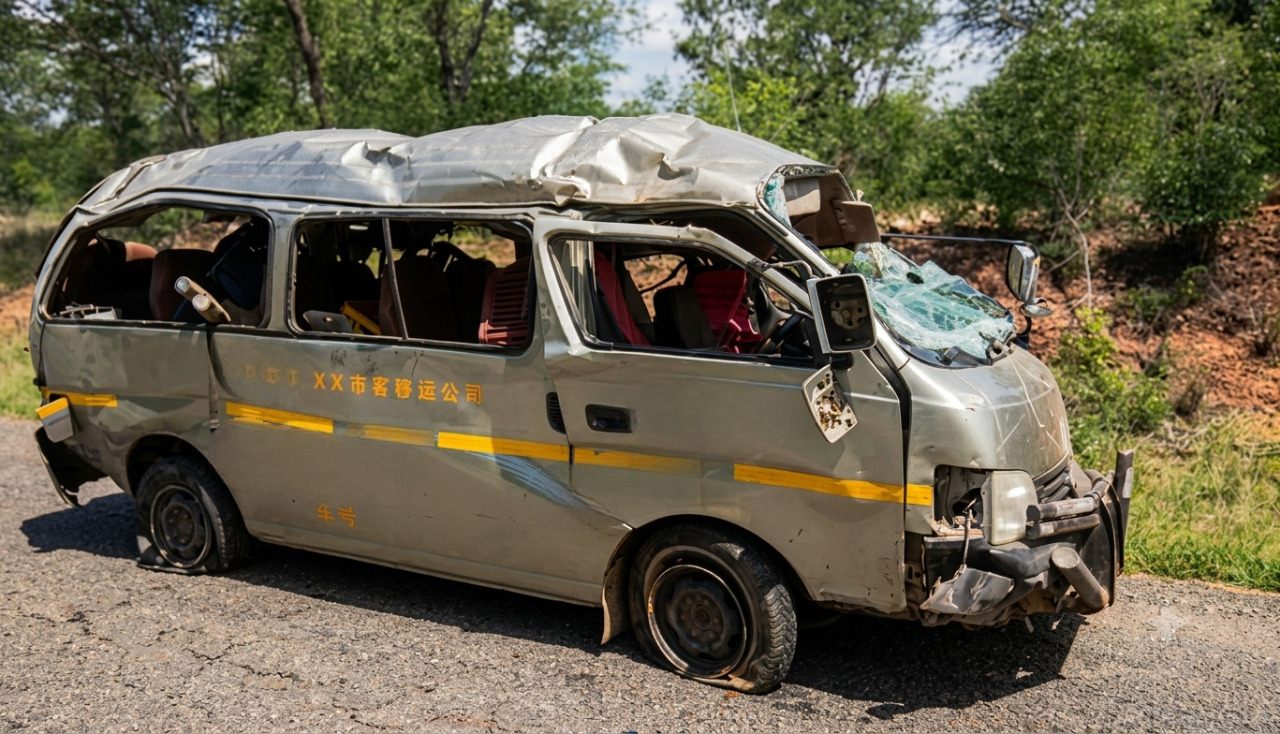
KAROI – The dust had barely settled on the latest tragedy before the familiar sound of sirens once again echoed through the rugged terrain of Mashonaland West. On a sweltering Wednesday afternoon, at the 16-kilometre peg of the notorious Karoi-Binga Road, a silver Toyota Hiace commuter omnibus became the latest vessel of grief. Two female passengers died on the spot, and their lives were cut short in a mangled heap of metal and shattered glass, while nine others were left nursing injuries that may haunt them for a lifetime.
According to official reports from the Zimbabwe Republic Police (ZRP), the driver of the omnibus lost control of the vehicle, causing it to overturn. The scene was one of grim efficiency; the dead were moved to the local mortuary, and the injured were rushed to Karoi District Hospital. For two of the victims, the local facilities were not enough. Their injuries were so severe that they had to be transferred to Chinhoyi Provincial Hospital, a journey that itself is a gamble on these treacherous routes.
“Two of the victims who sustained serious injuries were later transferred to Chinhoyi Provincial Hospital for further medical treatment,” the police confirmed in a brief, sombre statement.
But for those who live and work along this 300-kilometre stretch of road, this is not just another accident. It is a recurring nightmare. The Karoi-Binga Road, intended to be a vital artery connecting the agricultural hub of Karoi to the tourist-rich shores of Binga, has instead earned a reputation as a “suspension-breaker” and a death trap. It is a road defined by “exploded tar,” deep corrugations, and a complete lack of basic services—a physical manifestation of decades of neglect.
A Pattern of Bloodshed
To understand the weight of Wednesday’s tragedy, one must look back at the trail of wreckage left behind in recent months. Only a year ago, in June 2025, the same road claimed the lives of four members of the Matonde family. In that incident, a head-on collision between a Ford Ranger and an overloaded Honda Fit at the 106-kilometre peg left 15 others seriously injured. The victims—Eunice Matonde (13), Debra Matonde (8), Letwin Matonde (3), and Juliet Matonde (32)—were wiped out in an instant, leaving a void in their village that no government statement could fill.
The statistics are staggering. In 2024 alone, Zimbabwe recorded more than 2,000 deaths from road traffic accidents, with over 10,000 injuries. While the national figures are alarming, the Karoi-Binga Road stands out for its unique combination of poor infrastructure and high-risk driving. The road is a primary route for those seeking a shortcut between Kariba and Victoria Falls, two of the country’s biggest tourist draws. Yet, the “shortcut” often proves to be the longest and most dangerous journey a traveller can take.
Local drivers describe the road as a test of survival. The gravel sections are prone to washouts during the rainy season, while the paved sections are so riddled with potholes that they resemble a lunar landscape. “It is not a road; it is a obstacle course,” says one local transporter who requested anonymity. “You are constantly choosing between hitting a pothole that will snap your axle or swerving into oncoming traffic. The dust makes it impossible to see, and the corrugations rattle your brain until you lose focus.”
The Cost of Delays
The tragedy of the Karoi-Binga Road is not just found in the accidents, but in the promises that have gone unfulfilled. In early 2019, there was a glimmer of hope. The government announced that it had started tarring the 300-kilometre stretch, with the Treasury availing $10 million for the project. The funding was sourced from the 2% Intermediated Money Transfer Tax – commonly known as the “2% Mthuli Ncube tax” – a levy that many Zimbabweans pay daily with the expectation of seeing their infrastructure improve.
At the time, the upgrade was hailed as a game-changer that would boost tourism and regional connectivity. However, seven years later, the progress has been painfully slow. By 2024, only the first 10 kilometres had been completed. While recent reports in May 2026 suggested that the project was “gaining momentum” and that contractors had been invited to bid for an additional 30 kilometres, the pace remains glacial. At the current rate of 10 kilometres every few years, it could take decades to complete the entire 300-kilometre stretch.
Meanwhile, the road continues to deteriorate faster than it can be repaired. The “exploded tar” mentioned by frequent travellers refers to sections where the old pavement has disintegrated into jagged chunks of asphalt, creating hazards that are often more dangerous than the gravel itself. For the people of Binga and Karoi, the road is a barrier to development. Farmers struggle to get their produce to market, and sick patients often die in ambulances that cannot navigate the terrain quickly enough to reach life-saving care.
A Crisis of Enforcement and Attitude
While the state of the road is a primary factor, the ZRP has also pointed to a crisis in driver attitude and vehicle maintenance. The June 2025 accident involved a Honda Fit that was reportedly carrying 12 passengers—nearly triple its legal capacity. Overloading is a common sight on the Karoi-Binga Road, where public transport is scarce and people are desperate to reach their destinations.
Commissioner Paul Nyathi, the ZRP national spokesperson, has repeatedly implored drivers to change their attitude. “The ZRP confirms a fatal road traffic accident which occurred on 30/07/2026… two female passengers succumbed to injuries,” he stated, once again urging caution. But caution is a difficult commodity to sell when the road itself seems designed to cause failure.
Investigating the history of these incidents reveals a cycle of blame. The government blames the drivers for speeding and overloading; the drivers blame the government for the crumbling roads; and the families of the victims are left to pick up the pieces. The lack of a consistent police presence along the more remote sections of the road also means that traffic laws are often treated as suggestions rather than mandates.
The Human Toll
Beyond the numbers and the political promises lie the human stories. Every death on the Karoi-Binga Road represents a family shattered. The two women who died on Wednesday were more than just statistics; they were mothers, daughters, and breadwinners. Their deaths will ripple through their communities, affecting everything from the care of children to the stability of local households.
The Karoi District Hospital, which handled the majority of the injured, is often overwhelmed by these mass casualty events. Staff there work tirelessly with limited resources to stabilise patients who have suffered traumatic injuries. The transfer of the two most serious cases to Chinhoyi Provincial Hospital highlights the lack of specialised trauma care in the immediate vicinity of one of the country’s most dangerous roads.
“We do what we can,” says a nurse at the hospital who spoke on the condition of anonymity. “But it is heartbreaking to see the same kinds of injuries week after week. We know the road is bad, we know the buses are overloaded, and we know that until something changes, we will keep seeing these faces.”
Looking Ahead
As the sun sets over the dusty horizon of the Karoi-Binga Road, the wreckage of the Toyota Hiace serves as a grim monument to a system in failure. The road remains a vital link for the nation, yet it continues to take more than it gives. The $10 million availed in 2019 seems like a distant memory, and the “momentum” promised in 2026 has yet to translate into a safe passage for the thousands who rely on this route.
The question remains: how many more lives must be lost before the Karoi-Binga Road is treated with the urgency it deserves? For now, the people of Mashonaland West and Matabeleland North continue to travel in hope and fear, knowing that every journey could be their last. They are not asking for luxury; they are asking for a road that does not kill them.