


The Two-Husband Dilemma: Inside the Rare World of Zimbabwean Polyandry
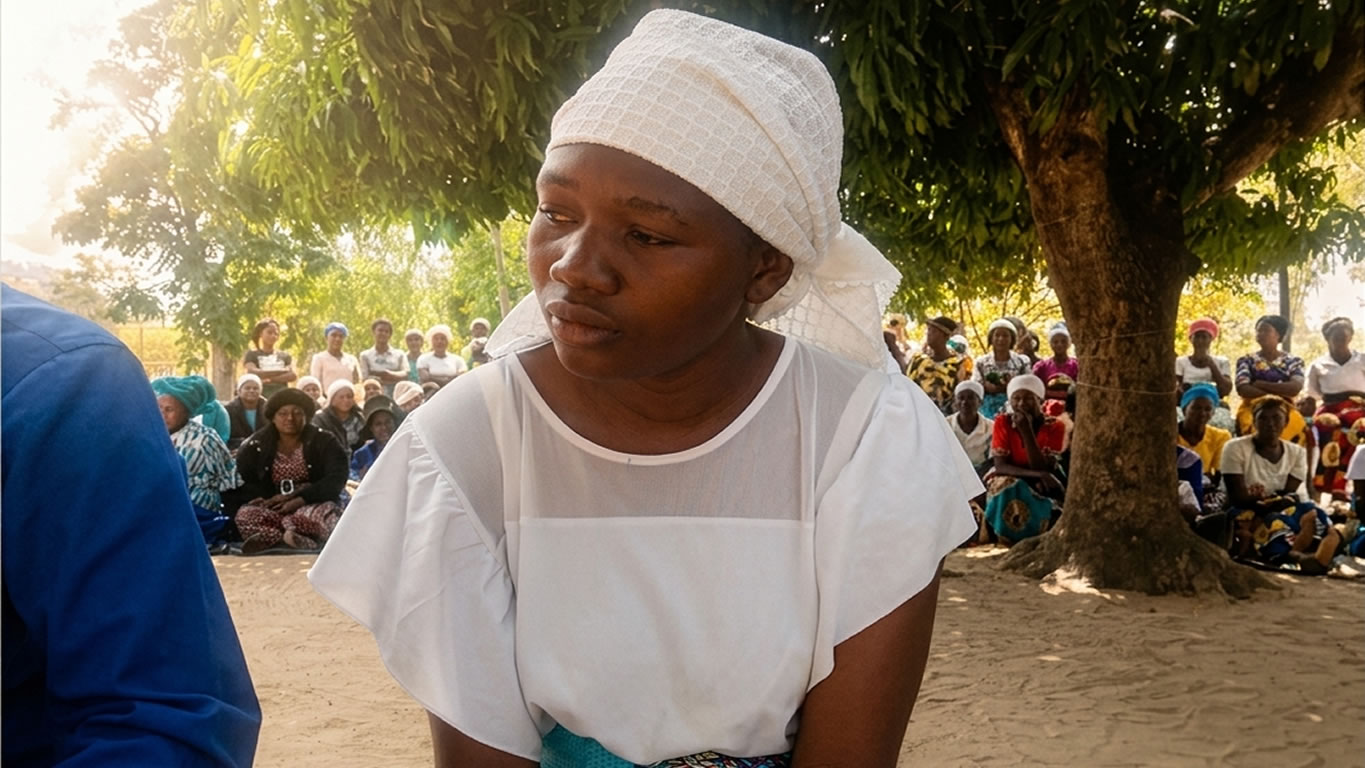
MUTARE — The dust outside Chief Zimunya’s traditional court does not settle easily. It hangs in the humid air, much like the heavy silence that fell over the gathered villagers when 18-year-old Tanatswa Muhomba took her seat before the elders last Saturday. In a country where polygamy—specifically a man having multiple wives—is a common sight and a legally recognised customary practice, the reverse is almost unheard of. Yet, here was a teenager, barely out of childhood, standing at the centre of a storm involving two men who both claim her as their wife.
The case has brought the quiet village of Zimunya into the national spotlight, forcing a confrontation between modern choices and ancient traditions. Tanatswa Muhomba is not just a young woman with a complicated love life; she is currently at the heart of a legal and cultural paradox. She has two husbands: Godfrey Mutsago, a 35-year-old gold panner, and Takudzwa Mahlunge, a 22-year-old tout (hwindi).
A Tale of Two Lobolas and One Orphan
The story began in 2024. Tanatswa, an orphan who had been living with her maternal grandmother, 66-year-old Gogo Ketty Musikavanhu, started a relationship with Mutsago. To the community and the family, this seemed like a standard arrangement. Mutsago, known locally as a mukorokoza or gweja (gold panner), followed the traditional path. He paid a lobola of US$1,100 to Tanatswa’s parents in Shamva.
However, the marriage never truly took root. Speaking in the hushed environment of the Chief’s court, Mutsago explained that after paying the substantial sum, he did not immediately take Tanatswa to his home. “I wanted to prepare for a proper wedding ceremony,” he told the court, with voice tinged with the frustration of a man who feels cheated of his investment. But while he was planning for a white wedding, his bride was planning an escape.
Tanatswa fled her grandmother’s home. It was during this period of flight that she met Mahlunge. At the time, Mahlunge was selling gas in the same village. The two fell in love and eventually eloped. Today, Mahlunge works as a hwindi (tout), a job that keeps him on the move, but he now finds himself stationary in the face of a traditional lawsuit.
The Courtroom Confrontation
The atmosphere in Chief Zimunya’s court was tense as the three parties faced each other. The Chief, a man whose word carries the weight of centuries of Shona tradition, observed that the situation was a blatant violation of both custom and national law. In Zimbabwe, while the new Marriages Act of 2022 allows for polygamous customary marriages, this right is strictly reserved for men. Polyandry — the practice of a woman having multiple husbands — remains a legal impossibility and a social taboo.
Mahlunge, the second husband, appeared bewildered by the turn of events. “I fell in love with this woman without knowing she had a husband, and we got together with the knowledge of her grandmother,” he told the court. “I was surprised to later hear that she had a husband, and now we are being summoned to this court. I no longer know whose child it truly is, between the two of us.”
This revelation added a layer of biological complexity to the legal dispute. Tanatswa has a young child, and because she was allegedly involved with both men during the same period, the paternity is now in question.
Tanatswa, however, remained defiant. She spoke of a lack of choice and a heart that was never in the first union. “Yes, Mutsago came and paid lobola at our home, which was paid in Shamva, but I didn’t love him,” she stated clearly. “He then left completely; he never came back. I then fell in love with this second man, Mahlunge.”
Her grandmother, Gogo Musikavanhu, admitted to the court that the situation was exactly as it appeared. “It is true that this first man paid his lobola money to her in-laws in Shamva while I was present. This first man then left, and the child then ran away from home and started a relationship with this second man. I know both of them, even though this second one did not pay lobola. Traditionally, the one I recognise is the first,” the elderly woman said.
The Price of a Broken Union
For Mutsago, the gold panner, the issue is now one of finance as much as it is of honour. He told the court he wanted his US$1,100 lobola returned—but with a steep penalty. He demanded that Mahlunge triple the amount.
Chief Zimunya and his advisors have deferred a final ruling, but the path forward is clear: science must intervene where tradition has failed. “Since this woman has two husbands, there is now a need for a DNA investigation to determine whose child it is between these two men,” the Chief ruled. He also ordered the in-laws of all parties to attend the next hearing to resolve the matter of the son-in-law status and the reimbursement of the lobola.
A Recurring Phenomenon?
While Tanatswa’s case is rare, it is not the first time Zimbabwe has grappled with polyandry. Investigative forays into the country’s rural and peri-urban areas reveal that these “unconventional” unions, while officially denied, exist in the shadows.
One of the most famous cases occurred in 2013 in Magunje,in Hurungwe. Enetty Midzi, who was 28 years old at the time, lived openly with two husbands under the same roof. Her house became known as “kwaMai Two Husbands”. Her first husband was Chamunorwa Rurami, and the second was Samuel Pirkins Tsambara, a builder and a Masowe madzibaba.
Unlike the Zimunya case, Enetty’s husbands reportedly ate from the same plate. “They are both my husbands,” Enetty told reporters at the time. “I serve their sadza in one plate and they eat together. I do not know what they will be discussing.” The arrangement was born out of a similar mix of economic necessity and personal preference. Enetty claimed she loved the second husband more because he provided for her, but she couldn’t let go of the first, with whom she had four children.
Similarly, in 2022, a nurse from Seke named Emma Nguwo made headlines when she confirmed she was living with two husbands and even expressed a desire to add more. Her second husband, Robert Musakanda, was surprisingly accepting. He told journalists that when he met Emma, she was honest about her first husband who was struggling in South Africa. Musakanda agreed to let the first husband move back into the family home upon his return. “Nguwo disclosed everything about her life when I met her and I liked that. She was honest,” Musakanda said.
The Apostolic Connection and Cultural Taboo
Interestingly, many of these cases involve members of various Apostolic sects. In the Zimunya case, all three parties attend a prominent local Apostolic church. In the Magunje case, the second husband was a Masowe prophet. These religious groups often operate with their own internal sets of rules that sometimes clash with broader Zimbabwean social norms, though even within these churches, polyandry is officially condemned.
Sociologists suggest that the rise in these reports, though still few, indicates a shifting landscape in gender dynamics and economic survival. In a country where the economy often forces men to migrate for work—like Emma Nguwo’s first husband—women are sometimes left to fend for themselves for years. When they find a new partner who can provide immediate support, the result is often a messy, multi-layered marital status that traditional courts are ill-equipped to handle.
However, the public reaction remains largely one of derision. In the Magunje case, neighbours equated the trio to “wild animals,” and some even suggested they needed psychiatric help. One villager, Tendai Chimuti, remarked at the time, “I have never heard of a woman who has two husbands, even dogs give each other a chance.”
The Legal Dead End
Zimbabwean law is unequivocal. The Marriages Act [Chapter 5:17] and the Customary Marriages Act [Chapter 5:07] (now consolidated) do not recognise polyandry. A woman who enters into a second marriage while the first is still subsisting can technically be charged with bigamy, although such prosecutions are rare in customary settings.
Chief Zimunya’s closing remarks last Saturday served as a stern reminder of this legal reality. “Our country’s law does not allow women to have multiple husbands,” he stated. For Tanatswa Muhomba, the next few weeks will be a period of anxious waiting—for DNA results, for a final court ruling, and for a resolution to a life that has become a national talking point.
As the sun set over the Zimunya court, the three young people at the centre of this drama left separately. The gold panner returned to his mines, the toutwent back to his bus terminus, and the 18-year-old mother came back to a home that is no longer hers alone.